


By Amy Butler, Florida Atlantic University
On the evening of Oct. 26, more than 7 inches of rain soaked Palm Beach County’s southern coast. Boca Raton, including Florida Atlantic University’s campus, was hit especially hard by the unexpected and historic storm. City officials estimate that a whopping 1 billion gallons of water poured down in just two hours enough to fill 25 to 30 football stadiums.
Two assistant professors in the Charles E. Schmidt College of Science’s Department of Geosciences, Xiaolang Zhang, Ph.D., a hydrogeologist, and Yijie Zhu, Ph.D., a climate scientist, shared detailed insights about why this flooding occurred and what factors contributed to its severity.

Zhang explained that the primary cause of the flooding was due to an extreme rainfall burst from a stalled frontal boundary over eastern Florida. The sheer volume of water produced by the storm overwhelmed stormwater systems and caused rapid flash flooding.
“This amount of rainfall in such a short period simply exceeded the capacity of existing infrastructure to manage the deluge, resulting in streets and neighborhoods being quickly inundated,” stated Zhang.
While this was fundamentally a weather event, Zhang noted that the flooding event does align with broader climate trends. He highlighted three key contributing factors: a warmer atmosphere can hold and release more moisture; stalled fronts are occurring more frequently; and Florida is experiencing an increasing number of short-duration, high-intensity rainfall extremes.
“Although climate change did not ‘cause’ the event, it is making this type of extreme rainfall more likely and more severe,” Zhang asserted.
Zhu offered a complementary meteorological perspective, emphasizing the atmospheric dynamics at play. He noted that this particular weather event was mostly driven by a strong north–south pressure dipole: a low-pressure system was over the Caribbean (Hurricane Melissa), and a high-pressure system was over the northern United States.
“Florida was right in the middle of the two merging airflows,” said Zhu. “With strong easterly winds that brought abundant moisture from the Atlantic, conditions were very favorable for torrential rain to occur.”
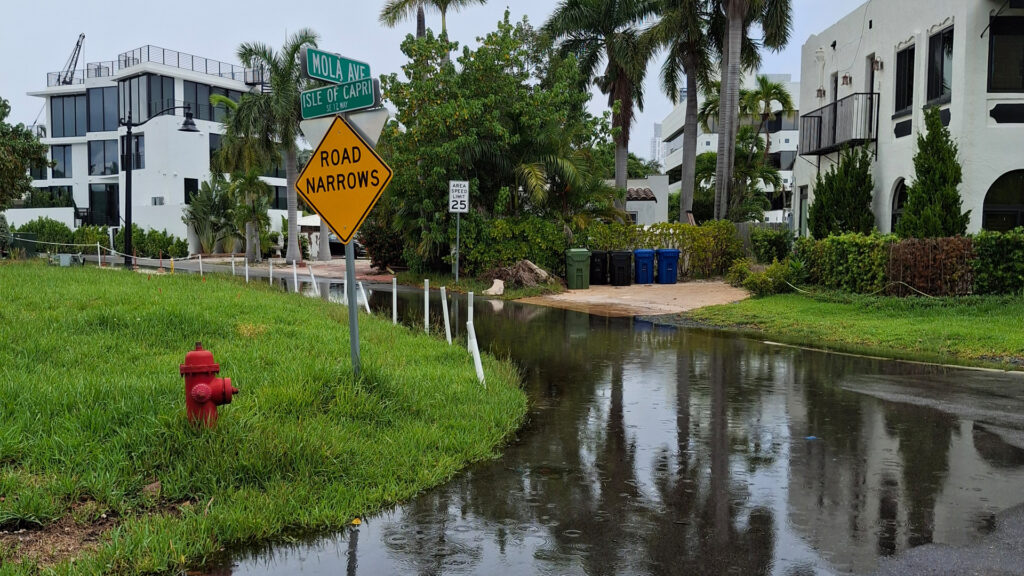
Both scientists agreed that king tides and elevated sea levels were not major factors that contributed to the Oct. 26 flooding. Based on the National Oceanic and Atmospheric Administration’s preliminary observed records, the area’s peak tide was in early October.
“The night of the Oct. 26 storm, the soil was already saturated with moisture due to the king tide flooding in early October,” said Zhu. “This exacerbated the severity of the surface flooding conditions.”
Both experts shared that as current climate trends continue and sea levels rise, extreme rainfall events like this are likely to become more frequent and severe. However, there are measure that citizens and communities can implement to help minimize flooding in the future, including: modernizing stormwater infrastructure, building green infrastructure to absorb rainfall, managing groundwater and drainage together, establishing flood-smart development policies and improving weather monitoring and forecasting.
“Communities can meaningfully reduce impacts through a combination of infrastructure upgrades and nature-based solutions,” said Zhang. “These strategies can help cities stay ahead of fast-developing, flash-flood conditions like the Oct. 26 event.”
This piece was originally published at https://www.fau.edu/science/news/fau-scientists-explain-floridas-flash-flooding-events/. Banner photo: Water levels are measured on a flooded street. (FAU photo).
Sign up for The Invading Sea newsletter by visiting here. To support The Invading Sea, click here to make a donation. If you are interested in submitting an opinion piece to The Invading Sea, email Editor Nathan Crabbe. To learn more about what causes flooding, watch the short video below.
