


By Arielle Perry, FAU Center for Environmental Studies and Florida Office of Ocean Economy
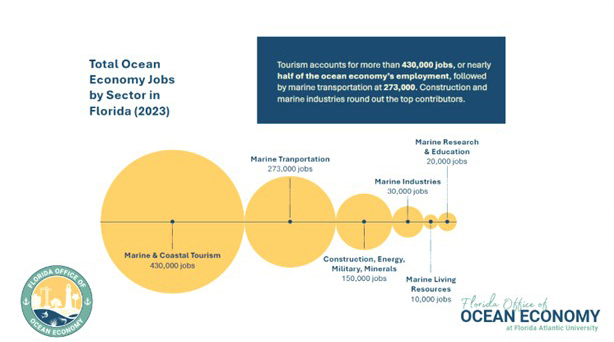
With more than 8,000 miles of coastline, 16 publicly owned seaports and over 900,000 people employed in ocean- and marine-related sectors, Florida’s economic development is intrinsically tied to the ocean and its resources.
In 2024, the state Legislature established the Florida Office of Ocean Economy to facilitate economic growth related to ocean and coastal resources and ensure they are used sustainably.
Housed within Florida Atlantic University, the office acts as a “centralized hub,” connecting stakeholders such as businesses, startups, nonprofits and academic institutions to advance Florida’s ocean economy, said Jim Sullivan, executive director of FAU’s Harbor Branch Oceanographic Institute.
“The thing that’s important for people to realize is you don’t have to live on the ocean or work on the ocean for this to have an impact on your life,” Sullivan said this month during a lecture at Harbor Branch’s Marine Education Center in Fort Pierce. “A lot of the urban and rural economies across Florida are affected by what happens in the ocean economy.”
Sullivan’s talk, which was livestreamed and given as part of the John and Barbara Ferrera Ocean Science Lecture Series, provided an introduction to the Office of Ocean Economy and showcased its ongoing efforts and priorities.
The office’s first annual report, released last July, reveals that Florida leads the nation in ocean economy employment and stands among the most ocean-dependent economies in the world.
During its first year, the office focused on data collection and better understanding Florida’s ocean economy. Consulting with research institutions, industry groups, local and regional agencies, and economic development organizations, the office compiled economic data, determined workforce and infrastructure gaps, and mapped existing programs and assets.
Within this period, the Office of Ocean Economy also identified a number of near-term priorities to guide its future. They include expanding the office’s operational capacity and supporting workforce development, as well as assisting with efforts to increase coastal resilience and improve water quality in the state.
To give the public an opportunity to voice their opinions and concerns about the office, virtual listening sessions will be held statewide. Upcoming listening sessions are scheduled for Feb. 11, Feb. 25, March 11 and March 25. The Feb. 11 listening session will be focusing on the Southwest Florida region. A listening session targeting the Treasure Coast and Gold Coast region was also held this past December.
Sullivan said the office is now seeking recurring state funding to hire permanent staff to run the office.
“Our economy is big, growing and essential … Without this sustained investment by the state and the people and the infrastructure and the innovation that we need, it’s going to fall way short of potential,” he said.
Arielle Perry is a master’s student in the Environmental Science Program at Florida Atlantic University and is a graduate research assistant at FAU’s Center for Environmental Studies and the Florida Office of Ocean Economy. The center manages The Invading Sea. Banner photo: Boats at Peanut Island on Memorial Day weekend (iStock image).
Sign up for The Invading Sea newsletter by visiting here. To support The Invading Sea, click here to make a donation. If you are interested in submitting an opinion piece to The Invading Sea, email Editor Nathan Crabbe. To learn more about the ocean economy, also known as the blue economy, watch the short video below.
