


By Sol Moyano, The Invading Sea
Scientists and conservation experts gathered last week at Florida Atlantic University to discuss the damage being done to Florida’s coral reefs and potential solutions.
Climate change, disease, pollution and other threats have devastated corals around the world in recent years. For Florida, losing coral reefs could increase coastal flooding and storm damage as well as reduce other benefits they provide to the state’s economy and image.
“I think if we lose coral reefs, we risk losing a part of what Florida is, what Florida stands for,” said Joshua Voss, a research professor at FAU’s Harbor Branch Oceanographic Institute.
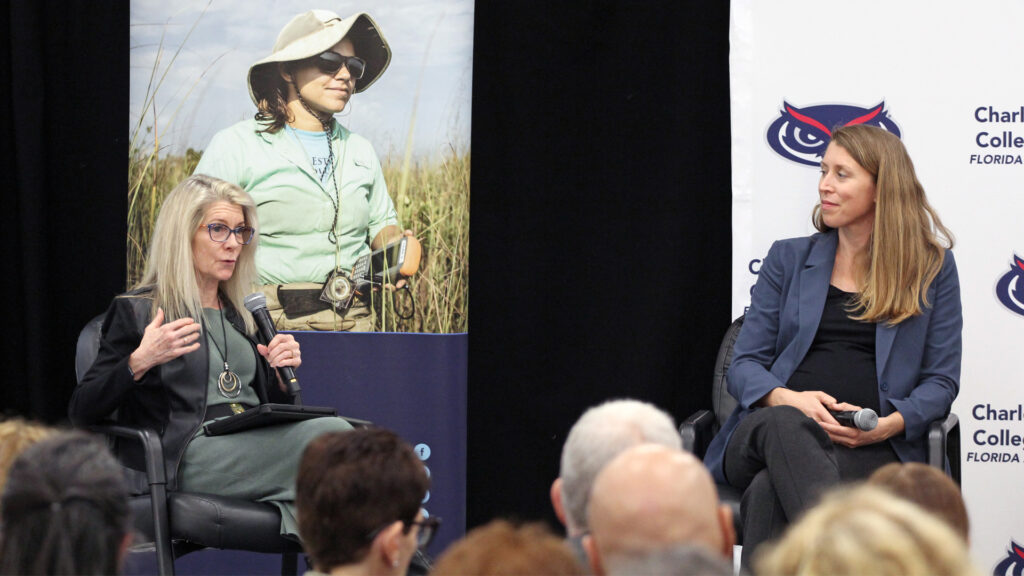
Voss spoke last Wednesday during a panel discussion hosted by FAU’s Charles E. Schmidt College of Science as part of the 2026 Frontiers in Science Public Lecture Series. Valery Forbes, dean of the college, moderated the discussion.
Forbes said Florida’s coral reefs have “rightfully been called the heartbeat of our blue economy,” generating about $6 billion annually for the state and supporting over 70,000 jobs.
“What’s alarming is, since the 1970s, Florida’s live coral has suffered a 90% collapse,” she said.
Molly Moynihan, an assistant professor of geosciences at FAU, said corals are adapted to living in what she called the deserts of the sea – or regions in the ocean that have little nutrients. Nutrient-rich runoff from agriculture or sewage can “really disrupt the balance,” Moynihan said.
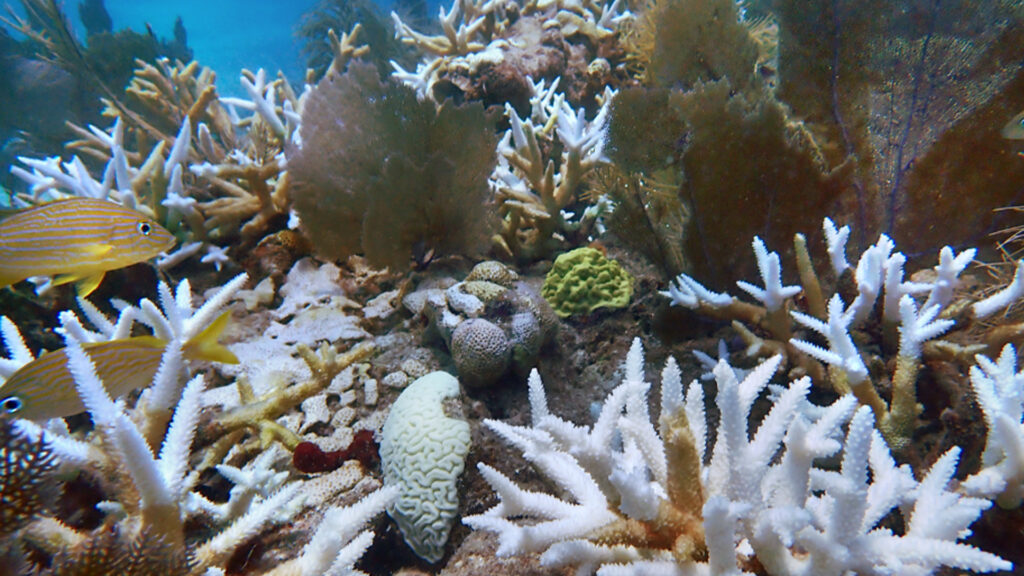
Coral bleaching is another threat facing reefs. When sea temperatures rise too high, corals expel the symbiotic algae living in their tissues and turn white. Prolonged bleaching can kill off corals.
Voss said that “corals, as an entity, are going to survive,” but coastal communities will lose the benefits that reefs provide as they die off. Coral reefs serve as a natural barrier, helping shield coastal communities from flooding and storms.
“If we don’t protect it, if we don’t do something to fix it, Florida is literally going to start crumbling into the sea,” said Leneita Fix, executive director of the Reef Institute, a West Palm Beach-based nonprofit focused on coral reef restoration.
Voss said that losing coral reefs could also affect property insurance due to the protection they provide coastal homes.
“You can literally thank our coral reefs for the fact that you can even get homeowners’ insurance in the first place if you live on the coast,” he said.
The panel also discussed potential solutions to the problems facing corals. Moynihan said that nutrients from runoff are a local problem can be managed locally, as compared to carbon emissions that are a large-scale problem requiring more global coordination.
“Our local officials are in charge of our waste management; our local agricultural industries also control what they’re using in their practices,” she said.

Different microorganisms inside corals can help them when it comes to diseases, she said, but scientists are just beginning to scratch the surface on what they can and can’t do.
“Some microbes might help us remove nutrients, help detoxify the environment,” she said.
Steven Vollmer, FAU professor and director of the School of Environmental, Coastal, and Ocean Sustainability (ECOS), said that some experts have been talking about importing corals from the Pacific Ocean that are different from the ones in Florida. But Vollmer said that kind of invasive species introduction has “gone wrong a thousand times over.”
Although Florida’s corals have been decimated in recent years, Moynihan said there is still hope for humans to live sustainably alongside nature.
“We do have to balance the economy of the region with the environment, find ways to harmonize things,” she said.
Sol Moyano is a senior majoring in multimedia journalism at FAU who is reporting for The Invading Sea in the spring 2026 semester. Editor’s note: ECOS hosts The Invading Sea. Banner photo: Voss (center) speaks during the panel discussion while Moynihan (left) and Vollmer (right) listen (Zach Greathouse photo).
Sign up for The Invading Sea newsletter by visiting here. To support The Invading Sea, click here to make a donation. If you are interested in submitting an opinion piece to The Invading Sea, email Editor Nathan Crabbe. To learn more about coral bleaching, watch the short video below.
