


By Jerald Pinson, Paul Donsky and Belina Meador
During a rare reservoir drawdown this winter, hundreds of paddlers on the Ocklawaha River found themselves gliding past the remains of a centuries-old cypress forest drowned by a long-abandoned canal project, and into the center of a renewed debate over whether to remove the Kirkpatrick Dam.
Every four to five years, the Florida Department of Environmental Protection lowers the Rodman Reservoir, briefly allowing the Ocklawaha to return to its natural flow. The water level drops from roughly 18 to 11 feet above sea level, exposing submerged springs, clearing debris and revealing a river ecosystem that once flowed freely toward the Atlantic.
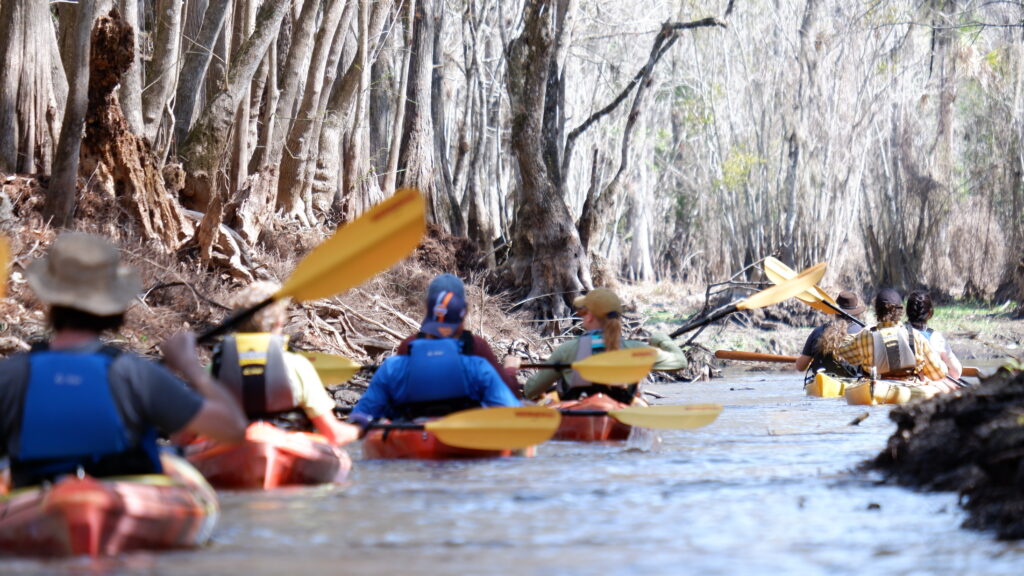
In February, 13 members of Climate Cafe GNV joined the ranks of those paddlers exploring the revived river with the guidance of Earth Kinship, an ecotourism company based in Elkton. The water, having returned to its original dimensions, revealed old scars along the riverbanks.
At one bend, a wooden scab more than 17 feet long sprawled across the waterway, the remains of a massive bald cypress (Taxodium distichum) that had likely stood for several centuries before it was cut down.
We gathered by the stump in our kayaks, marveling at the venerable cypress. Although it had once stood too tall to be toppled even by the largest land-clearing machine ever built, it had been cut down all the same.
That machine was the crawler-crusher, a one-of-a-kind vehicle commissioned by the U.S. Army Corps of Engineers during the second attempt to construct the Cross Florida Barge Canal in the 1960s. Nicknamed the tree killer and Paul Bunyan’s bull, the tank-like machine could push over forest at a rate of up to two acres per hour, even while partially submerged in mud and water.
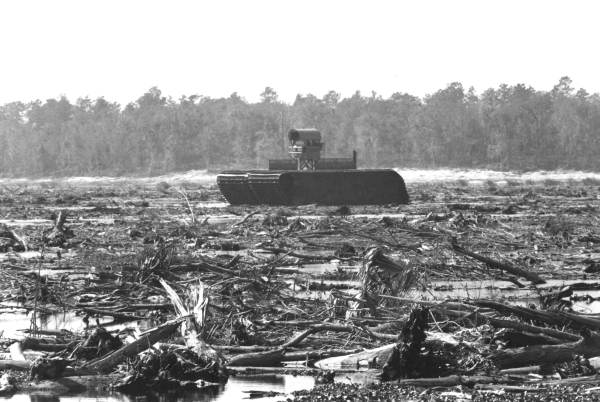
The canal had been envisioned as a Panama Canal–style shipping route across Florida, and construction began in 1935. Within a year, concerns about damage to the Floridian Aquifer and opposition from conservationists brought the project to a halt, but not before roughly 4,000 acres of forest had been cleared.
The project was revived in 1964 after funding was approved by President John F. Kennedy. Renewed public opposition, this time led by conservationist Marjorie Harris Carr, prompted President Richard Nixon to rescind funding in 1971, bringing the project to a final halt.
Fifty-five years later, the Kirkpatrick Dam and Rodman Reservoir remain, still altering the river’s natural flow. Environmental advocates, most recently coalescing under the “Reunite the Rivers” banner, have called for the dam’s removal, citing severe impacts to the Ocklawaha and Silver rivers: The dam floods a pristine cypress forest, blocks aquatic wildlife migration to the Atlantic and suppresses flow from more than 20 freshwater springs.
Restoration advocates have worked to address concerns from the local bass-fishing community by shaping proposed legislation to include provisions supporting nearby towns and river-dependent economies. A former St. Johns County master naturalist said fish populations would likely sustain themselves after restoration, potentially strengthening the fishery over time while reducing the need for intensive management. Supporters add that, if enacted, the bills could help a restored river become an economic engine for the region.
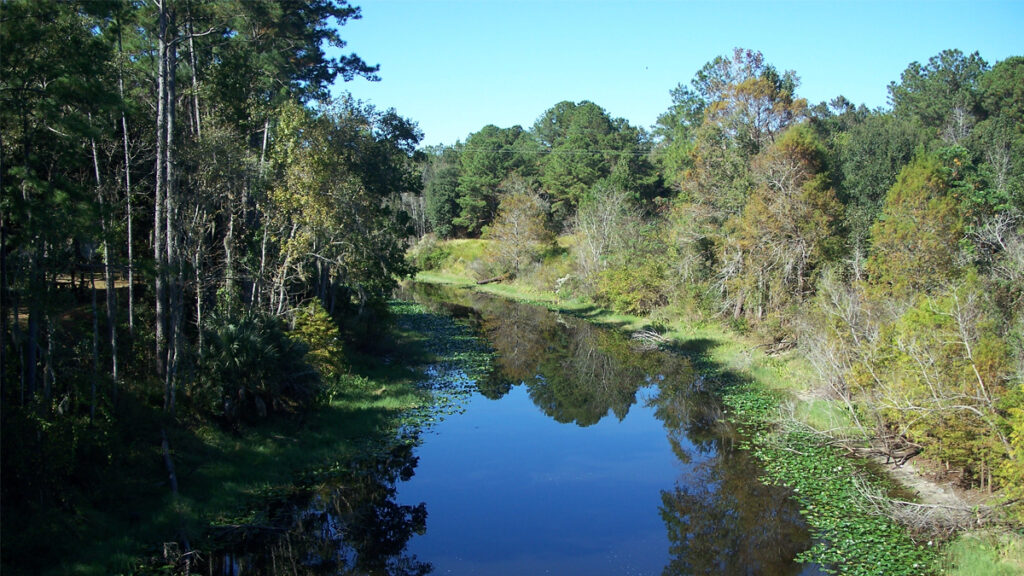
In 2025, Florida lawmakers approved funding to begin dam removal, but the effort was vetoed by Gov. Ron DeSantis. This year, a House bill requiring a formal plan to remove the dam and restore connectivity between the Silver, Ocklawaha and St. Johns rivers passed its chamber. A companion Senate measure advanced out of committee but was never taken up for a full vote before the legislative session ended.
With no final action taken, the future of the Northeast Florida Rivers, Springs, and Community Investment Act, and of the long-impounded river, remains unresolved.
For paddlers witnessing the river’s temporary revival, the issue felt immediate.
“It was especially striking to see such beautiful springs and realize that places like that could be flooded and lost,” said Jinyi Xia, a participant in the trip. “Being on the river made the issue feel personal in a way that reading about it never could.”
Bob Tancig noted the drawdown made the river’s climate resilience potential immediately clear.
“It was not hard to comprehend the vast quantity of stormwater the river system could hold” during increasingly intense hurricanes, he said. “This experience is not something I will soon forget. I hope and pray that similar experiences will be available for generations to come.”

“The Ocklawaha during the drawdown was beautiful to see,” said a third paddler, a lifelong Florida resident. “It’s inspiring that the springs still flow so strong after years of being buried behind the dam.”
Bald cypress trees, well adapted to life in standing water, are known for their resistance to decay, helping explain why the ancient stump remains decades after the tree’s death. Its roots likely still lie beneath the reservoir’s shifting sediments. It will still be there if and when the Kirkpatrick Dam is removed.
Failing that, the drowned forest will continue to wait below the water’s surface, reappearing only when the reservoir is lowered, a reminder of a river still trying to find its way home.
Jerald Pinson is a science writer who is a member of Climate Cafe GNV’s Board of Directors. Paul Donsky is a full-time springs ecologist and Ph.D. candidate at the University of Florida’s Ecohydrology Lab, and a member of Climate Cafe GNV. He was born and raised in Gainesville. Belina Meador is an energy efficiency professional and the founder and director of Climate Cafe GNV. Editor’s note: The original version of this piece was edited to update the status of the vote and correct the name of the agency responsible for the drawdown. Banner photo: The Kirkpatrick Dam on the Rodman Reservoir (Florida State Parks).
Sign up for The Invading Sea newsletter by visiting here. To support The Invading Sea, click here to make a donation. If you are interested in submitting an opinion piece to The Invading Sea, email Editor Nathan Crabbe.

Thanks!