


By Trisha Radulovich, Florida State University News
Researchers at the FAMU-FSU College of Engineering have developed a rechargeable zinc-ion battery that uses low-cost materials and a simplified water-based assembly process to make safer reliable batteries. The approach could reshape how utility-level energy storage and home energy systems are designed and manufactured.
The work, led by Professor Petru Andrei of the Department of Electrical and Computer Engineering and doctoral student Peng Wang, was published in ACS Omega.
Meeting the demand for improved battery technology
Demand for reliable, safe and eco-friendly batteries continues to grow across industries, from consumer electronics to electric vehicles to medical devices. Lithium-ion batteries remain the industry standard, but their safety concerns — overheating and flammability chief among them — along with their environmental footprint have pushed researchers to explore alternatives.
Aqueous zinc-ion batteries, known as AZIBs, offer a cost-effective and environmentally friendlier option. Their widespread use has been held back by technical hurdles: short-circuiting caused by dendrite growth, complex manufacturing and limited long-term stability.
Dendrites are tiny metal structures that form inside batteries during charging. When they grow unchecked, they can pierce internal barriers and cause short circuits or outright failure.
How it works: solving the dendrite problem
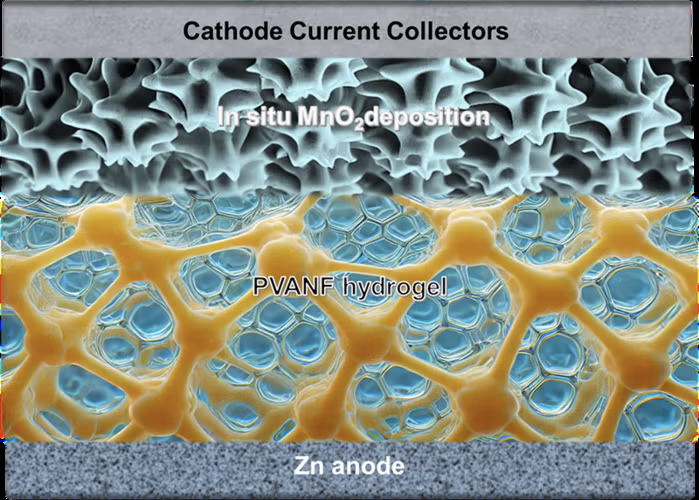
To address those challenges, the FAMU-FSU team developed a new battery assembly approach. They integrated a specialized hydrogel electrolyte with electrodeposition of manganese dioxide, meaning a critical battery component grows directly inside the cell during assembly rather than being manufactured separately and inserted.
“We want to improve how aqueous zinc-ion batteries are made,” Andrei said. Everything is processed in water, with a nonflammable hydrogel that stabilizes and suppresses dendrites. These are tiny metal structures that can cause battery failure, making the assembly much simpler and significantly safer.”
The hydrogel is composed of poly(vinyl alcohol) and aramid nanofibers derived from Kevlar, the same material used in body armor. Together they form a flexible, durable network that retains the battery’s electrolyte and physically blocks the formation of zinc dendrites. The battery charges and discharges rapidly over hundreds of cycles with minimal capacity loss, without the hazardous solvents or energy-intensive drying steps that conventional manufacturing requires.
A simpler manufacturing process
Traditional battery manufacturing relies on slurry mixing: Powdered electrode materials are combined with solvents to form a thick paste, coated onto metal foils and then dried. It is time-intensive and requires precise equipment and quality controls at every stage.
The FAMU-FSU approach eliminates that step entirely.
“This concept can be used in production in the future,” Andrei said. “Because our process is fully water-based and doesn’t require slurry mixing and drying steps, it can fit naturally into a manufacturing line.”
Removing that step reduces equipment needs and simplifies quality controls, offering a meaningful advantage for any manufacturer looking to scale production of next-generation energy storage.
Why it matters: grid-scale energy storage
The batteries maintained capacity after more than 900 rapid charge-and-discharge cycles and performed reliably under demanding conditions.
Those results have real-world implications. Grid-scale energy storage — the infrastructure that buffers power from solar and wind sources — demands batteries that are stable, long-lasting and inexpensive to produce at scale. Home energy backup systems face similar requirements.
“The future of this technology is safe, low-cost energy storage,” Andrei said. “I see it being used in applications where safety, cost and long cycle life matter more than high energy density, such as grid storage, home energy systems and large backup power. These are situations where batteries need to last a long time and be very reliable, even if they aren’t the most powerful. Our technology is designed for stability and safety, making it well-suited for these critical uses.”
The advances could also benefit flexible electronics and wearable medical devices, where battery flammability is a particular concern.
The research was supported by Florida State University.
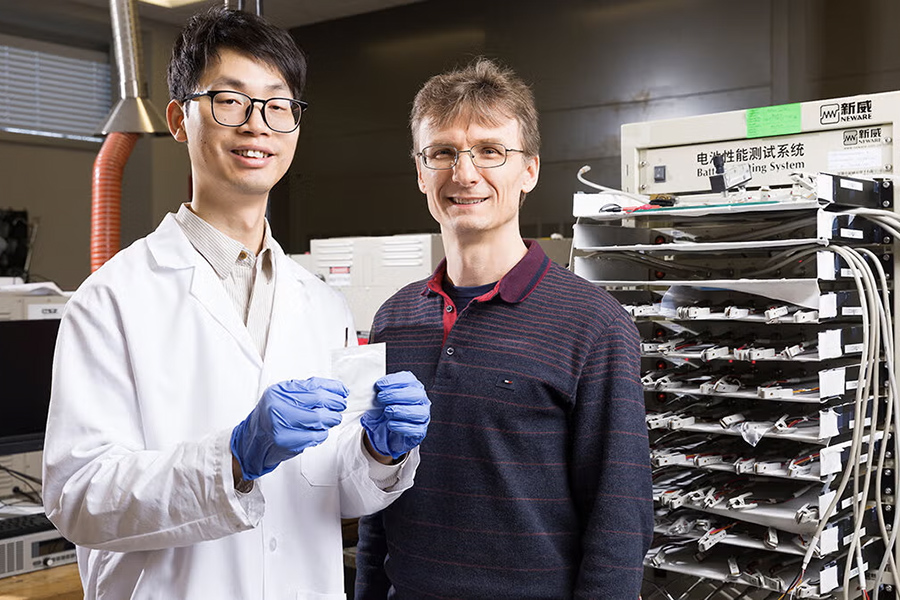
This piece was originally published at https://news.fsu.edu/news/science-technology/2026/04/08/famu-fsu-college-of-engineering-researchers-develop-safer-water-based-zinc-ion-battery-with-900-cycle-durability. Banner photo: Peng Wang holds an aqueous zinc-ion battery (Scott Holstein/FAMU-FSU College of Engineering).
Sign up for The Invading Sea newsletter by visiting here. To support The Invading Sea, click here to make a donation. If you are interested in submitting an opinion piece to The Invading Sea, email Editor Nathan Crabbe.
