


By Christine Calvo, FIU News
Forever chemicals don’t break down and don’t disappear, but Florida International University scientists have developed a safer, cheaper and reusable solution that could remove these chemicals.
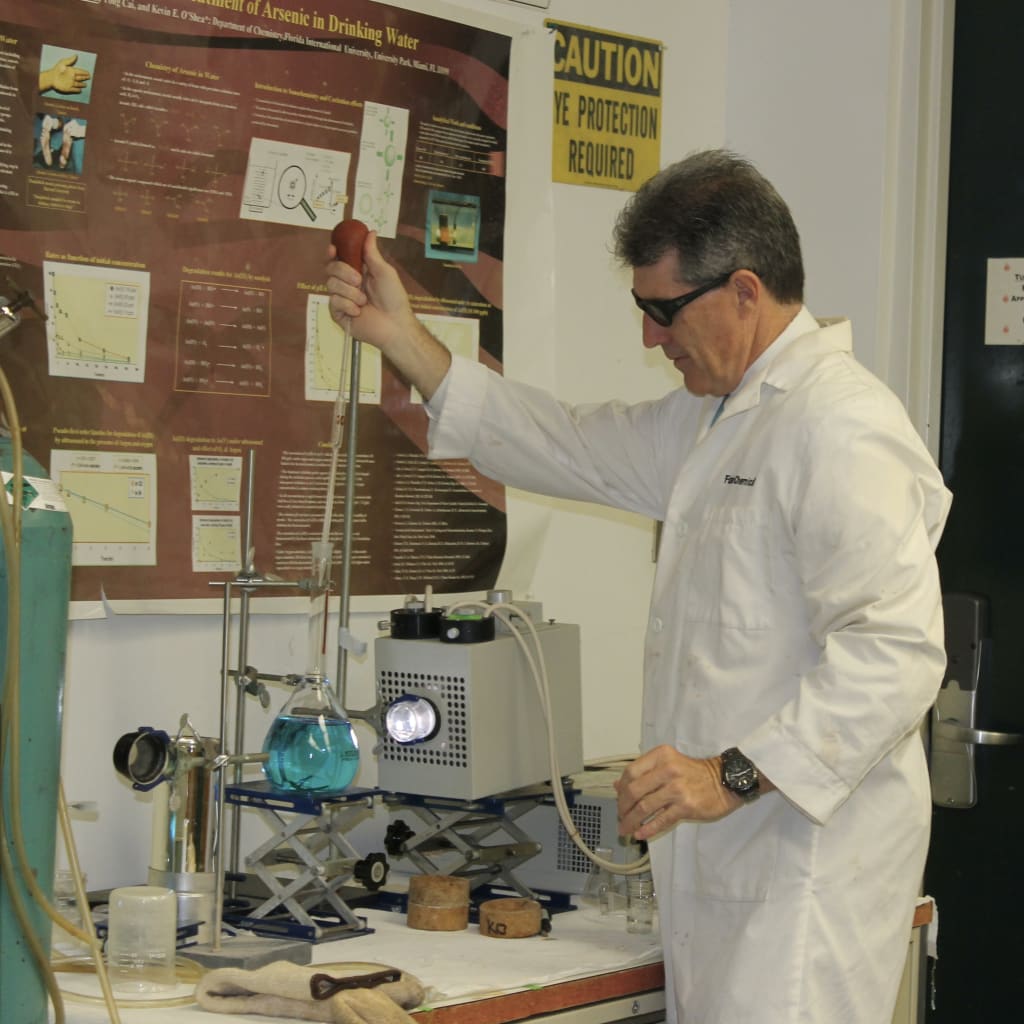
FIU chemistry professor Kevin O’Shea and chemistry Ph.D. candidate Rodrigo Restrepo Osorio have created a new cleanup approach that captures and releases PFAS chemicals on demand by using water’s own pH level. The system offers a sustainable way to address the growing challenge of PFAS contamination – one of the most persistent environmental and health threats today.
By harnessing the power of pH, this method makes it possible to remove PFAS from waterways, while allowing the system to be reused.
Scientists previously found sugar molecules shaped like donuts are effective tools to capture forever chemicals in water. These sugar molecules act as a molecular handcuff to detain the linear PFAS. But that’s only half the battle.
“Current water treatment methods are largely ineffective for PFAS remediation, costly, and/or require the treatment of the entire drinking water supply,” O’Shea said. “We need a way to concentrate and remove them from our water supplies.”
O’Shea realized the key is pH. At neutral pH, these sugar-based materials hold tightly onto PFAS. But when the water becomes more alkaline, or when a basic substance like baking soda is added, both the PFAS and the material take on negative charges and repel each other. This reaction releases the chemicals and allows the material to be reused.
Like a door, under neutral pH, the PFAS goes in and closes. Under basic pH, that door opens and the chemicals come out, O’Shea explains.
O’Shea’s interest in forever chemicals began when looking more closely at one of his son’s favorite snacks – microwave popcorn. His son particularly liked just the right amount of char on the popped kernels, but concerned O’Shea, who knew that microwave popcorn bags can contain PFAS. This concern led to a series of research studies looking for solutions to the world’s PFAS problem.
Building on his earlier patented work attaching these tiny sugar “molecular traps” to solid supports, O’Shea’s pH-based breakthrough transforms PFAS cleanup into a reusable, sustainable technology – a cleverer solution in the fight against these persistent “forever chemicals.”
The study was published in the Journal of Hazardous Materials Advances.
This piece was originally published at https://news.fiu.edu/2026/new-fiu-method-traps-and-releases-pfas-from-drinking-water. Banner photo: Water being poured into a glass from a faucet (iStock image).
Sign up for The Invading Sea newsletter by visiting here. To support The Invading Sea, click here to make a donation. If you are interested in submitting an opinion piece to The Invading Sea, email Editor Nathan Crabbe.
