


By Zachary Handlos, Georgia Institute of Technology
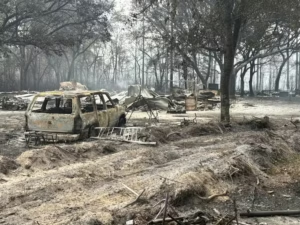
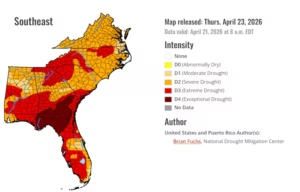
Large parts of the southeastern U.S. are in the midst of an exceptional drought, and it is fueling dozens of wildfires in Florida and Georgia.
One of those wildfires, in southeastern Georgia’s Brantley County, had damaged more than 80 homes by today, and officials said about 1,000 other homes were at risk. Another fire near the Georgia-Florida border had burned more than 30,000 acres and was only about 10% contained. The smoke from the blazes triggered air quality alerts in Atlanta, in the north-central part of the state.
Why is a region of the U.S. more often known for thunderstorms and humidity in spring seeing so many wildfires?
I teach meteorology at the Georgia Institute of Technology, including how weather patterns can lead to conditions conducive to wildfires. Here’s what’s happening to drive these conditions.
Key ingredients for a wildfire
Wildfires need a few key ingredients to spread: low relative humidity, dry fuels and strong winds.
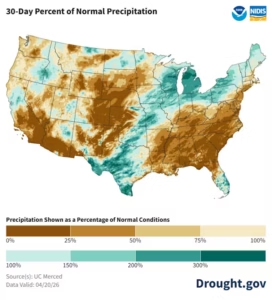
Much of the Southeast has been in a drought since July 2025. From mid-March to mid-April 2026, the region saw less than a quarter of its normal precipitation for that time of year.
As a result, the U.S. Drought Monitor classified most of this region in “extreme” or “exceptional” drought by mid-April.
Part of the reason for the lack of rainfall has been a persistent high-pressure system over the Southeast.
High-pressure systems are areas where air aloft sinks toward the surface, preventing clouds and precipitation from forming. The Southeast high-pressure system resulted from the presence of a “ridge” in the jet stream, a northward bend in this fast current of air several miles above Earth’s surface.
Another consequence of this high pressure has been the presence of generally southeast winds, which have transported warm and fairly dry air into the area.
The relative humidity – a measure of the amount of moisture in the air relative to the maximum amount the air can contain at its actual air temperature – has also been very low due to warmer-than-usual temperatures and lower-than-usual moisture.
As a result of these conditions, trees, grass and leaves dry out and can quickly become fuel for wildfires. That kind of dry fuel is widespread throughout rural areas of Georgia and north Florida.
Once a fire starts, whether from lightning, power lines or other human sources, strong winds can spread it rapidly in these conditions.
What’s ahead for the region?
As global temperatures rise, the frequency of drought conditions in the Southeast will increase. This, in combination with less soil moisture content in the summer, could be conducive for increased wildfire activity.
Wildfires do eventually burn out. It takes a combination of help from the atmosphere, with moisture to douse them, and firefighters clearing away dry fuel to stop their spread.
Georgia and Florida may get a reprieve soon from the weather, as multiple low-pressure systems are forecast for the region in late April and early May that could bring rainfall.
In the meantime, more than half of Georgia’s counties are under a state of emergency, as several agencies battle the flames to protect homes with helicopters in the air and scores of firefighters on the ground.
Zachary Handlos is an atmospheric science educator with the Georgia Institute of Technology.
This article is republished from The Conversation under a Creative Commons license. Read the original article. Banner photo: Fire crews responded to dozens of wildfires burning in Georgia and northern Florida on April 23 (Georgia Department of Natural Resources via AP).
Sign up for The Invading Sea newsletter by visiting here. To support The Invading Sea, click here to make a donation. If you are interested in submitting an opinion piece to The Invading Sea, email Editor Nathan Crabbe.
