


By Bob Inglis, republicEn.org
During President Donald Trump’s visit to Xi Jinping in China last week, there certainly was not a shortage of critical issues for the leaders of the two superpowers to discuss. Taiwan. The war in Iran. Tariffs. But conspicuously absent in the publicized agenda for their meeting: the clean energy economy — and China’s sheer dominance of it. It’s a tough pill to swallow, and in no sector is this more apparent than in the electric vehicle market.
Automakers from Germany, Japan and, of course, the iconic “big three” of the U.S. are household names, brands as familiar as the cereals we eat for breakfast. But the name of the No. 1 EV manufacturer globally is most likely not familiar to most Americans: BYD.
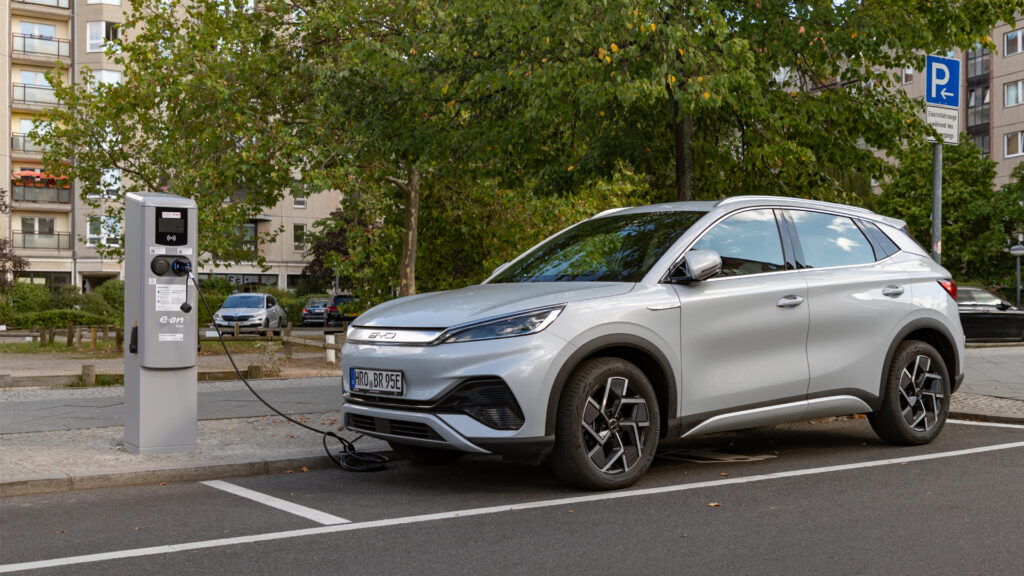
Yet, in the last five years, this Chinese EV manufacturer has surpassed the largest, most-established automakers in the world to export more cars than the U.S. and Japan combined, moving from a ranking of sixth to first. BYD even surpassed Tesla in 2025 for EV sales.
Maybe you’re thinking: These cars can’t be that great, right? Maybe they’re the Yugo of EVs? And that’s why we haven’t seen them dodging in and out of traffic on American streets.
Think again. BYD vehicles — with a spectrum of choices from economy to luxury — are best in class. They have longer range (one of their 2026 models gets 626 miles on a single charge) and faster battery charging (under 15 minutes for “flash” charging and an average of three hours for at-home charging) than any other competitor. Even the company’s executive vice president, Stella Li, notes that she “doesn’t see any competition” with what they are producing.
“It’s the most humbling thing I’ve ever seen,” Ford CEO Jim Farley said in 2025 of the Chinese automaker filing an average of 52 patents a day. “Their cost, their quality of their vehicles, is far superior to what I see in the West.”
But even if an American wanted a BYD car, tariffs of over 100% on the vehicle has kept them off our streets.
China’s dominance in EVs (replicated in other clean energy sectors too) should send red flags up across the U.S., which politically has retreated from its clean energy commitments at the precise time when the rest of the world is moving rapidly toward a lower carbon economy — with all the financial windfalls that transition presents. While here in America we are watching gas prices tick up by the day, projected to soon reach the highest we’ve seen in a generation, we also eliminated incentives for consumers to purchase EVs. Not to mention, persistent challenges in the EV charging network fuel range anxiety.

It is true that EV sales here have gradually ticked up — and Florida is a top state for EVs — but as a nation, we remain woefully behind other nations, in quantity and quality.
As a nation with a great history of innovative thinking and ingenuity, running behind is not a position America should feel comfortable in. We have come from behind before. In the 1960s, the Soviets’ launch of Sputnik started the race to the moon.
“To be sure, we are behind and will be behind for some time in manned flight,” President John F. Kennedy said in his famous moonshot speech at Rice University in 1962. “But we do not intend to stay behind, and in this decade we shall make up and move ahead.” And we did.
We’re in a new race. EVs are the wave of the present and future. We may be behind. But we can catch up. We can even win.
Former U.S. Rep. Bob Inglis (R-South Carolina, 1993-1999 and 2005-2011) directs republicEn.org, conservatives who see innovation as the path to climate stability. Banner photo: A BYD dealership in Brazil (iStock image).
Sign up for The Invading Sea newsletter by visiting here. If you are interested in submitting an opinion piece to The Invading Sea, email Editor Nathan Crabbe.
