


By Robert L. Knight, Florida Springs Institute
For the past 74 years, Stephen Foster State Park has hosted the Florida Folk Festival on the banks of the Suwannee River near the town of White Springs. Advertised as Florida’s “Best Cultural Event,” the Florida Folk Festival attracts hundreds of musicians and thousands of tourists each year.
Financial sponsors, park service volunteers and nonprofit organizations help raise “environmental and cultural heritage awareness” and “celebrate and help conserve Florida’s natural resources, including endangered species and vital rivers, artists, educators, and historical sites.”
The irony that the Suwannee River was listed as one of America’s Most Endangered Rivers this year is probably lost on most attendees. But if you look past the musical stages, food trucks and cultural/historical displays, the depleted Suwannee River was just behind the trees and barely hanging on right now.
At this year’s festival, this vital river lived up to its endangered status. Flow was barely a trickle with a wadable depth of only six inches and a low mark 30 times less than average.
A short drive upstream to historic White Sulfur Spring House provides a perspective on the declining Suwannee River flows. Historically dependent on tannic waters from the Okefenokee Swamp in Georgia, the upper Suwannee River at White Sulfur Spring used to transition from 100% swamp inflows to a pleasingly cool blend of clear and tannic waters ideal for summer recreational paddling.
In times past, tannic inflows were diluted by clear spring flows, starting at the historically and culturally famous White Sulfur Spring. Giving the town its name, White Sulfur Spring attracted thousands of northerners who came in large numbers to bathe in the sulfur-flavored “healing” waters of “Florida’s first tourist attraction” while staying in a vibrant town with 14 luxury hotels.
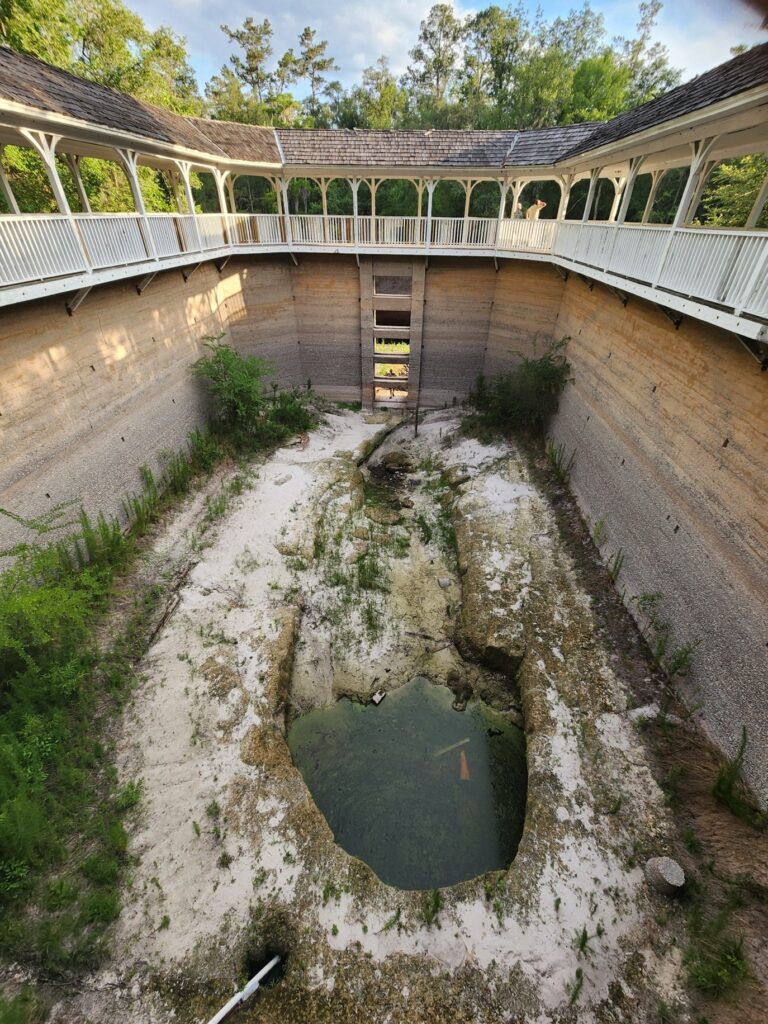
On this year’s Memorial Day weekend, White Sulfur Spring was a non-flowing sinkhole enclosed within a historic spring house. With its trademark river and spring deeply depleted, the town of White Springs now feels like a ghost town.
As prophesied by H.T. Odum in the early 1950s, “a long history of permanency is of course no guarantee of a future.” Referring to Kissingen Spring on the Peace River that dried up due to the nearby phosphate mine’s excessive groundwater demand, Dr. Odum was no doubt aware that the same tragedy was happening at White Sulfur Spring.
White Sulfur Spring first stopped flowing in 1977 due to regionally declining groundwater pressure (potentiometric levels) in the Floridan Aquifer. Looking into the Spring House, there is no longer a gushing spring. Now one only sees a sinkhole, simply an opening into the aquifer.
Anecdotal evidence indicates that White Sulfur Spring discharge was decreasing significantly over time. The decline was noticeable by the 1960s, not long after Occidental Petroleum (now Nutrien) established a phosphate mine nearby. Between 1982 and 1996 the spring only flowed about 40% of the time. Now, when water levels in the adjacent Suwannee River are elevated, river waters flood back into the empty spring, tainting groundwater in the surrounding areas.
Springs stop flowing when surrounding groundwater levels are lower than the spring outlet. Only two factors are likely to lower groundwater levels appreciably: long-term reduced rainfall (drought) and groundwater pumping.
North Florida has always had years with high or low rainfall totals, but the long-term rainfall trend is essentially unchanged. For example, multi-year droughts occurred in 2001, 2012 and this year. But annual rainfall in North Florida continues to be about 52 inches per year.

Yet, groundwater pumping has accelerated during the past 100 years. Since the Floridan Aquifer is interconnected throughout the northern half of the state of Florida and the southern half of Georgia, pumping anywhere in this karst region negatively affects aquifer levels and reduces spring flows regionally.
In 2011, four organizations blamed each other for the death of White Sulfur Springs. Experts from the Suwannee River Water Management District, the St. Johns River Water Management District, JEA (formerly Jacksonville Electric Authority, the largest water supply utility in the area with 164 large wells permitted to pump up to 142 million gallons per day), and Nutrien (a phosphate mining company in Hamilton County with 66 large wells and a permit to pump up to 64 million gallons per day), all pointed their fingers at each other.
In reality, they are all large contributors to the demise of White Sulfur Spring. But there are also roughly 370,000 additional large and small wells extracting more than 3 billion gallons of groundwater each day in the Florida Springs Region. And likewise, in addition to JEA and Nutrien, all these wells are contributing to the demise of this culturally significant spring and the Suwannee River.
It is amazing that any of our precious springs are still flowing — a miracle we should not take for granted.
Robert L. Knight is president of the Howard T. Odum Florida Springs Institute in High Springs. Banner photo: The outside of the Spring House at Stephen Foster Folk Culture Center State Park (Ebyabe, CC BY-SA 2.5, via Wikimedia Commons).
Sign up for The Invading Sea newsletter by visiting here. If you are interested in submitting an opinion piece to The Invading Sea, email Editor Nathan Crabbe.
