


By Weizhi Deng, University of Iowa; Jun Wang, University of Iowa; and Meng Zhou, University of Maryland, Baltimore County
For decades, the United States made steady progress in reducing surface ozone pollution, the main ingredient in smog. But that progress – achieved as vehicles, industries and power sources became cleaner – is increasingly being overshadowed by a different and growing source of ozone pollution: wildfires.
Our team of atmospheric and wildfire scientists analyzed wildfires’ contribution to surface ozone levels from 2003 to 2024 across the United States.
We found that the gases in wildfire smoke have reversed the national ozone trend, forcing a shift from declining ozone levels prior to 2015 to increasing ozone levels after 2015. We also found that the number of ozone-related premature deaths due to wildfires has been increasing by about 300 deaths per year since then.
Battling smog
Most people know ozone as the protective layer of the atmosphere high above the Earth that shields the planet from harmful ultraviolet radiation. But ozone has two very different faces.
High in the atmosphere, ozone is beneficial. Near the ground, it is a harmful air pollutant that can irritate the lungs and worsen respiratory diseases.
Los Angeles made ozone visible to the nation in the 1940s and 1950s, as thick, eye-stinging smog often blanketed the city. It turned an invisible chemistry problem into a public-health crisis people could see and feel. That crisis helped motivate decades of air pollution control efforts in California and, later, across the United States.
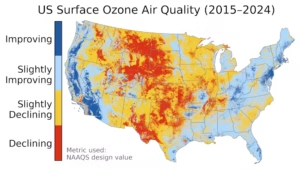
After the passage of the Clean Air Act and its amendments in the 1970s, the U.S. made steady progress in cleaning up surface ozone. Regulations on vehicles, power plants and industrial sources reduced emissions of nitrogen oxides and other ozone-forming chemicals.
To monitor the progress, the U.S. Environmental Protection Agency has over 1,000 stations that measure ozone around the country. They cover many places, but mostly urban areas, and do not measure ground-level ozone everywhere at the neighborhood scale.
We were able to fill in the gaps by combining those monitoring station measurements with satellite-derived information about air pollution and human activity, along with weather and air quality model simulations. We then used artificial intelligence to estimate daily surface ozone levels everywhere in the contiguous U.S., with data every square kilometer, over the past 22 years.
The results show that national progress in reducing surface ozone reversed around 2015 as North America began to face more severe wildfires. In many regions, ozone levels are now increasing, especially in the western U.S. and the Midwest, where smoke and gases from wildfires are becoming more common as they are transported through the air.
Overall, surface ozone levels that had been falling by about 0.65 part per billion per year from 2003–2015 have since increased by about 0.13 parts per billion per year. If wildfires hadn’t been an influence, we found, the trend of falling surface ozone levels would have continued instead.
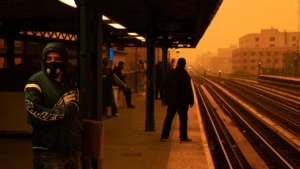
(David Dee Delgado/Getty Images)
People often think of wildfires as a problem for the western U.S., but smoke and gas pollutants from their emissions can travel thousands of miles, affecting communities far from the fires themselves.
The 2023 Canadian wildfires offered a vivid example. In much of the Midwest, ozone reached unhealthy levels for more than a week. The impact of wildfire smoke reached as far as Georgia and New York. That year, an additional 43 million Americans lived in areas with ozone exceeding healthy standards compared to previous years because of increased wildfire emissions.
As the Earth and its atmosphere warm, wildfire seasons are becoming longer and more severe across many parts of North America, and the trend is predicted to continue. In line with projections, Canada experienced its most devastating wildfire seasons on record in 2023 and 2025. In January 2025, destructive fires burned more than 16,000 homes and businesses in and around Los Angeles during a time of year when such events have historically been uncommon.
The shift toward more fires suggests that the rising ozone problem could become even greater in the future. That’s a problem for human health.
Reducing exposure to ozone and its health risks
People can reduce their exposure to ozone pollution by checking air quality forecasts and limiting outdoor activities when wildfires are sending smoke into the air. But protecting public health in the long run will require broader actions to reduce ground-level ozone itself.
That includes efforts to mitigate fire risk by improving wildfire management, such as reducing brush and other dry undergrowth that can fuel fires, and also scaling back the causes of rising global temperatures, such as the burning of fossil fuels. As temperatures rise, the ground loses moisture, creating conditions for more extreme fires.
Protecting public health also means strengthening air quality forecasting systems to provide accurate early warnings, so people can take precautions, and maintaining air pollution monitoring networks and investing in satellite sensors to continue measuring progress, so problems can be identified and fixed.
Weizhi Deng is a Ph.D. student in atmospheric and environmental science at the University of Iowa, Jun Wang is a professor of chemical and biochemical engineering at the University of Iowa, and Meng Zhou is a researcher in atmospheric and Earth sciences at the University of Maryland, Baltimore County.
This article is republished from The Conversation under a Creative Commons license. Read the original article. Banner photo: Smoke over a wilffire in California (iStock image).
Sign up for The Invading Sea newsletter by visiting here. If you are interested in submitting an opinion piece to The Invading Sea, email Editor Nathan Crabbe.
