


By Diana Udel, University of Miami News
On Caribbean coral reefs, small striped gobies perform a vital service. These finger-length cleaner fish pick parasites and dead tissue from the skin, mouths and gills of larger “client” fish, creating underwater service stations where fish stop by to be groomed. But what if these stations do more than keep reef residents healthy — what if they help move microbes around the reef, too?
That question is central to a new study co-authored by Paul Sikkel, a research professor in the Department of Marine Biology and Ecology at the University of Miami Rosenstiel School of Marine, Atmospheric, and Earth Science. The research, published in Marine Ecology Progress Series, is the first to investigate whether cleaner fish influence the diversity and distribution of microbial life on coral reefs.
“Cleaner fish have long fascinated marine scientists, but we’re now seeing that their role in reef ecosystems may go far beyond parasite removal,” said Sikkel. “This study shows that they could also be shaping microbial communities — which has implications for coral health, fish immunity and overall reef resilience.”
The research team — which included scientists from Woods Hole Oceanographic Institution, UC Davis and Portugal’s University of Porto — studied cleaner gobies on reefs in Puerto Rico and St. Croix. In June 2021, they experimentally removed these gobies from certain reef stations and compared microbial communities, water nutrient levels and fish activity to nearby stations where the gobies remained. How pathogens or microbes are moving around a reef could be critically important to understanding how individuals will be affected.
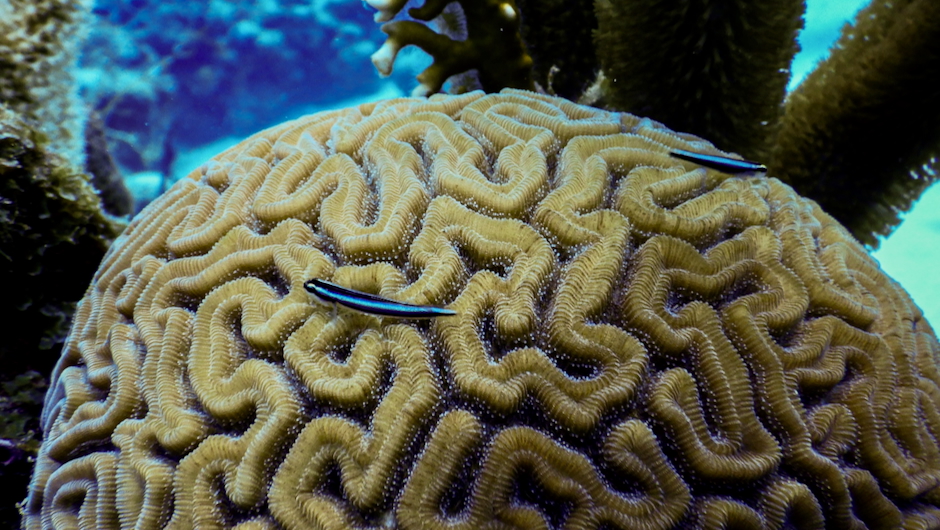
The findings showed that fish congregated more around stations with active cleaner fish and that microbial patterns shifted in their presence, particularly among resident client damselfish. However, the degree of microbial change varied between reef sites, influenced by habitat and substrate.
“Reefs have distinct microbial fingerprints, and understanding what alters them is key,” said Sikkel. “Cleaner fish may be unintentionally moving microbes as they interact with different fish — including beneficial microbes, or potentially harmful ones. That’s an ecological role we need to explore further.”
“We know microbes play a role in coral bleaching, said co-author Anya Brown, an assistant professor with UC Davis Bodega Marine Laboratory who collaborated on the study while at WHOI. “This really lays a foundation for using cleaner fish stations to study movement of microbes around the reef environment.”
Gina Hendrick, now a post-doctoral scientist at the Rosenstiel School, helped lead the fieldwork and analysis while a graduate student in Sikkel’s lab, said the project sheds light on how everyday reef behaviors may shape bigger ecological outcomes.
“Something as simple as a cleaning interaction — which happens thousands of times a day across reefs — could be influencing the microbial makeup of the entire community,” said Hendrick. “This study broadens the growing body of evidence that reef health is closely tied to the tiniest of organisms — and that even the smallest fish can have an outsized impact.”
The study titled: “Context-dependent effects of a Caribbean cleaner goby on coral reef microbial communities,” was published on May 28 in the journal Marine Ecology Progress Series. Funding was provided by the National Science Foundation, WHOI, and the Portuguese Foundation for Science and Technology. The authors include Anya Brown, from UC Davis Bodega Marine Laboratory, Paul Sikkel, from the University of Miami Rosenstiel School of Marine, Atmospheric, and Earth Science, Jeanne Bloomberg, from WHOI, Gina Hendrick and Matthew Nicholson from the University of Miami Rosenstiel School, Marta Soares and Raquel Xavier from the University of Porto, Portugal, and Amy Apprill, from WHOI.
This piece was originally published at https://news.miami.edu/rosenstiel/stories/2025/07/tiny-fish-big-impact-study-explores-how-cleaner-fish-shape-reef-microbial-life.html. Banner photo: A cleaner goby cleans a grouper on a Caribbean coral reef. (Image: Matthew Nicholson, University of Miami).
Sign up for The Invading Sea newsletter by visiting here. To support The Invading Sea, click here to make a donation. If you are interested in submitting an opinion piece to The Invading Sea, email Editor Nathan Crabbe at ncrabbe@fau.edu.
