


By Christopher Halsch and Eliza Grames, Binghamton University, State University of New York
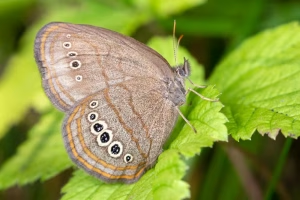
Insects are all around us – an ant on the sidewalk, a bee buzzing by, a butterfly floating on the breeze – and they shape the world we experience. They pollinate flowering plants, decompose waste, control pests, and are critical links in food chains.
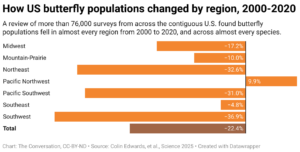
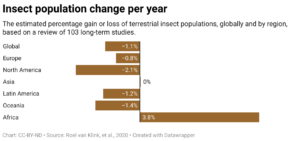
Despite how much humans rely on insects, our actions are reducing their populations in many parts of the world. A recent study found that the United States lost more than 20% of its butterflies over the past two decades. Sadly, this rate of decline is not unusual. Many studies have found that insect populations are declining at 1% to 2% per year.
To understand why this is happening, Status of Insects, an international research group we are part of, reviewed 175 recent studies on the causes of insect decline. We found hundreds of potential causes that are all highly connected, almost all of which stem directly or indirectly from human activities.
The drivers of insect decline are connected
The causes of insect decline are led by a few major sources: intensive agriculture, climate change, pollution, invasive species and habitat loss. Some drivers are bigger threats than others, but all of them play a role in causing insect declines.
Importantly, many insects experience more than one of these stressors at the same time.
Urban risks
Picture a moth in a city park. It is threatened by habitat loss as the city grows, but its habitat may also be threatened by invasive plants that escape from gardens. At the same time, it is suffering from the effects of pollution – light, air and noise pollution are common in urban areas.
Light pollution is especially important for moths because they are attracted to artificial lights at night, and so are their predators. Spiders, for example, have learned to hunt in lit areas. When moth species that fly at night spend a lot of time around lights, they can expend a lot of energy, leaving less for other activities, such as pollinating plants.
In addition to being pollinators, moths also control plant growth by eating leaves during their caterpillar stage. And they provide food for many species of birds and bats, which play their own important roles in ecosystems.
Risks on farmland and orchards
Intensive agriculture is one of the most commonly discussed drivers of insect decline. It is also heavily connected to other causes.
Consider native bees in agricultural areas. As agriculture expands, their native habitat is reduced. Agricultural landscapes also tend to have high levels of chemical pollution – especially insecticides, fungicides, herbicides and fertilizers. Insecticides are designed to disrupt insect physiology and can directly harm bees, while herbicides indirectly disrupt bees by removing plants that provide food.
Often, U.S. farms also use honeybees, native to Europe, for pollination. These introduced bees are easier to manage but can spread diseases and parasites into native bee populations.
Native bees may be able to survive one of these threats, but all three together present a much bigger challenge.
Polluted water can also harm insects
Humans often focus on insects such as bees and butterflies because they are more visible, but many insects spend much of their life underwater, where they face another set of threats.
For instance, dragonflies are aquatic when they are juveniles. The threats at this stage of life are no less severe but are entirely different from those facing adults.
When water levels in streams or ponds decrease, that reduces young dragonflies’ habitat. These insects can also be threatened by water pollution from runoff and increases in water temperature with climate change.
Successful conservation considers all the risks
These connections mean humans must be thoughtful about conservation.
Well-meaning actions such as reducing pollution or controlling invasive species can help, but they will have little effect if there is no habitat for insects to return to. Restoring habitat can have widespread benefits and potentially help insects respond to other threats.
There are more insect species on Earth than species in any other plant or animal group. They can be found almost everywhere you look.
Yet public attention is mostly focused on pollinators. That can leave other insects facing unaddressed human threats.
Preserving and restoring water resources such as wetlands, lakes and streams is vital for aquatic insects like dragonflies. Many other insects spend much of their lives underground. Soil-dwelling insects, such as some beetles and flies, serve important functions, like decomposing dead plant material.
Successful conservation also considers species throughout their life cycles. For instance, planting pollinator gardens provides nectar for adult hoverflies – an important but often overlooked pollinator. But a garden alone would not necessarily provide food for their larval stage, when many hoverflies decompose plant and animal matter.
How to help insects

The simplest way to help insects is by providing high-quality habitats.
This includes supporting a variety of native plants that can provide both nectar and leaves, which are food for many herbivorous insects throughout their lives.
A good habitat also provides places for insects to nest, such as bare ground or leaf litter. Bigger patches are better, but even small gardens can be helpful.
At the same time, limiting exposure to other threats is important. Actions such as dimming artificial lights at night and reducing the use of pesticides can help.
There are many reasons for insect decline, making population recovery an imposing challenge. But there are also many ways – large and small – that people, cities and companies can reduce the harm and help these valuable critters thrive.
Christopher Halsch is an ecologist and Eliza Grames is an assistant professor of biological sciences, both at Binghamton University, State University of New York.
This article is republished from The Conversation under a Creative Commons license. Read the original article. Banner photo: Dragonflies, just like bees and butterflies, face threats that humans can help prevent (Christopher Halsch).
Sign up for The Invading Sea newsletter by visiting here. To support The Invading Sea, click here to make a donation. If you are interested in submitting an opinion piece to The Invading Sea, email Editor Nathan Crabbe at ncrabbe@fau.edu.

.jpg)