


By Gisele Galoustian, FAU News Desk
Researchers at Florida Atlantic University’s Harbor Branch Oceanographic Institute have released a landmark review tracing four decades of changes in pelagic sargassum – free-floating brown seaweed that plays a vital role in the Atlantic Ocean ecosystem.
Once thought to be primarily confined to the nutrient-poor waters of the Sargasso Sea, sargassum is now recognized as a rapidly growing and widely distributed marine organism, whose expansion across the Atlantic is closely linked to both natural processes and human-induced nutrient enrichment.
The review, published in the journal Harmful Algae, sheds new light on the origins and development of the Great Atlantic Sargassum Belt, a massive recurring bloom of sargassum that stretches across the Atlantic Ocean from the coast of West Africa to the Gulf of America.
Since its first appearance in 2011, this belt has formed nearly every year – except in 2013 – and in May, reached a new record biomass of 37.5 million tons. This does not include the baseline biomass of 7.3 million tons historically estimated in the Sargasso Sea.
By combining historical oceanographic observations, modern satellite imagery and advanced biogeochemical analyses, this review provides a comprehensive framework for understanding the dramatic changes in sargassum distribution, productivity and nutrient dynamics. It also highlights the broader implications of anthropogenic nutrient enrichment on ocean ecology and the need for coordinated international efforts to monitor and manage the impacts of these massive seaweed blooms.
“Our review takes a deep dive into the changing story of sargassum – how it’s growing, what’s fueling that growth and why we’re seeing such a dramatic increase in biomass across the North Atlantic,” said Brian Lapointe, Ph.D., lead author and a research professor at FAU Harbor Branch. “By examining shifts in its nutrient composition – particularly nitrogen, phosphorus and carbon – and how those elements vary over time and space, we’re beginning to understand the larger environmental forces at play.”
Early in the review, Lapointe and co-authors Deanna F. Webber, research coordinator; and Rachel Brewton, Ph.D., an assistant research professor, both with FAU Harbor Branch, explain that early oceanographers charted the Sargasso Sea based on surface sightings of sargassum, believing the seaweed thrived in its warm, clear, but nutrient-poor waters. However, this notion created a paradox when mid-20th-century oceanographers described the region as a “biological desert.”
However, recent satellite observations, ocean circulation models and field studies have resolved this paradox by tracing the seasonal transport of sargassum from nutrient-rich coastal areas, particularly the western Gulf of America, to the open ocean via the Loop Current and Gulf Stream. These findings support early theories by explorers who proposed that Gulf-originating sargassum could feed populations in the Sargasso Sea.
Remote sensing technology played a pivotal role in these discoveries. In 2004 and 2005, satellites captured extensive sargassum windrows – long, narrow lines or bands of floating sargassum – in the western Gulf of America, a region experiencing increased nutrient loads from river systems such as the Mississippi and Atchafalaya.
“These nutrient-rich waters fueled high biomass events along the Gulf Coast, resulting in mass strandings, costly beach cleanups and even the emergency shutdown of a Florida nuclear power plant in 1991,” Lapointe said. “A major focus of our review is the elemental composition of sargassum tissue and how it has changed over time.”
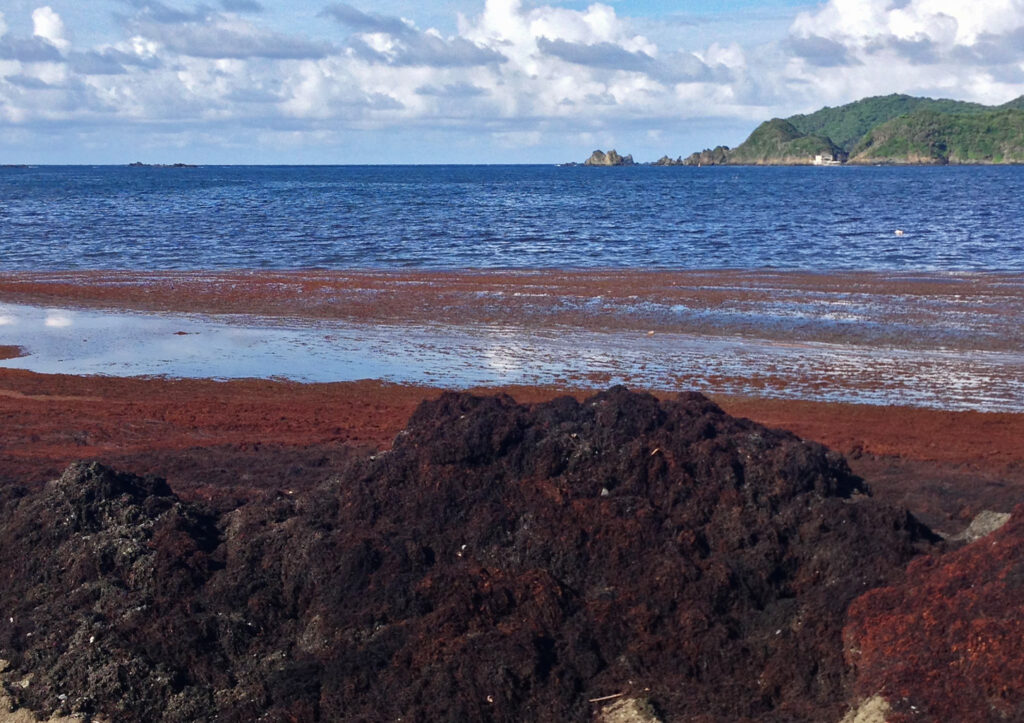
Laboratory experiments and field research dating back to the 1980s confirmed that sargassum grows more quickly and is more productive in nutrient-enriched neritic waters than in the oligotrophic waters of the open ocean. Controlled studies revealed that the two primary species, sargassum natans and sargassum fluitans, can double their biomass in just 11 days under optimal conditions. These studies also established that phosphorus is often the primary limiting nutrient for growth, although nitrogen also plays a critical role.
From the 1980s to the 2020s, the nitrogen content of sargassum increased by more than 50%, while phosphorus content decreased slightly, leading to a sharp rise in the nitrogen-to-phosphorus (N:P) ratio.
“These changes reflect a shift away from natural oceanic nutrient sources like upwelling and vertical mixing, and toward land-based inputs such as agricultural runoff, wastewater discharge and atmospheric deposition,” said Lapointe. “Carbon levels in sargassum also rose, contributing to changes in overall stoichiometry and further highlighting the impact of external nutrient loading on marine primary producers.”
The review also explores how nutrient recycling within sargassum windrows, including excretion by associated marine organisms and microbial breakdown of organic matter, can sustain growth in nutrient-poor environments. This micro-scale recycling is critical in maintaining sargassum populations in parts of the ocean that would otherwise not support high levels of productivity.
Data from sargassum collected near the Amazon River mouth support the hypothesis that nutrient outflows from this major river contribute significantly to the development of the GASB. Variations in sargassum biomass have been linked to flood and drought cycles in the Amazon basin, further connecting land-based nutrient inputs to the open ocean.
The formation of the GASB appears to have been seeded by an extreme atmospheric event – the negative phase of the North Atlantic Oscillation in 2009 to 2010, which may have helped shift surface waters and sargassum from the Sargasso Sea southward into the tropical Atlantic.
However, the researchers caution that there is no direct evidence of this movement. Moreover, genetic and morphological data suggest that some sargassum populations, particularly the dominant S. natans var. wingei, were already present in the tropical Atlantic prior to 2011, indicating that this region may have had an overlooked role in the early development of the GASB.
“The expansion of sargassum isn’t just an ecological curiosity – it has real impacts on coastal communities. The massive blooms can clog beaches, affect fisheries and tourism, and pose health risks,” said Lapointe. “Understanding why sargassum is growing so much is crucial for managing these impacts. Our review helps to connect the dots between land-based nutrient pollution, ocean circulation and the unprecedented expansion of sargassum across an entire ocean basin.”
This work was funded by the Florida Department of Emergency Management, United States Environmental Protection Agency, South Florida Program Project and the NOAA Monitoring and Event Response for Harmful Algal Blooms program. Historical studies included within the review were funded by the NASA Ocean Biology and Biogeochemistry Program and Ecological Forecast Program, NOAA RESTORE Science Program, National Science Foundation, “Save Our Seas” Specialty License Plate and discretionary funds, granted through the Harbor Branch Oceanographic Institute Foundation and a Red Wright Fellowship from the Bermuda Biological Station.
This piece was originally published at https://www.fau.edu/newsdesk/articles/sargassum-story-forty-years-data.php. Banner photo: Brian Lapointe, Ph.D., emerges from sargassum at Little Palm Island in June 2014 (FAU photo).
Sign up for The Invading Sea newsletter by visiting here. To support The Invading Sea, click here to make a donation. If you are interested in submitting an opinion piece to The Invading Sea, email Editor Nathan Crabbe at ncrabbe@fau.edu.
