


By Robert C. Jones Jr., University of Miami News
Next-generation flatscreen televisions that project sharper, cleaner pictures with more vibrant colors could soon be the wave of the electronics industry thanks to an unsightly foul-smelling alga bloom that often smothers beaches from Florida to the Caribbean.
A University of Miami College of Engineering graduate student has been experimenting with clumps of sargassum seaweed for the past year, aerosolizing fine particles of the macroalgae into tiny droplets that are then superheated in a furnace at 800 degrees Celsius.
“During that superheating process, those droplets decompose, or pyrolyze, and form carbon dots at the nanoscale,” said Yiming Xi, a Ph.D. candidate in chemical engineering who conducts his seaweed experiments out of the college’s Aerosol and Air Quality Research Laboratory.
It is those carbon dots, said Xi, that show tremendous promise as a nontoxic alternative to conventional quantum dots in flatscreen TV displays, offering the potential for improved picture quality.
Carbon dots are already being used to detect latent fingerprints and in packaging to extend the shelf life of food. And because of their biocompatibility and fluorescence and electrochemical properties, they exhibit great promise in a myriad of other applications — from drug delivery and bioimaging to agriculture to promote plant growth and in energy storage systems such as supercapacitors.
But the technology to create them is relatively new, so their widespread application in other fields, including in the production of flatscreen TVs, is still in its infancy, according to Pratim Biswas, a professor in the Department of Chemical, Environmental, and Materials Engineering, and the principal investigator of the Aerosol and Air Quality Research Laboratory.
“The key part is we are taking a waste material that commonly ends up in landfills, where it could release dangerous pollutants, and converting it into something of very high value to society,” Xi said.
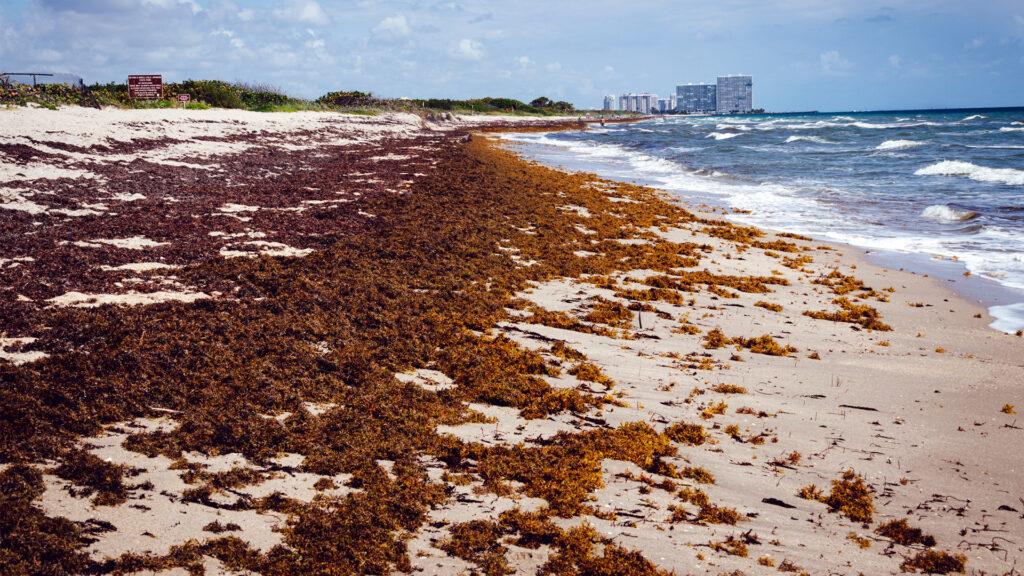
With millions of tons of sargassum seaweed floating in the tropical Atlantic Ocean this summer — making its way to shores throughout the Caribbean and in Florida, where the brown algae would release toxic gas — Xi’s research is timely.
“Our philosophy,” Xi said, “is not to call it waste but a resource.”
While other researchers are experimenting with carbon dots, Xi’s method of producing them offers advantages over other techniques, minimizing the steps involved in the process and using less aggressive methods absent of toxic chemicals, he explained.
“Our superheating furnace method offers more consistent production of carbon dots,” he said. “It is a continuous, one-step synthesis process, which largely simplifies the procedure to fabricate them.”
Next year, Xi hopes to test his carbon dots in LED units. “The testing requires specific photonic substrate materials,” he said. “So, we’ll wait to see when the supply chain becomes more stable to source the materials for building the testing environment.”
This piece was originally published at https://news.miami.edu/stories/2025/09/from-flatscreens-to-bioimaging-putting-sargassum-seaweed-to-good-use.html. Banner photo: Yiming Xi, a Ph.D. candidate in chemical engineering in the College of Engineering, is researching potential uses for sargassum seaweed (Photo: Joshua Prezant/University of Miami).
Sign up for The Invading Sea newsletter by visiting here. To support The Invading Sea, click here to make a donation. If you are interested in submitting an opinion piece to The Invading Sea, email Editor Nathan Crabbe at nc*****@*au.edu.
