


By Gisele Galoustian, FAU News Desk
Beneath the surface of lakes and coastal waters lies a hidden world of sediment that plays a crucial role in the health of aquatic ecosystems. “Benthic fluxes” of nitrogen and phosphorus, such as releases of these dissolved nutrients from sediments to their overlying waters, can fuel algae growth and toxic harmful algal blooms, which degrade water quality, disrupt wildlife and recreation, and reduce property values.
Sediments act as a natural archive, offering historical insights into ecosystem health. However, to fully understand nutrient exchanges between sediment and water, scientists rely on measurements of benthic fluxes, like the amount of nitrogen transported across the sediment/water interface in typical units of pounds per square meter of sediment area per day.
Traditional monitoring methods are slow, costly and challenging, and while newer autonomous systems show promise, few studies have explored how these systems can reveal how sediments contribute to or sustain armful algal blooms – an essential step in managing and protecting aquatic ecosystems. For example, in Florida’s Lake Okeechobee, benthic nutrient fluxes are the dominant source of nutrients fueling algal growth in this shallow turbid water body.
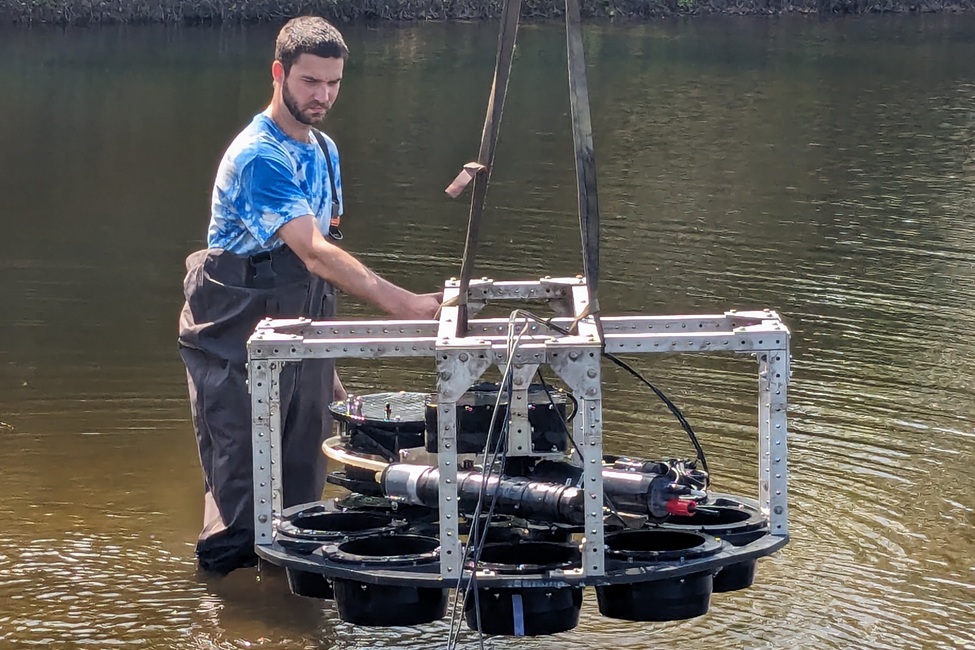
Florida Atlantic University Harbor Branch Oceanographic Institute researchers are the first to continuously track the exchanges of different forms of nitrogen between bottom sediments and the overlying water. Most importantly, their novel approach enables measuring how much ammonium is released from sediments in real time, multiple times a day, over an extended period – offering an unprecedented, detailed view of this critical nutrient exchange and preferred nutrient source of algal blooms.
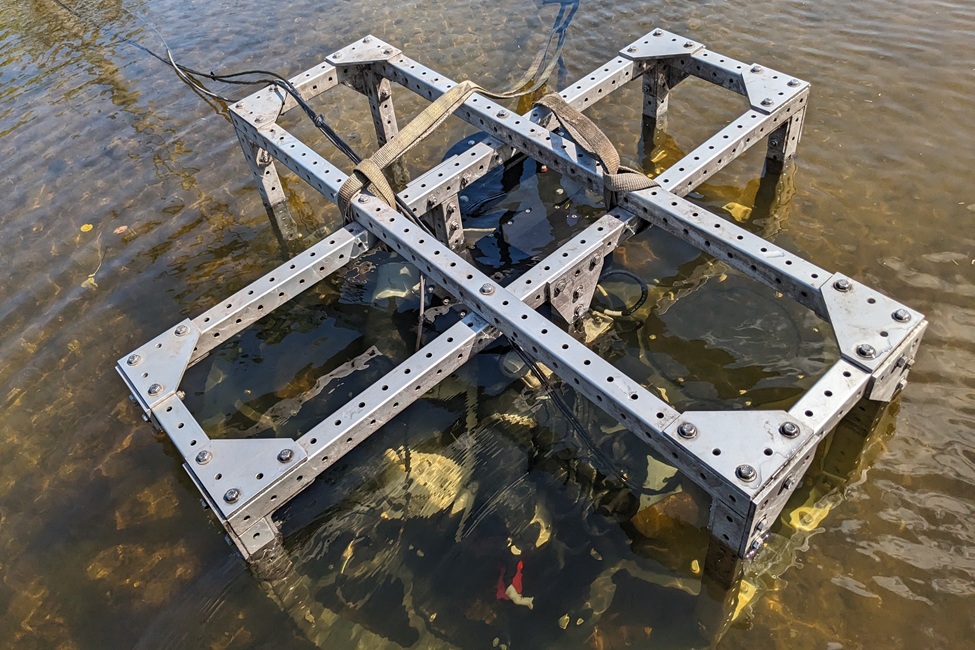
Their secret weapon? A new device called CAROSEL – short for Chamber ARray for Observing Sediment Exchanges Long-term.
The CAROSEL is a smart, underwater monitoring system designed to study how nutrients and other chemicals move between lake or ocean sediments and the water above. Unlike older methods that required two boat (or ship) trips and manpower to deploy and retrieve instrumentation packages to obtain only a single benthic flux data time point, the CAROSEL works automatically, taking multiple measurements each day without human help for periods of several weeks.
For the study, researchers tested the CAROSEL in a shallow freshwater retention pond on the FAU Harbor Branch campus in Fort Pierce. The goal was to better understand the interplay of nutrients and oxygen over both day and multi-day cycles, enabling better insights into the total nitrogen available as a function of the time of day and the weather. However, it also improved estimates of the nutrients removed from this pond system over time. These retention ponds – found all over Florida – are a common Best Management Practice (BMP) employed as part of the state’s regulations to do just that: eliminate the nutrients flowing to coastal estuaries.
Results of their research, published in the journal Limnology & Oceanography, also reveal that oxygen fluxes in the water followed a daily rhythm: increasing during the day from photosynthesis and decreasing at night due to respiration. Conversely, sediments consistently consumed oxygen from the overlying water. The sediments also released ammonium throughout the study, while the water column showed signs of nitrogen being added during the day and broken down at night – a surprising finding considering photosynthetic growth during the day would be expected to consume nutrients.
After rainstorms, both ammonium and nitrate fluxes changed quickly, showing how sensitive these processes are to the environment. It was also clear that nitrogen removal through nitrification/denitrification – the main process desired in these BMP systems – was intense but also highly variable over time. Uniquely, the CAROSEL captured high-frequency, real-time data, revealing sharp, short-term fluctuations in nutrient and oxygen exchange. These findings challenge the common assumption that sediment processes are slow or steady, and underscore how tools like the CAROSEL can uncover the hidden, dynamic forces shaping water quality.
“What’s most exciting is that CAROSEL gave us a detailed, hour-by-hour view of how weather and environmental changes directly affect the chemistry between the lake bottom and the water above,” said Jordon Beckler, Ph.D., senior author, an associate research professor at FAU Harbor Branch and an FAU Sensing Institute (I-SENSE) fellow. “That level of detail helps us untangle the complex chain reactions happening in lakes and estuaries – something that’s been incredibly hard to do until now with such low-resolution conventional benthic flux data.
“We see this technology as a powerful new tool for understanding how these fluxes drive ecosystem dynamics, especially given the explosion of harmful algal blooms globally over the last few decades,” “What’s most exciting is that CAROSEL gave us a detailed, hour-by-hour view of how weather and environmental changes directly affect the chemistry between the lake bottom and the water above,” Beckler said. “I see sediments, which cover about 70% of the Earth’s surface, as the next water, soil or air – for which we already have developed an appreciation for their health and conservation.”
This detailed view will help scientists understand how quickly nutrients cycle and how factors like light, temperature and storms drive those changes – key to improving water quality monitoring and management. The CAROSEL shows strong potential as a tool for tracking and responding to issues like nutrient pollution, harmful algal blooms, low oxygen “dead zones,” carbon cycling, and even organic and heavy metal contaminants amid shifting environmental conditions.
“What makes the CAROSEL especially valuable is its versatility – it’s designed to work in both freshwater and marine environments and can be adapted to monitor a wide range of substances, from nutrients like ammonium and nitrate to other parameters such as carbon dioxide or dissolved organic carbon. We’ve specifically designed the CAROSEL to accept any underwater sensor that exists on the market today,” said Mason Thackston, first author and graduate research assistant at FAU Harbor Branch.
“That flexibility means we can tailor the system to different ecosystems and research needs,” Thackston. “I’m currently gearing up for two new funded projects, one to establish a baseline for benthic nutrient fluxes in an area planned to be dredged in the Northern Indian River Lagoon, and another to directly monitor legacy nutrient fluxes in Lake Okeechobee. We also see great promise for improving our understanding of the nutrient dynamics of BMPs in Florida, which are presently underperforming with respect to expectations.”
Study co-authors are Donald Nuzzio, Ph.D., president of Analytical Instrument Systems Inc.; and Csaba Vaczo, a mechanical engineer at FAU Harbor Branch. This work was supported by the Harbor Branch Oceanographic Institute Foundation and an FAU I-SENSE seed grant, as well as the Florida Department of Environmental Protection Innovative Technologies for HAB Mitigation Program, for supporting research directly leading to the conception of the CAROSEL (Grant No. MN016).
This piece was originally published at https://www.fau.edu/newsdesk/articles/carosel-water-quality-monitoring.php. Banner photo: Jordon Beckler, Ph.D., and Mason Thackston (in the water) testing CAROSEL (FAU).
Sign up for The Invading Sea newsletter by visiting here. To support The Invading Sea, click here to make a donation. If you are interested in submitting an opinion piece to The Invading Sea, email Editor Nathan Crabbe at ncrabbe@fau.edu. To learn more about harmful algal blooms, watch the short video below.
