


This article originally appeared on Inside Climate News, a nonprofit, non-partisan news organization that covers climate, energy and the environment. Sign up for their newsletter here.
By Amy Green, Inside Climate News
A dozen different “forever chemicals” linked with cancer and other human health problems have been detected in the Everglades, Florida’s most important freshwater resource, responsible for the drinking water of millions in the state, according to new research.
It is the first time PFAS, or perfluoroalkyl and polyfluoroalkyl substances, have been measured on the Everglades reservation of the Miccosukee Tribe. For many generations the Indigenous people have inhabited the soaring cypress swamps and sweeping sawgrass prairies of the river of grass, a watershed encompassing much of the peninsula and which they regard as sacred.
PFAS are manufactured chemicals that have been used in consumer products since the 1940s. The chemicals can be found in items such as non-stick cookware, waterproof fabrics and long-lasting cosmetics, but they do not break down easily in the environment and can accumulate in the bodies of humans and other animals. The problem is a growing concern as climate change increases the rain dumped by hurricanes and other storms, contributing to more runoff that can wash the chemicals into waterways.
PFAS have been linked with several kinds of cancer, including prostate, kidney and testicular cancers. They also are associated with high cholesterol and obesity, developmental problems such as low birth weight and fertility problems. The chemicals can be found across the globe, in regions as remote as Grand Canyon National Park and the Tibetan mountains. Recent scientific advancements have shown evidence of health harms from PFAS even at low levels.
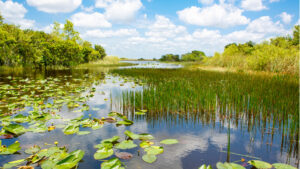
To understand the risks in the Everglades, the Miccosukee Tribe partnered with a team of researchers at Florida International University that has examined the spread of PFAS across South Florida. The researchers’ study, published in the journal Environmental Research, focused on sites on the Miccosukee reservation where the tribe has been most concerned about contamination. Researchers compared the findings with those from more urban areas along the Biscayne Canal, Little River and Miami River, which flow into Biscayne Bay.
“The tribe views the Everglades as a holistic system, not just the tribal lands but to the north where the Everglades headwaters are,” said Amy Castaneda, water resources director for the Miccosukee Tribe. “All of these were historically Miccosukee lands. They weren’t restricted to political boundaries, so they view the entire area as Everglades and homelands. So their concerns are in the water and fish tissues and wildlife. They use this area for hunting and fishing, and so holistically they would like to see PFAS eventually either eliminated or reduced.”
The researchers found that PFAS concentrations on the Miccosukee reservation were lower than those in the Miami canals. While 78% of the samples from the Miami canals exceeded safe surface water screening standards, none of the Everglades samples did. PFAS levels in the reservation canals and marshlands ranged from 3.94 to 40.1 parts per trillion. By comparison, in the Miami canals the levels were several times greater, from 30.1 to 153 parts per trillion.
The highest PFAS concentrations were detected at sites along the Miami River and Biscayne Canal, in areas with hospital wastewater and airport effluent. A comparison of the reservation findings with those of other studies conducted upstream from the tribal lands indicated to the research team that there may be additional PFAS sources that are not yet identified.
“It’s not a reason to panic,” said Natalia Soares Quinete, a study author and associate professor at Florida International University specializing in environmental chemistry. “Now we know we have PFAS in the water, and I think at this time it serves as, OK, we have to start thinking and implementing some regulation on those chemicals in the same way they have done before, for phosphorus especially.”
A multi-billion-dollar restoration of the Everglades is among the most ambitious of its kind in human history. An important component of the effort is addressing water quality problems associated with nutrient pollution, especially phosphorus contamination. The watershed begins in central Florida with the headwaters of the Kissimmee River and includes Lake Okeechobee, sawgrass marshes to the south and Florida Bay, at the peninsula’s southernmost tip.
Quinete and her team also have detected PFAS in rainwater in Miami-Dade County, an indication the chemicals are circulating in the atmosphere in an endless cycle of evaporation and rainfall. PFAS concentrations in the rainwater skyrocketed during the dry season from October to May, suggesting the chemicals may be spreading on drier air currents from the north. The researchers also have identified PFAS in tap water in Miami-Dade, Broward and Palm Beach counties. They even have found the chemicals in oysters in Biscayne Bay, Marco Island and Tampa Bay.
The Biden administration established the first federal drinking water limits for PFAS last year. Limits included 4 parts per trillion for two common types of the chemicals, PFOA and PFOS, effectively the lowest level where the chemicals can be detected reliably, although the Trump administration has announced plans to weaken the limits.
Quinete characterized her team’s study in the Everglades as a preliminary assessment. She said more research is needed to understand where the chemicals are coming from and how to control them. She noted that current Everglades restoration efforts do not consider PFAS.
“Hopefully we can start discussing … how we can change current restoration strategies to make sure that we are removing not only phosphorus but other chemicals as well,” she said.
Castaneda said Everglades restoration may help address PFAS by improving the flow of water in the river of grass. She said, for instance, one project involves backfilling canals and restoring the historic slow-moving sheet flow of the Everglades in an area north of the tribal lands.
“Everglades restoration is necessary and extremely important to the tribe, and although PFAS is extremely concerning I think we need to move forward with Everglades restoration even in the face of emerging contaminants,” she said. “We don’t want to stop Everglades restoration due to PFAS.”
Banner photo: The sun sets over the Everglades (iStock image).
Sign up for The Invading Sea newsletter by visiting here. To support The Invading Sea, click here to make a donation. If you are interested in submitting an opinion piece to The Invading Sea, email Editor Nathan Crabbe at ncrabbe@fau.edu.

I have been saying this for years The miccosukee tribe of people have are being poisoned by FWC spraying aquatic pesticides on a daily basis in every lake in the state of Florida especially Okeechobee it naturally all flows to the south especially underground in our drinking water aquifer