


By Chelsea Henderson, republicEn.org
Twenty-five years ago this week, history was made when the Comprehensive Everglades Restoration Plan (CERP) was signed into law after years of negotiation between the U.S. Congress, the Clinton administration and the state of Florida. This $8 billion (at the time) agreement solidified a federal-state partnership to preserve the greater Everglades ecosystem, which had been stressed by decades of water flow manipulation, unhealthy agricultural practices and unchecked urban development.
CERP was the top priority of my boss at the time, Sen. Bob Smith, a Republican from New Hampshire who called the intricate ecosystem “America’s Everglades,” an attempt in part to convey to his constituents nearly 1,500 miles away that his attention on this crown jewel was warranted.
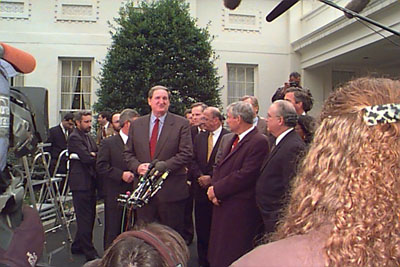
As chairman of the Senate Environment and Public Works Committee, which led the charge on authorizing the extensive components of the CERP, Smith set the tone for the proceedings. That started with his declaration at a Jan. 7, 2000, field hearing in Naples, Florida, that there was “no daylight” between him and the late John Chafee, his predecessor and the former EPW Committee chair with a reputation as a strong environmentalist.
The standing room only crowd cheered.
The fate of the Everglades and attempts to pass this historic restoration effort had been in question after the unexpected death of Chafee, who had been on the record as a strong proponent of the project. But the staunchly conservative Smith quickly nipped those fears in the bud and kicked off a robust set of hearings and negotiations that lasted most of the year.
CERP was being negotiated as a key part of the Water Resources Development Act, the biennial bill authorizing projects under the scope of the U.S. Army Corps of Engineers. Ironically, the Corps was responsible for many of the issues facing the ecosystem, harkening back to a day when we prioritized development over ecosystems. But the Corps would be critical to restoring the ecosystem back to some better version of its original glory.
Enactment of the CERP was no small feat. Appropriately so; given the cost and the environmental and economic ramifications, it shouldn’t have been easy to push through Congress like many of today’s big bills. This was an era when congressional committees did due diligence to the landmark legislation they drafted.
This was an era of bipartisanship.

And looking at the accomplishment through today’s bitter political lens, passing the Everglades legislation bipartisanly feels even more remarkable. What truly made this effort special was the level of commitment from Republicans and Democrats alike to seeing the project through to the day, Dec. 11, 2000, when President Bill Clinton signed it into law.
Next to him stood an array of lawmakers across the political spectrum, including Smith, Florida Gov. Jeb Bush, Sens. Bob Graham and Connie Mack of Florida, and most of the Florida congressional delegation. Spirits were high. Witnessing this signing is easily a top-three career moment for me personally.
But Dec. 11, 2000, isn’t just in the history books as the day the CERP was enacted. In fact, probably only a handful of us who were there at the time even remember the specific date. Dec. 11 was also the day the Supreme Court heard arguments in Bush v. Gore. But even the divisive 2000 election didn’t crush the bipartisan will to get the Everglades restoration done or the amity between the lawmakers (and staff) present for the signing.
2025 can take a lesson from 2000. We aren’t always going to agree, but we can still conduct ourselves with grace, kindness and respect without sacrificing tenacity. If we can do it for the Everglades, we should be able to do it on other important issues that touch all Americans.
Chelsea Henderson is the director of editorial content for republicEn.org and is the author of “Glacial: The Inside Story of Climate Politics.” She was staff on the Senate Environment and Public Works Committee from 1998 to 2002. Banner photo: Sun shines through the fog in the Everglades (iStock image).
Sign up for The Invading Sea newsletter by visiting here. To support The Invading Sea, click here to make a donation. If you are interested in submitting an opinion piece to The Invading Sea, email Editor Nathan Crabbe.
