


By Anna Bullock, Florida Student News Watch
If you’re a water droplet in Tallahassee, Florida, there’s a good chance you’ll see yourself on Florida State University’s campus. In this region, the Floridan Aquifer is the terrestrial system through which our water moves. The aquifer is the source of our drinking water in Tallahassee and the many springs we see in this region.
If you land along the surface, you may be filling up thirsty students’ Owala water bottles, but it’s much more likely that you’ll eventually find yourself flowing through a creek right next to Doak Campbell Stadium, where thousands of students gather to chant Garnet and Gold on autumn game days.
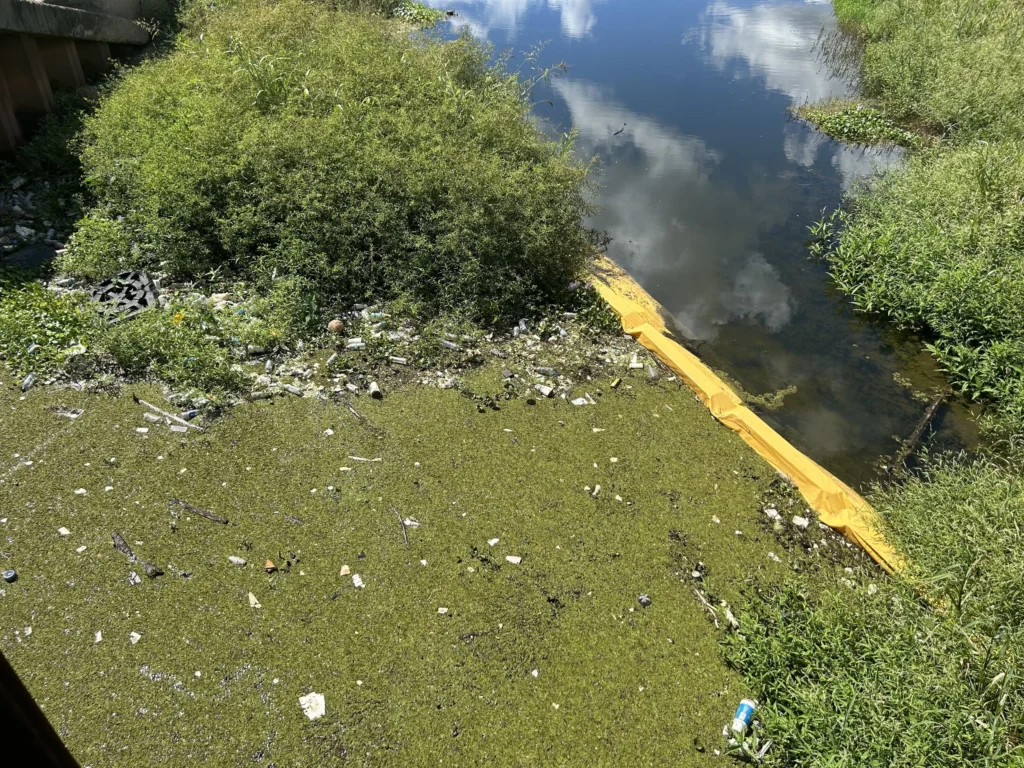
As the current pulls you alongside the bustling streets, someone might throw their old Red Bull can at you after they’re done with their midterms, or celebrate with toxic confetti from a graduation photo.
From Doak Campbell Stadium, you’ll travel underneath seemingly inconspicuous roads to find yourself about three miles southwest at the Anita L. Davis Preserve at Lake Henrietta Park. Here, this 100-acre lake is home to an abundance of birds and wildlife.
In this body of water, there are trash racks, paid for by federal funding, in the preserve’s waterways to capture floating litter, plastics and debris before they enter Lake Henrietta or flow into connected sloughs. This allows the litter to either be disposed of properly or recycled.
Only about 9% of plastic ever actually gets recycled, according to the Organization for Economic Cooperation and Development (OECD). The rest of it ends up in landfills or pollutes bodies of water, with the microplastics they leave behind.
Microplastics are small pieces of plastic that are less than five millimeters in size, similar to a grain of salt. They originate from larger pieces of plastic, like bottles and lids, that are carelessly thrown into lakes, breaking down into almost undetectable pieces. They harm wildlife, and recent studies show they are also beginning to impact our health.
In the heart of the FSU Wakulla Springs Lab, Professor Kellie Keys works with a team of researchers on this very issue.
“We’re here to talk with the public and with students about this fascinating place we live — No. 1 — and then No. 2, we’re doing communication research right alongside the scientific research,” Keys says.
The best way to reduce litter is to reduce the consumption of single-use products. If the litter isn’t being made, it can’t end up ruining these beautiful natural places.
A toxicity in Lake Munson
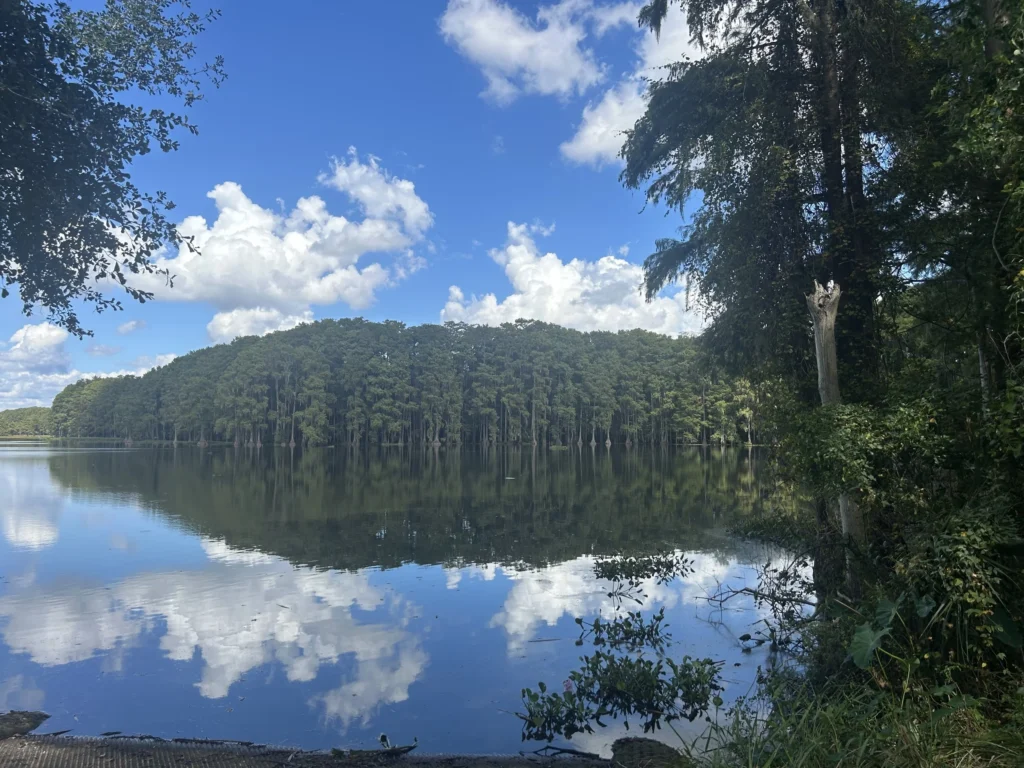
Four miles downstream, you may be sucked into the gills of a largemouth bass. The state warns against eating more than one per month from Lake Munson.
The 288-acre lake is surrounded by cypress trees and filled with microplastics and toxic chemicals, including polychlorinated biphenyls (PCBs). These man-made compounds are now banned since consuming them has proven to reduce the IQ of children who were exposed in utero. Immune system suppression, reproductive and developmental disorders, liver damage, and cancer can also occur, according to the U.S. Environmental Protection Agency.
Soda cups and chip bags also wash up on the edge of the lake, ruining the gorgeous scenery and leaving behind microplastics.
A complex underground
If you remain intact, from Lake Munson you’ll continue flowing downstream to the Ames Sink, the opening to a massive complex underwater cave system.
“The divers who physically go down there and dive say that if people could see it, it would be a national park,” Keys said.
Studies tracing the flow of dye confirm a direct path between the Ames Sink and Wakulla Springs, according to Leon County government officials.
A single droplet of water can rocket 20 miles underground and burst out at the spring in just 10 days, like an express train; proof of how remarkable this system is.
The challenge for Keys lies in effectively sharing this with the public and students about this remarkable place.
Every contribution upstream affects the water’s journey downstream.
“What’s up the creek is really important,” Keys says. “Outreach and education help us see what’s going on underneath us, which is important if we are going to care for the springs and care for our drinking water.”
Wakulla Springs
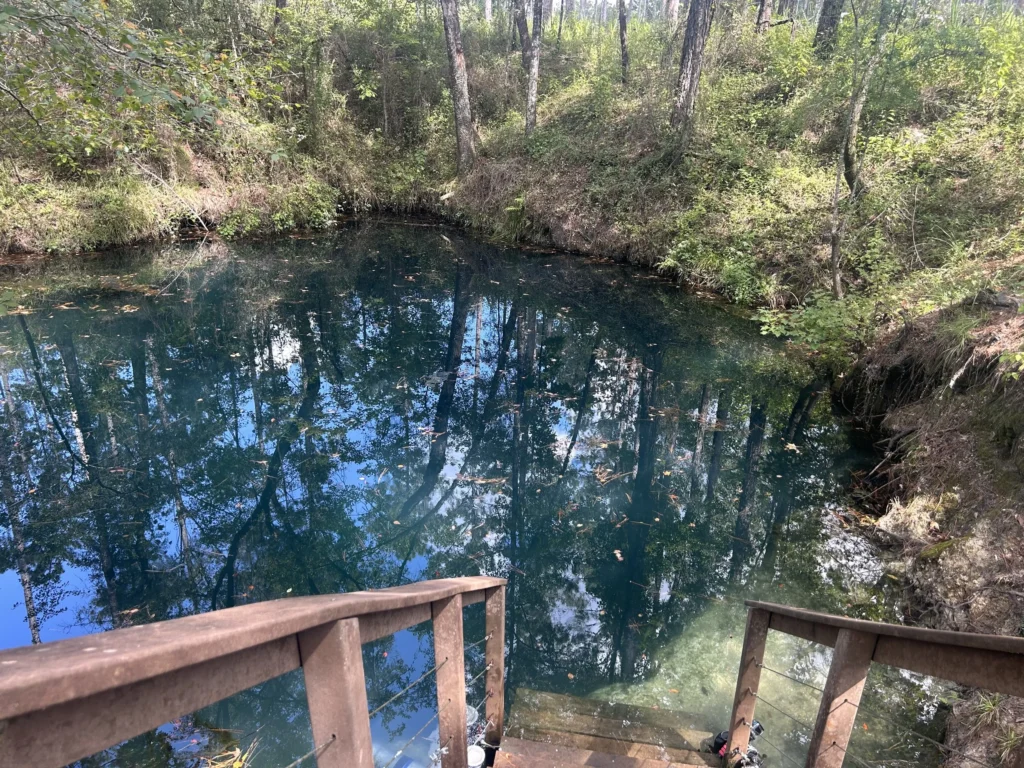
You’ve finally made it to Wakulla Springs State Park. As you float around, you will be a part of the incredible ecosystem with manatees, alligators, turtles and birds. On a good day, you may be the droplet the sun reflects off of in the crystal-clear water.
More recently, however, the water hasn’t been as crystal-clear. Harmful algal blooms (HABs) have caused the water to darken. Warmer temperatures and calm conditions trigger these, and they thrive on excess micronutrients like nitrogen and phosphorus, primarily from agricultural and lawn fertilizer runoff in the Wakulla watershed, as well as leaky septic systems and urban stormwater. These feed the blooms, and the algae grow out of control.
Nitrate levels in the spring have risen dramatically, fueling nuisance species like the filamentous Lyngbya wollei, which smothers native vegetation and reduces oxygen levels. This process, known as eutrophication, has led to murkier waters that have even grounded the park’s iconic glass-bottom boat tours, a once-reliable draw for visitors since the 1920s.
What we learn
Your journey as a water droplet through Tallahassee’s waterways — busy campus creeks to peaceful parks, downstream lakes, unseen cave systems, forested recharge areas and finally the springs — shows just how connected everything truly is, and how a small action in one place can have a great impact somewhere else later on.
By polluting and over-consuming, we have disrupted the balance of this system, just as unchecked algae blooms disrupt the springs.
If we have the potential to disrupt the balance, we have the potential to restore it. By reducing single-use plastics, avoiding fertilizer use and chemical contamination, supporting research and communication efforts, we can protect these waters for future generations.
Choose the refillable bottle over the single-use one. Skip the lawn fertilizer this spring. Demand better stormwater rules. Tell your roommate why the creek behind the stadium actually matters.
Small, stubborn acts of care compound the same way neglect does, only in the opposite direction.
Do that often enough, consistently enough, and one day soon a droplet leaving FSU’s campus will glide untouched through Lake Munson, slip past the caves no one sees, and emerge at Wakulla Springs exactly as it began: clear, cold enough to steal your breath and bright enough to remind every person standing on the dock that this water, and everything it carries, is still ours to save.
Anna Bullock is a media/communication studies student at Florida State University pursuing a career in journalism. This story was edited by CD Davidson-Hiers and was originally published at https://www.studentnewswatch.org/stories/following-a-water-droplet-on-its-journey-beneath-tallahassee. Banner photo: Lake Henrietta in September 2025 (Photo credit: Anna Bullock).
Sign up for The Invading Sea newsletter by visiting here. To support The Invading Sea, click here to make a donation. If you are interested in submitting an opinion piece to The Invading Sea, email Editor Nathan Crabbe.
