


By Harper West, Florida Springs Council
The fight to protect Florida’s state parks is not over.
Floridians were outraged in 2024 when the Florida Department of Environmental Protection tried to force golf courses and hotels on state parks. This year, bills moving in the Florida Legislature threaten once again to force private commercial activities on our state parks and other conservation lands.
This time, it’s cattle. HB 1421 and SB 1658, “Cattle Grazing on State Land,” by Rep. Jon Albert and Sen. Keith Truenow, would require all grazable public conservation lands in Florida to be made available for lease to private entities for cattle grazing, including in Florida’s most iconic state parks like Paynes Prairie and Myakka.
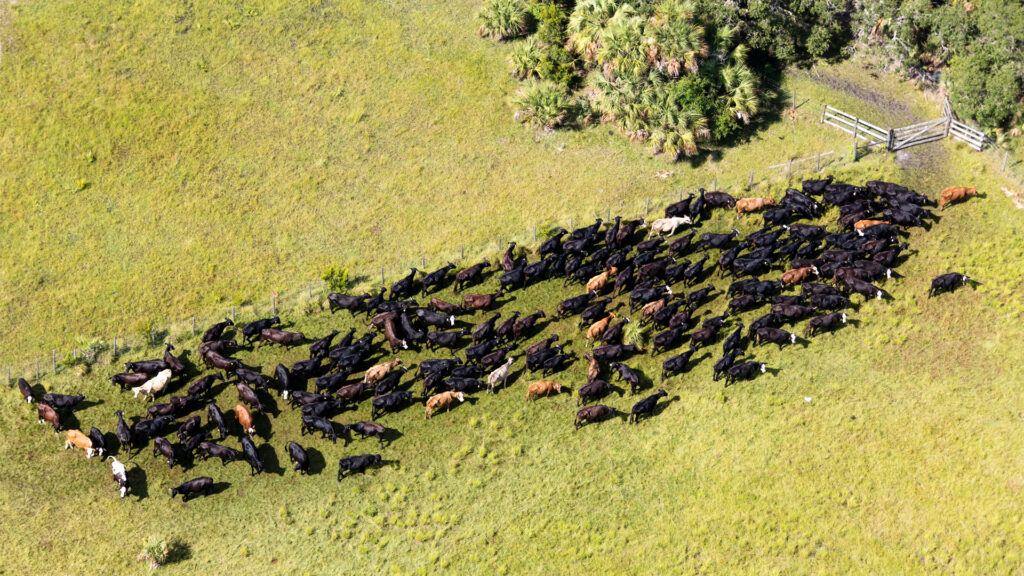
If this bill were made law, it would restrict Floridians’ access to state lands we paid for with our tax dollars, for livestock that would, in turn, trample and pollute the very ecosystems we paid to preserve. State parks are for sea cows, not beef cows.
Currently, five Florida state parks have cattle grazing lease agreements. In every case, these lands were already improved pasture being grazed by cattle at the time the state purchased them.
The Division of State Lands uses cattle grazing as an interim management tool while waiting for the Legislature to appropriate the funds necessary to restore the lands back to their native habitat, of which cows are not a part. While cattle grazing can be an effective tool for land management, it is not broadly applicable to all state conservation lands.
Cows don’t selectively graze; they will eat vulnerable native plants that are supposed to be protected on these lands. Thus, the system, as it is, now accounts for this: The leases are at the discretion of the agency and end when the land is ready to be restored.
HB 1421 and SB 1658 would eliminate this discretion and replace good land management with a large-scale takeover of our state parks. If these bills become law, the Division of State Lands must consider cattle grazing as part of each land management plan and must allow all “appropriate” “grazable” lands to be leased to “private entities for cattle grazing.” The state no longer has a choice whether or not to open up our public lands for cattle grazing; it absolutely must be considered.
Notably, the bill makes no requirements for keeping cattle away from sensitive habitats like Florida’s springs, preserving existing public access or protecting vulnerable native species. Environmentally speaking, cows are massive polluters. Cows are responsible for many millions of pounds of nitrogen every year, polluting Florida’s springs, rivers and estuaries. Excess nitrogen contributes to increased algae growth, destroying aquatic habitat, killing aquatic species, and spoiling waters for fishing, paddling and swimming.
Cows also produce approximately 220 pounds of methane each annually, contributing to climate change and rising sea levels, impacting Florida coastal communities.
When conservation lands can’t be left untouched but must become the home of a source of pollution, as this legislation proposes, the ecosystem services that these lands provide deteriorate. As ecosystem services deteriorate, so do our communities that rely on them. If our aquifer becomes massively polluted by cows, the clean water our rural communities and springs rely upon would be put at risk.
To fulfill the intentions of the Florida statutes on conservation lands, we must conserve them and not turn them into farmland. The very statute that this bill intends to amend, F.S. 253.034, was created to prevent such a use of our state conservation lands.
The opening line reads that all state lands “shall be managed to serve the public interest by protecting and conserving land, air, water, and the state’s natural resources, which contribute to the public health, welfare, and economy of the state.” This bill violates the “public interest” and conservation values these lands have by encouraging the introduction of a non-native, highly polluting species whose activity would have to be kept separate from humans.
Untold acres would need to be set aside to let cows graze, detracting from what land is left wild and for the public. Even if you’re not inclined to care about environmental aspects, you should at least be concerned about the decreased human access to these lands for recreational purposes.
Consider, Floridians, why should private industry be allowed prioritized access to lands that are supposed to remain protected and accessible for us all? No matter your personal feelings about cows, it is inarguable that they would pollute our waters and cut off access to these lands. Tell your senator and representative to vote no on “Cattle Grazing on Public Land.”
Harper West is a junior at Florida State University studying history and environment & society. This is her second year as a legislative intern with the Florida Springs Council. Banner photo: Beef cattle on a ranch (iStock image).
Sign up for The Invading Sea newsletter by visiting here. To support The Invading Sea, click here to make a donation. If you are interested in submitting an opinion piece to The Invading Sea, email Editor Nathan Crabbe.
