


By Arielle Perry, FAU’s School for Environmental, Coastal, and Ocean Sustainability
Beachgoers might know sargassum as the seaweed that sometimes piles up on Florida’s shores, but a Florida Atlantic University researcher said sargassum is also a “little bio-observatory” for understanding ocean conditions.
“We can learn a lot about the ocean by studying macroalgae,” said FAU Research Professor Brian Lapointe at a recent lecture at FAU’s Harbor Branch Oceanographic Institute.
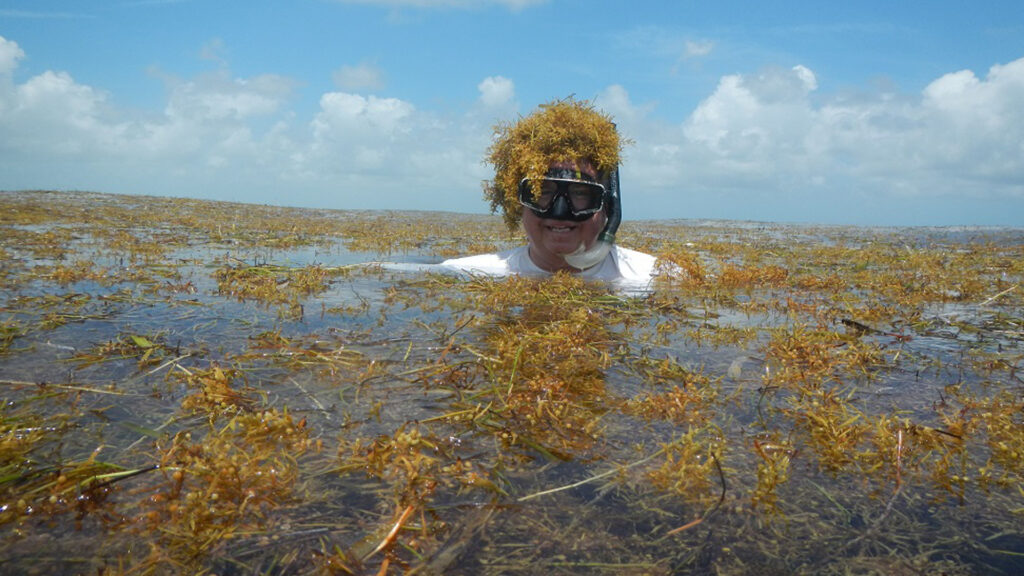
Sargassum is a type of macroalgae, commonly known as seaweed, that lives on the bottom of the ocean floor or floating in the ocean. Sargassum has accumulated in large, floating mats across the Atlantic Ocean in recent years, causing problems when it washes up on beaches in large amounts.
Lapointe’s talk, which was livestreamed and given as part of the John and Barbara Ferrera Ocean Science Lecture Series, provided an introduction to sargassum’s negative impacts on human health, coastal economies and ecosystems, as well as its potential as an opportunity for small businesses.
Lapointe said there are two species of sargassum that float in the North Atlantic Ocean: Sargassum fluitans and Sargassum natans, both of which can be found in the Sargasso Sea region of the ocean and the Great Atlantic Sargassum Belt.
While sargassum has been observed to float naturally in the Sargasso Sea for hundreds of years, providing a food source, habitat and shelter for marine life, it never formed large masses south of this area — that is, until 2011.
“By 2011, we saw the formation for the first time ever, of the Great Atlantic Sargassum Belt, south of the Sargasso Sea … the biggest seaweed bloom on the planet,” Lapointe said.
The Great Atlantic Sargassum Belt is a large stretch of floating sargassum mats spanning from Brazil to West Africa. Ocean currents carry the sargassum from this bloom west toward the Caribbean and into the Gulf, where it can end up on Florida beaches.
The Great Atlantic Sargassum Belt is being fueled by nutrient runoff and warming ocean temperatures, as well as more intense droughts and floods.
Lapointe said that this past year broke a new record on the amount of sargassum floating in the Great Atlantic Sargassum Belt: 37.5 million tons of seaweed.
All the extra sargassum poses risks for Florida’s economy, especially when it decomposes on our shores. As sargassum decomposes, it releases toxic gases, which can negatively harm human health and affect local economies, including tourism. A recent study estimates that sargassum has a $3.5 billion impact annually on Florida’s economy alone.
“I think we really need to think hard about how we can better protect our beaches,” Lapointe said.
He highlighted examples of companies who have been harvesting sargassum from the ocean to convert it into other goods and services.
From homes being built out of sargassum, to plastic replacement products, and fertilizers and soil amendments, there is great potential for a wide range of sargassum-based products and services.
“So, this is really great to be able to transform sargassum, which is such a problem,” Lapointe said.
Arielle Perry is a master’s student in the Environmental Science Program at Florida Atlantic University and is a graduate research assistant at FAU’s School for Environmental, Coastal, and Ocean Sustainability and the Florida Office of Ocean Economy. The school hosts The Invading Sea. Banner photo: A Florida beach covered in sargassum (iStock image).
Sign up for The Invading Sea newsletter by visiting here. To support The Invading Sea, click here to make a donation. If you are interested in submitting an opinion piece to The Invading Sea, email Editor Nathan Crabbe.
