


By David Vaina
Last summer, after five years working with and leading environmental advocacy groups here in north central Florida, I was feeling a sense of futility and burnout. The losses on issues we fought for kept piling up – and there were very few wins to take the sting out of defeat. Of course, I realize this is hardly a unique sentiment in the environmental movement.
But my desire to do something to address the climate crisis in Florida and beyond never dissipated. So, I began looking for spaces outside political advocacy, ones that could provide an alternative framework for understanding our collective responsibility toward climate justice and a strategy for a renewed engagement in the struggle for climate justice.
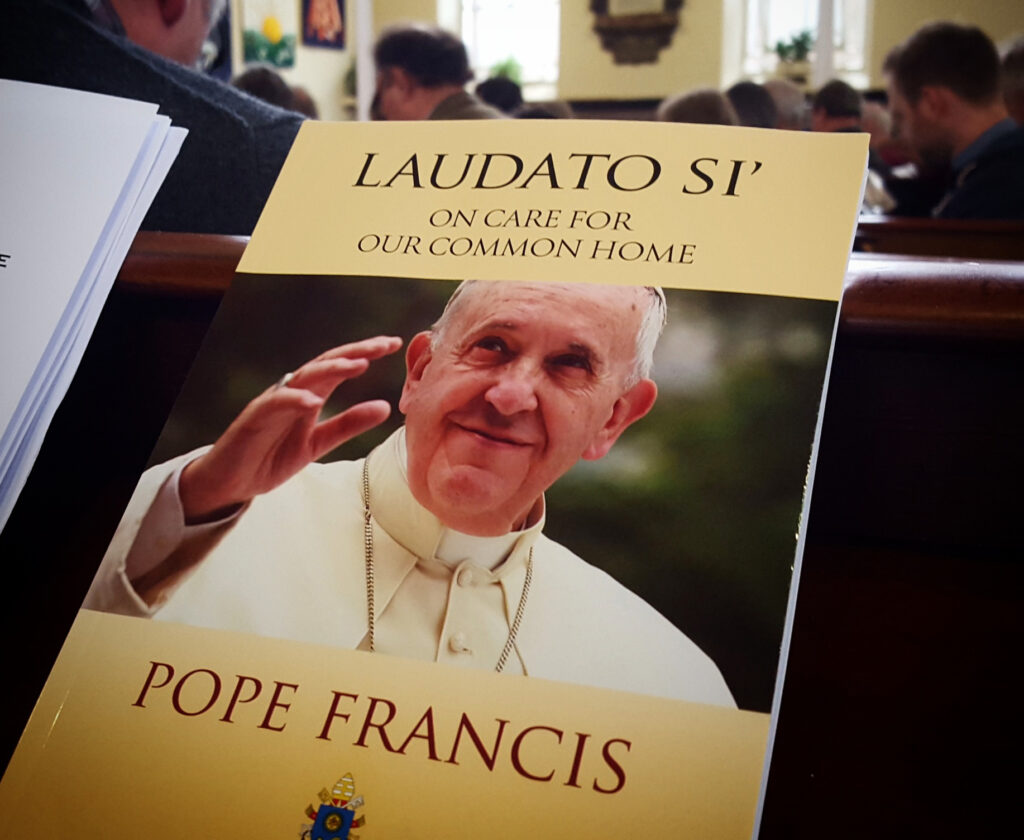
As my commitment to a life of faith has deepened in recent years, I’ve grown more curious about the ways faith and climate change connect. And so I’ve read “Laudato Si’,” an encyclical by Pope Francis on caring for the planet, and “Al-Mizan: A Covenant for the Earth,” which presents an Islamic outlook on the environment.
In “Following Jesus in Warming World,” The Rev. Kyle Meyaard-Schaap explains that the ground from which Adam is formed comes from the Hebrew word for soil: adamah. Human beings are Adam from the adamah — quite literally, “soil people” in Hebrew. From the very beginning, we are inseparably connected to all creation.
I’ve also turned to the Bible and discovered many passages underscoring our duty to safeguard and protect the Earth from harm: Genesis 1:26-28, Jeremiah 2:7 and Psalm 104, just to point out a few.
Looking to deepen my spiritual practice, I attended the National Faith + Climate Forum on April 25 at the United Church of Gainesville, an official Creation Justice Church that has been recognized for the congregation’s dedication to environmental stewardship. About 40 Protestants, Catholics, Jews, Bahais, humanists and others from Alachua County filled the room, and we joined 77 other in-person gatherings from around the country as well as thousands who participated through a live stream.
Both climate justice activists and proselytizers have a tendency to be rhetorical firebrands. While climate justice activists speak of irreversible collapse and entire populations being wiped out, the Bible has its Book of Revelations that depicts lakes of fire, violent hail and famine. As such, the skeptics in us might be tempted to retreat to less dramatic grounds.
One might also turn away from those who dismiss any actions in addressing the climate crisis as pointless or, conversely, those suggest there are quick fixes. Accordingly, I couldn’t help but roll my eyes when the keynote speaker at the Faith & Climate forum spoke online about a future utopia where the most radical climate change policies ran without a hitch and all thorny social justice issues had been resolved. How, I wondered, can we miraculously get from where we are now to this beautiful new world?
In all seriousness, I understood the speaker’s message was designed to inspire those attending the forum – especially those, like me, dealing with activist burnout. Yet, I realized the messaging was working.
Rooted in their faith, the conference attendees were a movement of action. But what they were doing eschewed grand, global projects. Instead, their work was practical and modest in scope – and deployed specifically to achieve incremental change.
Participants, for instance, spoke of their efforts to fund and operate cooling stations, composting initiatives and going vegetarian. These undertakings were done in the spirit of other local projects such as churches and synagogues installing solar panels and building carbon-sequestration gardens.
The message I heard was that habit-building through small, continuous improvements reinforces shared goals. This incremental approach prioritizes steady, manageable change over sweeping overhauls, making long-term progress more sustainable.
Alongside the rhetorical flair of the Bible’s apocalyptic imagery are passages speaking of small-scale ventures and measured change as the pathway to the transformation that the climate crisis demands. Perhaps my favorite is the parable of the mustard seed (Matthew 13:31-32) in which a tiny seed grows into a large, sheltering tree.
This is not to say there isn’t room for policies bolder in scope. The Florida Forever program, for example, has preserved 2.6 million acres of land across the state for conservation and low-impact, recreational purposes. But as we in Florida’s environmental community well know, we can’t exclusively rely on the state or corporations to solve every climate problem. Nor should we, and thus the need for everyday citizens to work en masse remains.
Faith groups have put community before campaigning and have identified, I believe, the pace of change that many of us feel is achievable at this exact moment. Of course, just one community in our secular society moving more gradually and more locally won’t be enough. But perhaps we can restore our hope for a world where both faith and advocacy groups – behind our common shared belief – are accomplishing things more minor in scale, but major in effect.
David Vaina holds a Ph.D. in political theory and has published articles on social movements, political theory and climate change as well as a 2024 book (“On Ramps to a New Civil Society: Mutual Aid at the Edge of the Anthropocene,” Rebel Hearts). He lives in rural north Florida. Banner photo: Solar panels in the shape of a cross on the roof of a church (iStock image).
Sign up for The Invading Sea newsletter by visiting here. To support The Invading Sea, click here to make a donation. If you are interested in submitting an opinion piece to The Invading Sea, email Editor Nathan Crabbe.

David Vaina may be interested in a global interfaith association we started this past January in preparation for the JUST TRANSITION FRoM FOSSIL FUEL Conference held March 28*29 in Colombia.
Check out website @FAITHSFORAFOSSILFREEFUTURE.ORG
We also have an Initiative in Florida
Joe A Iannone, Hollywood, FL
iannonejoe@yahoo.com