


By Jonae Powell, Florida Student News Watch
In April 2022, Terry Ryan went kayaking on Lake Munson, a popular boating spot. He was concerned by the sight of four large mats of algae that had spread across the lake’s surface. As the president of an environmental group in Tallahassee, he immediately contacted the Florida Department of Environmental Protection (DEP) to report the blooms.
“I see these huge green and yellow scummy-looking large mats, almost an acre in size,” Ryan said. “Lake Munson is where about 40% of the stormwater flows from Tallahassee, and it contains a lot of nutrients and toxic contaminants.”
A month later, Ryan returned to the lake to record a YouTube video about Lake Munson’s history. The next morning, he woke up covered in painful lesions across his body, a reaction to exposure to harmful algae.
Ryan’s experience highlights a growing environmental concern in Tallahassee that advocates hope to educate more people about: Harmful algal blooms pose a threat to the city’s water quality, public health and ecosystem well-being.
What are harmful algae blooms?
Algae are photosynthetic organisms found in marine and freshwater environments and are a natural and crucial part of the aquatic ecosystem. However, harmful algal blooms, or HABs, occur when algal colonies grow out of control in water bodies, producing toxins that impact people and marine life, according to the National Oceanic and Atmospheric Administration.
The Centers for Disease Control (CDC) warns that HABs can make people and animals sick if they drink contaminated water, eat affected shellfish or fish, or encounter polluted water. For humans, HABs can cause gastrointestinal distress, respiratory issues and dermatoxins, which are airborne toxins that can damage the skin and mucous membranes.
In 2022, the CDC documented 372 HAB events in the United States, which were associated with 95 human illnesses and more than 100,000 animal illnesses. Out of the 372 HAB events, 92% occurred in fresh water such as lakes, ponds and reservoirs.
The Florida Department of Health (DOH) explained that in Florida waterways, both freshwater blue-green algae and red tide can produce toxins harmful to people and animals.
These blooms often develop when excess nutrients, such as phosphorus and nitrogen, enter waterways. Fertilizer use, agricultural runoff and stormwater pollution can carry these nutrients into lakes and rivers, creating conditions where algae can spread quickly.
Harmful blooms in Tallahassee waters
While environmental advocates like Ryan raise awareness and report blooms, researchers in Tallahassee are studying various water pollution issues.
Ebrahim Ahmadisharaf, a civil and environmental engineering professor at Florida State University, and his team of students and researchers, focus on developing models that depict how pollutants such as microplastics are transported from terrestrial to aquatic systems.
“In my team, we do a lot of modeling, generating data and remote sensing, but if we want to make this impactful, we need to work alongside the public,” said Ahmadisharaf. “Communication specialists and sociologists can bridge this gap for the public.”
Ahmadisharaf explained that for some of his water quality research projects, they work with advisory groups from various community stakeholders to receive feedback, promote their research to the public, and explain the severity of water quality issues such as microplastics and HABS.
The DEP receives reports of algal blooms across Florida and conducts sampling to determine whether they’re harmful. Between 2022 and 2026, at least four HAB incidents were officially reported in Tallahassee waterways. These include confirmed blue-green algae at Lake Munson in 2022, Lake Petty Gulf in 2024, Lake Jackson in 2025 and a pond near Dorothy B. Oven Park in early 2026.
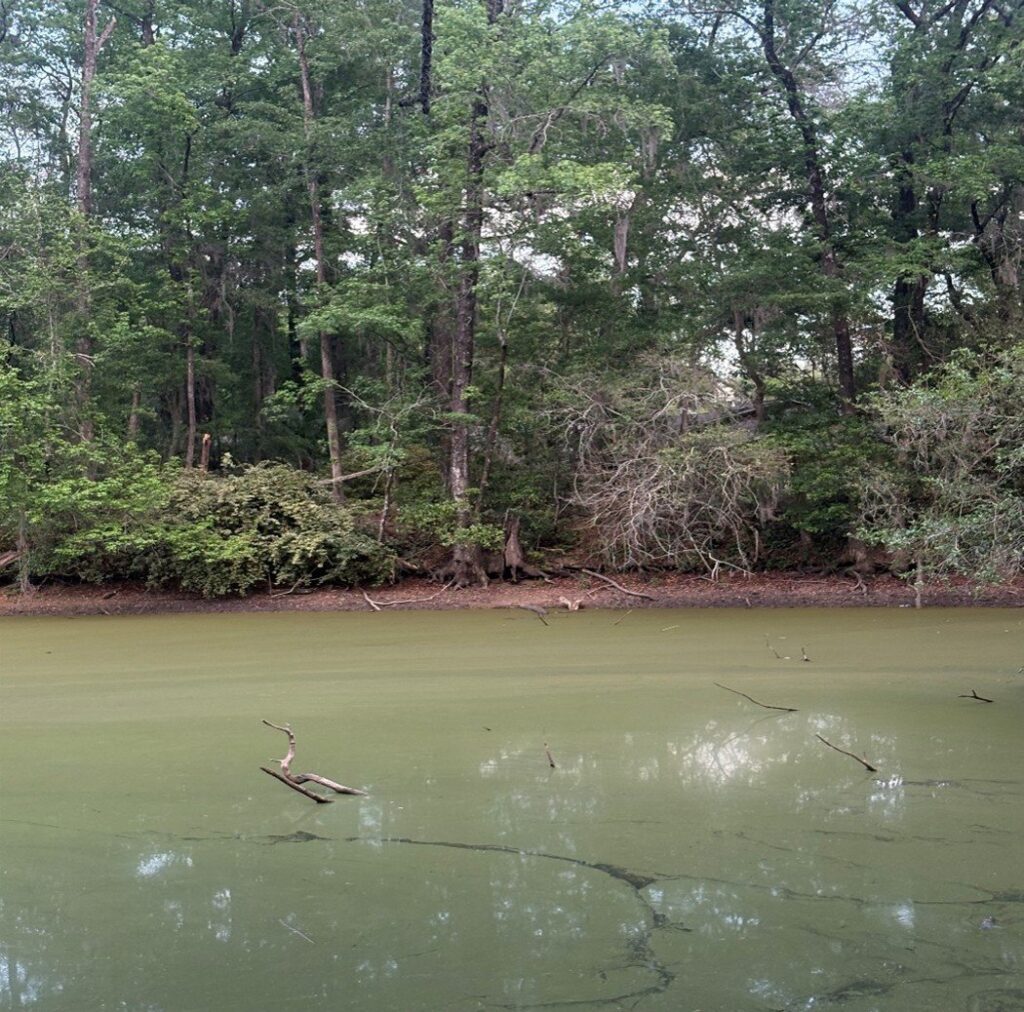
Lake Munson, a 288-acre shallow reservoir, has historically struggled with water quality problems because it receives large amounts of stormwater runoff from the Tallahassee wastewater facility, according to Leon County Water, which provides information on preserving the county’s waterways. The lake has experienced fish kills, algal blooms, and other ecological issues linked to nutrient pollution.
This issue isn’t contained to a single lake as water from Lake Munson flows into Munson Slough and then drains into Ames Sink, where it travels underground before reaching Wakulla Springs.
In the case of Ryan’s 2022 alert about Lake Munson, DEP confirmed that the algae were harmful, causing Leon County to close boat ramps and ban fishing. The DEP posted signs around the lake and boat ramps advising residents not to drink, swim, fish or boat in the lake.
In January 2026, DOH in Leon County issued a health alert following the confirmation that harmful blue-green algae toxins were present in a pond near Dorothy B. Oven Park, which is located close to residential neighborhoods in North Tallahassee.
Since some algal toxins can become airborne, nearby residents may be affected similarly to Ryan, even without entering the water. His experience with dermatoxins, he said, demonstrates the severity of any kind of contact with the blooms. He has since advocated that the city not only tests the water but also the air near affected waterways.
“The next day I woke up; I was covered in lesions all over my body,” Ryan said. “It was painful and itchy, like having poison ivy.”
Raising awareness in Tallahassee
The Tallahassee Regional Environmental Group, of which Ryan is president, is a non-profit that focuses on protecting the waterways in the North Florida area through education, research and citizen advocacy. The organization delivers presentations, seminars and training sessions to students and the public.
“There is a big education component here that we have got to emphasize,” said Ryan. “We need to emphasize this not only in schools, but in the residential areas and general citizenry of Tallahassee.”
The Tallahassee Regional Environmental Group also distributes a newsletter that informs residents on how to report HABs and other water concerns to the DEP. The newsletter documents ongoing water quality issues in Tallahassee, such as sewage spills, flooding and nutrient pollution –– information that is not widely accessible, Ryan said.
Ryan has also collaborated with students from Florida State University on water quality research projects, including studying wildlife and plant deaths in Lake Munson.
What’s next for Tallahassee residents?
Environmental advocates and researchers say the first steps to tackling the issue are reducing nutrient pollution, increasing ongoing monitoring, and providing accessible education and awareness.
“It starts from the youth,” Ahmadisharaf said. “We need to use innovative approaches to show what water pollution is, and educational activities and hands-on models. I think it is very important, and everyone is responsible — the government, researchers, the public, students and teachers.”
Residents who notice unusual algae growth in lakes or ponds are encouraged to report it through the DEP online reporting system immediately. The form can be found on the “Report Algae Bloom” link on the website. Additionally, reports can be made by calling 1-855-305-3903.
For advocates like Ryan, this issue is more than simply an environmental issue, but rather a personal health and community safety issue. He hopes that more residents, scientists and government agencies will take HABs seriously to work together to protect Tallahassee’s waterways.
This piece was originally published at https://www.studentnewswatch.org/stories/harmful-algae-blooms-threaten-tallahassee-waterways. It was originally edited by News Watch mentors Ashley White and CD Davidson-Hiers. Jonae Powell is a senior at Florida State University, majoring in English with a concentration in editing, writing and media, and minoring in psychology. Her interests include poetry, music and environmental conservation.
Banner photo: Blue-green algae in Lake Munson in April 2022 (Credit: Terry Ryan). To learn more about harmful algae blooms, watch the short video below from The Invading Sea.

Kudos to Mr.Ryan and others. Now the FDEP and other regulatory groups have to perform their Statutory obligations. Save the rhetoric and work group committee procrastinating
Do your job.
And also the way that our atmosphere is running to is one calls but our own pollution is the other cause algae bloom comes from the waste plant right up the road they spray the wastewater and drain it right there but I love that place The swans are beautiful blessings to all