


By Michelle Marie Arean, FIU News
There is a forever chemical lurking in the world’s oceans that could be fundamentally altering the biology of marine life before it even hatches.
PFOS, a notorious member of the PFAS family of chemicals, is known for its ability to bioaccumulate, binding specifically to proteins in the blood and livers. While it’s long been recognized as a pollutant, scientists are only beginning to understand how it changes an organism from the inside out.
A new study of yellowtail snapper embryos, conducted by recent Florida International University Ph.D. graduate and current Institute of Environment postdoctoral associate Ariel Lawson, in the Department of Chemistry and Biochemistry, has identified 18 key metabolites that signal a trio of shifts including liver and neural dysfunction, altered energy metabolism and associated oxidative stress.
“The goal was to be able to see if we could translate what we did in the zebrafish into other ecological receptors of different species,” Lawson says. “We use fish to try to understand the overview of how a chemical or toxic toxin would affect the species.”
From lab to environment
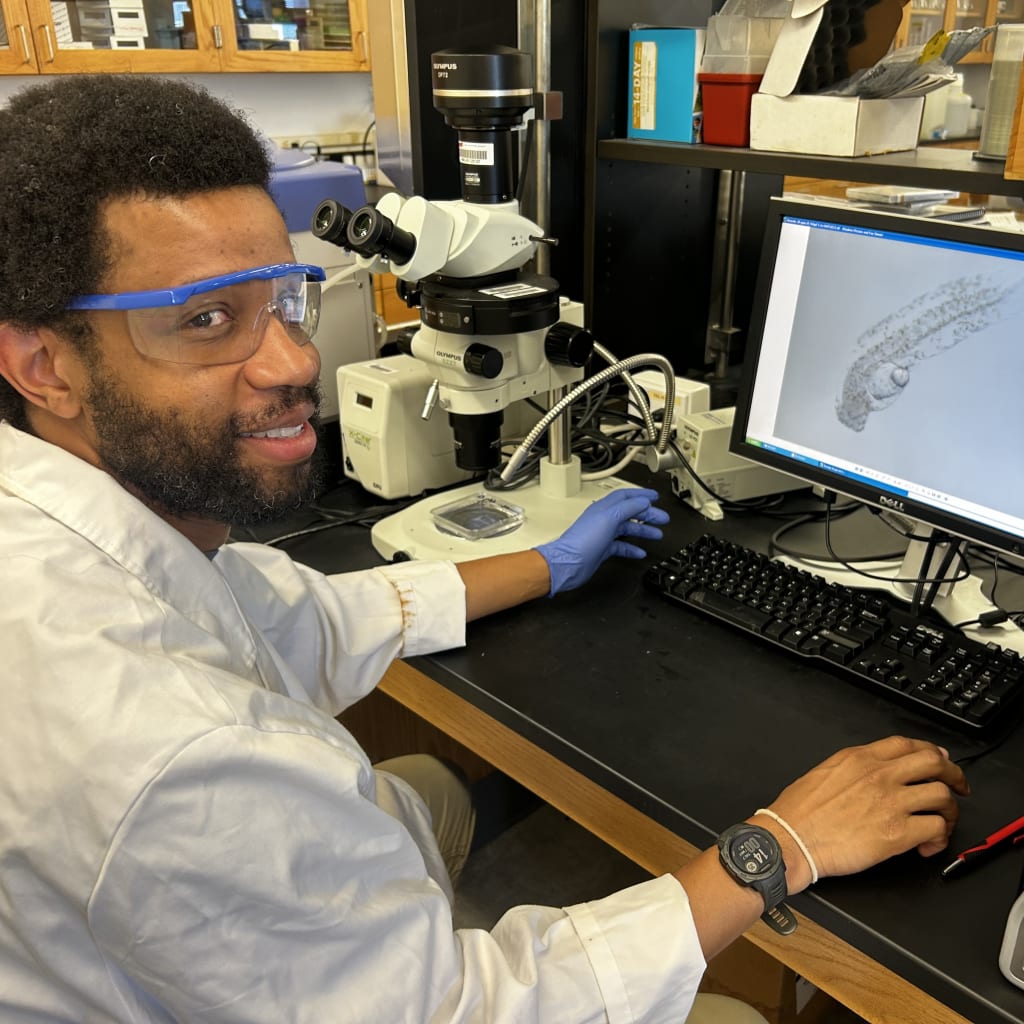
In the lab, the team exposed embryos to large concentrations of PFOS within 24 hours of spawning. While these lab concentrations are higher than those found in the open ocean, they allow researchers to account for the way PFOS builds up in fish tissues over time.
By maintaining the embryos for 48-72 hours, researchers observed metabolic changes that may serve as either a survival mechanism or warning sign of future harm. While it’s difficult to predict long-term effects without growing the embryos to adulthood, Lawson can already identify developmental issues at the larval stage by analyzing the fish’s morphology — its size, shape and structure — as well as its swimming speed.
The research suggests that PFOS infiltrates metabolic pathways, altering the activity of key enzymes involved in energy metabolism. These disruptions are evident in energy production and liver function. Interestingly, while the liver is highly sensitive due to the chemical’s affinity for fatty tissues, the study indicates a body-wide effect rather than damage to one specific organ.
“You can use these metabolites as biomarkers for disease situations,” Lawson says. “The epigenetic effect can affect the genes, which could translate to the later issues.”
These later issues may extend beyond a single generation. While Lawson’s work focuses on the immediate biological shifts, John Berry, associate professor of chemistry and biochemistry and researcher at FIU’s Institute of Environment and Biomedical Sciences Institute, said the environment plays a critical role in how those genetic blueprints unfold over time.
“Offspring inherit their genome from their parents, but the metabolic expression of the genome would depend on the stressors, such as pollutants like PFAS, to which they are exposed during their lifetime,” Berry says. “In clean water, these metabolic changes may not manifest.”
He also explains that over generations, it is possible offspring could adapt to effectively deal with stressors. In these cases, the metabolic machinery in their genes can be passed down between generations.
Expanding the scope
This work is part of a broader study by Lawson, and Berry’s lab, to translate findings to more environmentally relevant species. By studying a variety of species, the team hopes to identify exactly how these contaminants move through the marine ecosystem and affect a diverse range of species, as ecological receptors of these contaminants.
“You never know where these compounds could end up,” Lawson said. “The more species we can study, the more we could see how far into the environment these compounds go. So, environmental monitoring would be an important thing to take away from our research.”
While current data suggests these fish are likely still safe to eat, the biochemical and molecular damage reveals a hidden environmental toll — one that highlights the lasting impact of forever chemicals.
This piece was originally published at https://news.fiu.edu/2026/forever-chemical-reaches-fish-before-they-even-hatch. Banner photo: Yellowtail snapper (iStock image). To learn more about forever chemicals, watch the short video below from The Invading Sea.
