


By Diana Udel, University of Miami News
In a groundbreaking, first-of-its-kind milestone for coral restoration, scientists from the University of Miami Rosenstiel School of Marine, Atmospheric, and Earth Science, Tela Marine and The Florida Aquarium have outplanted elkhorn corals onto a Miami reef that were produced by breeding elkhorn parents from Florida with elkhorn parents from an unusually warm reef in Honduras.
These “Flonduran” elkhorn corals could hold the genetic keys to increase the diversity of Florida’s remaining elkhorn coral gene pool, while also potentially enhancing their heat tolerance and overall resilience.
“Elkhorn coral is a critically endangered species and one of the most important reef-building corals in the Caribbean,” said Andrew Baker, professor of marine biology and ecology at the Rosenstiel School and director of the Coral Reef Futures Lab. “Its large, branching structure creates vital habitat for marine life, helps reefs grow and acts as a natural barrier protecting coastlines from storms.”
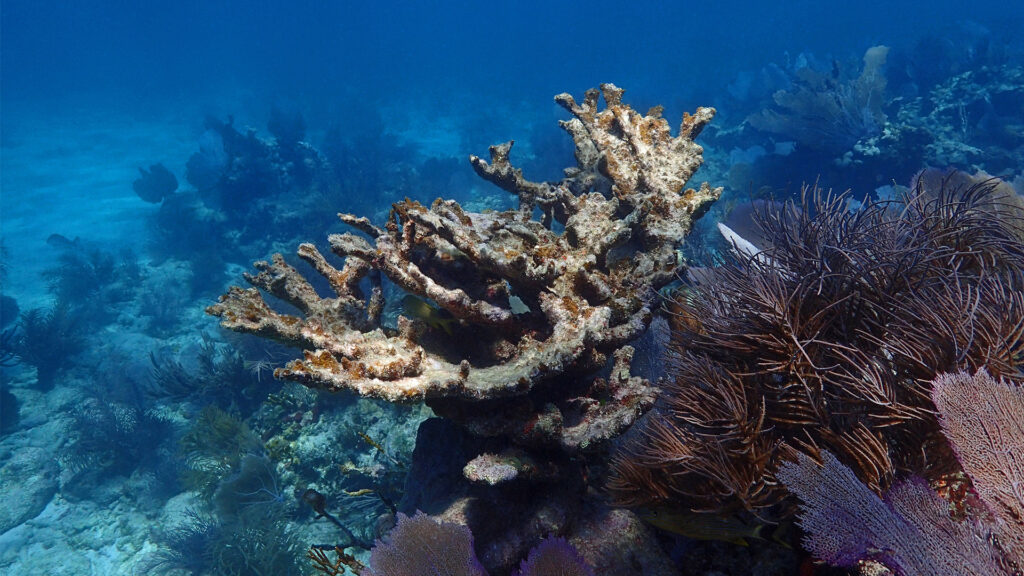
Elkhorn coral (Acropora palmata) populations have declined by more than 99% since the 1980s due to disease, warming oceans and other stressors — making it a key focus of coral restoration efforts.
In June 2024, a research team led by Baker collaborated with Tela Marine in Tela Bay, Honduras, to conduct genetic sampling and collect spawning-sized fragments of the unusually resilient corals of Tela Bay. Tela Bay’s reefs thrive despite warm water temperatures, low visibility and agricultural fertilizer runoff — conditions that typically devastate coral ecosystems elsewhere.
Baker’s lab collected hundreds of DNA samples from 10 coral species from Tela Bay to investigate genetic traits that can provide clues to their ability to withstand heat. They also transported 13 elkhorn coral fragments to Miami with the aim of crossbreeding them with Florida elkhorn colonies to boost thermal resilience.
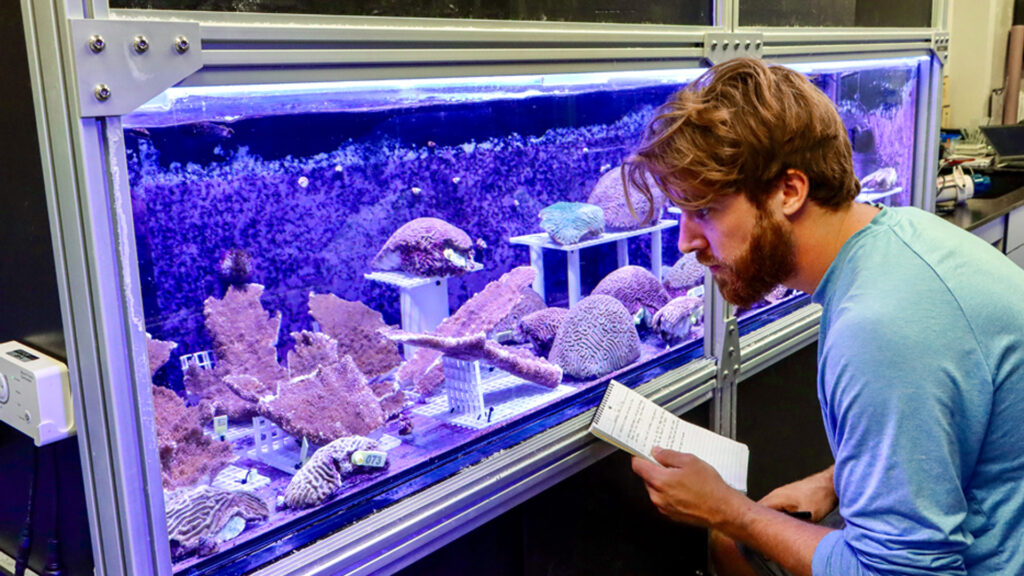
Shortly after their arrival, seven of the Honduran elkhorn coral colonies were transported to The Florida Aquarium’s Coral Conservation and Research Center in Apollo Beach, Florida — the first facility in the world to successfully induce elkhorn coral to spawn in a laboratory.
In July 2024, the colonies successfully spawned at the Rosenstiel School and The Florida Aquarium.
“At the aquarium, the corals from Honduras spawned on the same nights as Florida’s elkhorn corals, allowing us to create more than 200 Flonduran coral babies,” said Keri O’Neil, senior scientist and director of the Coral Conservation Program at The Florida Aquarium. “After nearly a year of careful care, the first 35 Flonduran babies and 35 Florida elkhorn coral babies have returned to the ocean off Miami to help rebuild and strengthen future reefs. We’re hopeful these babies will lead to stronger, more resilient coral populations across the Caribbean.”
“Corals don’t know international boundaries,” said Baker. “By working together across borders, we’re helping these critical reef-builders strengthen the entire Caribbean population. This outplanting is also an important pilot to see how these babies fare as water temperatures start to warm this summer, informing our next steps for coral restoration.”
Baker views this collaboration as a pivotal moment in global coral conservation, demonstrating the power of scientific and regulatory partnerships that can transcend borders to preserve biodiversity. By fusing genetic material from resilient coral populations in Honduras and Florida, researchers aim to restore not only the structural integrity of reefs but also their ecological functions across the Caribbean.
“The successful spawning and outplanting of Flonduran coral babies underscore the importance of combining innovation with international cooperation in combating the increasing threats faced by coral ecosystems,” Baker added.
“Tela Bay’s reefs have shown us that corals can survive and even thrive in challenging, warm-water environments,” said Antal Borcsok, CEO and co-founder of Tela Marine. “By sharing this resilience and collaborating across borders, we are giving elkhorn coral a better chance not just in Honduras, but across the Caribbean.”
This historic step is supported by the Florida Fish and Wildlife Conservation Commission (FWC), which recognizes that mixing these two coral populations mirrors natural processes in the wild and is critical to the species’ survival.
“Restoring Florida’s elkhorn coral will take a coordinated genetic-rescue effort — much like the successful Florida panther recovery — combining legacy Florida colonies with carefully selected, genetically compatible nonlocal colonies from the western Caribbean,” said Mike Tringali, FWC’s senior research scientist. “The benefits outweigh the genetic risks.”
The NOAA Coral Reef Conservation Program provided funding for the research conducted at the Rosenstiel School and The Florida Aquarium.
“NOAA was proud to support this work and partner with the University of Miami to advance technologies that strengthen Florida’s coral reef resilience,” said Jennifer Koss, director of NOAA’s Coral Reef Conservation Program. “This effort stems from a National Academies study we commissioned on coral interventions, and we’re excited to see how quickly these innovations are being put into action.”
The remaining parent colonies at The Florida Aquarium and the Rosenstiel School continue to thrive, ensuring the ability to produce more Flonduran babies in future spawning seasons — helping to rebuild and strengthen coral reefs across the Caribbean for years to come.
This piece was originally published at https://news.miami.edu/rosenstiel/stories/2025/07/international-collaboration-provides-hope-for-the-future-of-florida-and-caribbean-coral-reefs.html. Banner photo: Rosenstiel School scientists from the Coral Reef Futures Lab outplant the first “Flonduran” elkhorn corals. (Photo: Danny Varela).
Sign up for The Invading Sea newsletter by visiting here. To support The Invading Sea, click here to make a donation. If you are interested in submitting an opinion piece to The Invading Sea, email Editor Nathan Crabbe at ncrabbe@fau.edu. To learn how coral bleaching affects reefs, watch the video below.
