


By Gisele Galoustian, FAU News Desk
Andia Chaves-Fonnegra, Ph.D., an associate professor of biology at Florida Atlantic University’s Harbor Branch Oceanographic Institute and Harriet L. Wilkes Honors College, has been awarded a five-year, $720,446 grant from the U.S. Environmental Protection Agency to support a pioneering project aimed at restoring sponge populations in Florida Bay through a genetics-based approach.
Florida Bay is a shallow body of water between the southern tip of mainland Florida and the Florida Keys. It is part of Everglades National Park, which supports important marine life like sponges, fish and spiny lobster.
The project marks the first genetic assessment of sponge restoration efforts in the region and seeks to build long-term ecological resilience in one of the nation’s most vulnerable marine environments.
Sponges are a vital component of benthic, hard-bottom communities throughout Florida Bay and the Florida reef tract. These organisms perform essential ecological functions – filtering vast volumes of water, cycling nutrients such as nitrogen, stabilizing seafloor sediments and providing habitat for a variety of marine species.
Among the most economically important is the spiny lobster, which depends on sponge-rich environments as nursery grounds. Although we may not think of sponges as important or charismatic animals, they support a multi-million-dollar lobster fishery in South Florida.
In addition, two of the sponge species in the study are commercial bath sponges, which, on their own, also supported the highly successful sponge fishery industry before the introduction of plastic sponges and the collapse of their populations. The degradation of sponge communities has had cascading impacts on both the sponge and lobster fisheries, as well as on the broader ecosystem services that sponges provide.
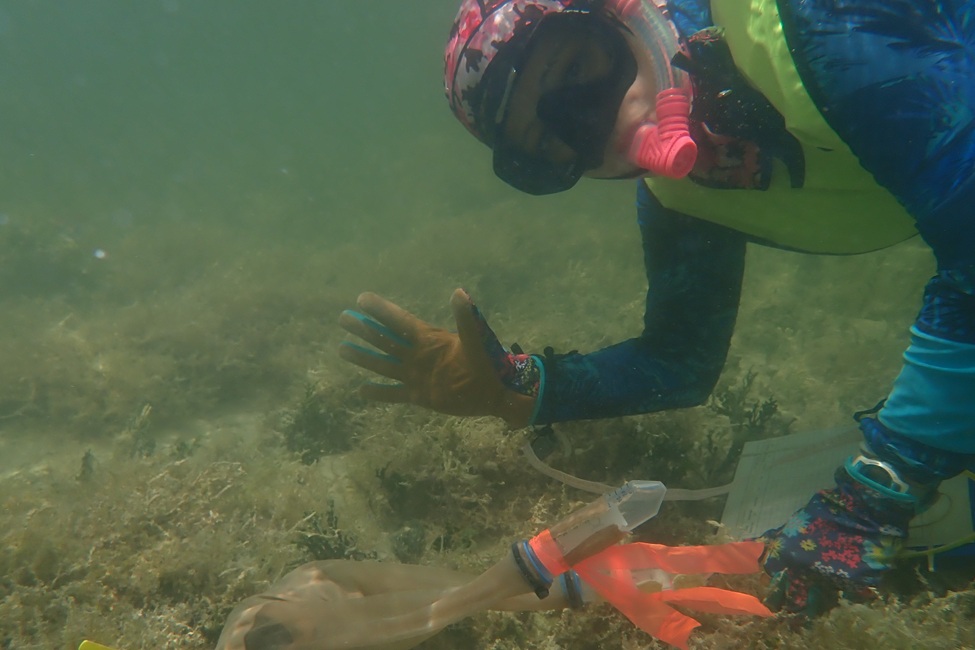
Over the past decade, significant progress has been made in restoring sponge populations through transplantation programs that use asexual cuttings. These efforts, spearheaded by a coalition of scientists, state agencies and community partners, have helped to reestablish sponge cover in areas heavily impacted by disease, phytoplankton blooms and cold-water events. However, because these transplants are clonal, they lack genetic diversity, limiting the resilience of restored populations to environmental stressors and reducing their capacity to adapt to shifts in weather patterns.
Chaves-Fonnegra’s research will address this critical limitation by integrating population genetics into restoration strategies. Her team will analyze the genetic structure and diversity of four key sponge species currently used in Florida Fish and Wildlife Conservation Commission (FWC) restoration programs: Spongia barbara – a type of bath sponge known for its soft textures, Spongia graminea – referred to as the grass sponge, Ircinia campana – known as the vase sponge because of its shape, and Spheciospongia vesparium – commonly called the loggerhead sponge.
Using advanced tools such as microsatellites and single nucleotide polymorphisms, the researchers will evaluate genetic diversity, inbreeding levels, clonality and reproductive success in both nursery and outplant sites. This innovative project will also examine the degree to which restored sponges are reproducing sexually with wild populations and whether their offspring are genetically diverse enough to withstand the pressures of a warming ocean.
By monitoring larval recruits raised in a land-based nursery at FAU Harbor Branch and transplanting them into restoration sites, the team aims to enhance the genetic variation of sponge communities. Coupled with GIS mapping, these findings will help guide where and how transplants are placed to maximize ecological benefits.
“Receiving this EPA grant is incredibly significant because it means that we can move from simply rebuilding sponge numbers to restoring sponge populations with the genetic strength to withstand a shifting climate, disease and other growing threats,” said Chaves-Fonnegra, principal investigator. “For the region, that means more stable fisheries, healthier reef ecosystems, clearer waters,and a safeguard for communities and businesses that depend on a thriving Florida Bay. It’s not just science – it’s an investment in resilience, for our ecosystems and for our people.”
Florida’s coral reef ecosystems, which include reefs, hard-bottom habitats and sponge communities, support more than $1 billion annually in tourism and recreational activities. Reef-related fishing generates more than $150 million in sales each year, and tens of thousands of jobs across the state depend on the health of these marine systems. As Florida’s coastal ecosystems face increasing threats, restoration efforts must evolve to ensure they are both effective and adaptive.
By directly informing FWC’s ongoing restoration practices, this project will have immediate practical applications. It also supports Goal 5 of the EPA’s Strategic Plan, which aims to protect and restore ecosystems and communities from environmental degradation. Through this work, FAU is helping to shape the future of marine conservation in Florida, integrating science, policy and innovation to protect one of the state’s most ecologically and economically valuable natural resources.
This piece was originally published at https://www.theinvadingsea.com/2025/09/17/sargassum-sea-turtle-hatchlings-beaches-juno-beach-jupiter-boca-raton-florida-atlantic-university. Banner photo: Megan Russell, a Ph.D. student at FAU, holds a Spongia graminea, one of the bath sponges known as the “glove sponge” by fishermen (FAU).
Sign up for The Invading Sea newsletter by visiting here. To support The Invading Sea, click here to make a donation. If you are interested in submitting an opinion piece to The Invading Sea, email Editor Nathan Crabbe at ncrabbe@fau.edu.
