


By Rafe Pomerance, The Upper Limit Project
The United States’ decision to host the 2026 Group of 20 (G20) Summit of world leaders at Trump National Doral Miami resort offers an opportunity to confront the growing impacts of sea-level rise on coastal cities.
As the source of 78% of global greenhouse gas emissions, the G20 has the collective capacity to resolve the climate crisis through concerted action. Almost all G20 countries are impacted by sea-level rise due to their extensive coastlines and major coastal cities like Shanghai, London, Mumbai, Melbourne, Jakarta and Tokyo.
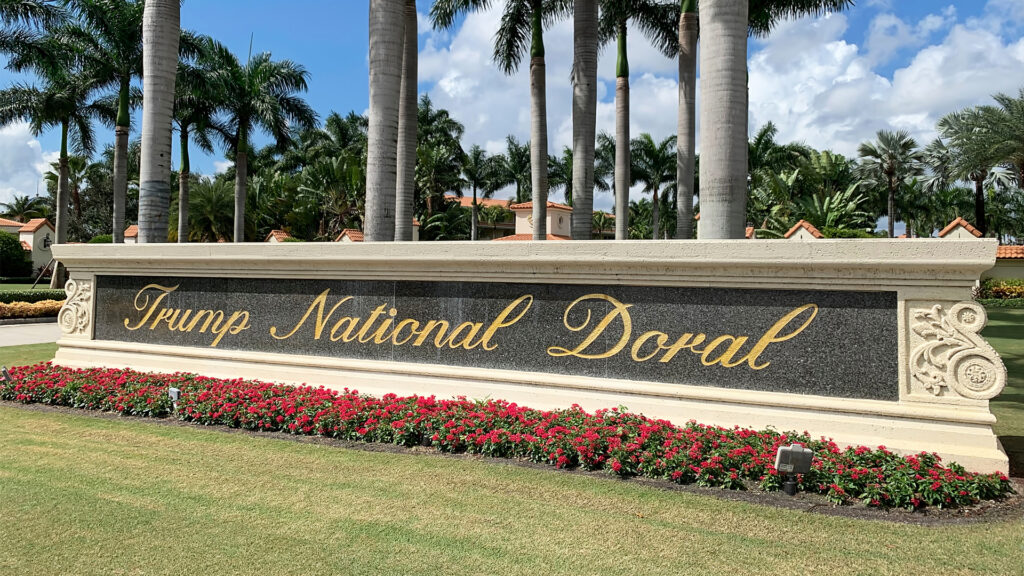
The U.S. will take over the G20 presidency from South Africa on Dec. 1 and will hold the role for one year. President Donald Trump said the agenda for the 2026 meeting will focus on “unleashing economic prosperity by the burdens of regulations, unlocking affordable energy and pioneering new technologies.” The decision to host the G20 Summit in Miami is striking given that elected federal and state leaders are some of the most outspoken climate deniers in U.S. history.
Known for towering ocean-view condos, office buildings and beachfront hotels, Miami’s financial risk of loss from the impacts of warming-driven sea-level rise is the highest in the world, according to CNBC. Coastal areas already experience sunny-day flooding and king tides that cripple tourism, damage beaches and community infrastructure, and increase saltwater intrusion.
“Nearly 6 million (Florida) homes, valued at $3.4 trillion, are likely to experience severe or extreme flooding over the next 30 years,” according to a recent Realtor.com analysis, as reported by The Palm Beach Post.
At the direction of the current administration, the U.S. has withdrawn again from the Paris Climate Agreement, and billions of dollars in grants for renewable energy projects funded by the Inflation Reduction Act have been canceled. Although pro-fossil fuel talking points dismissing climate change concerns are commonly used by federal and state leaders, many fact-checking reports debunk the claims. Floridians already feel the effects: Hurricanes are becoming more destructive, droughts are more severe, flooding is more frequent, heat waves are more intense and saltwater intrusion is diminishing water quality and supply.
My colleagues at ReThink Energy Florida and I are proposing an idea that is gaining traction: for government jurisdictions at the local, state, national and international levels to set an upper limit to reduce sea-level rise to the lowest possible rate of increase to avoid the worst impacts. Such a limit could help clarify how much sea-level rise is already unavoidable, while revealing trade-offs among investments in climate adaptation, mitigation and emergency response, as compared to the cost of inaction.
Miami’s average elevation is 6 feet, and University of Miami scientists estimate that 60% of Miami-Dade County may be submerged by 2060. Cities like Miami have struggled to account for the long-term risks of climate change with inadequate state and federal funding, and public policy and investment choices at the federal level too often disregard the dangers of increased sea-level rise. Setting an upper limit would help contain the threat that rising tides pose to real estate and property insurance markets.
The Upper Limit Project proposes sea-level rise as a second metric in addition to the 1.5 C global temperature limit set forth in the Paris Climate Agreement to help people understand the local impacts of climate change. If greenhouse gas emission rates continue to rise, the planet risks overstepping tipping points that would melt Antarctic and Greenland ice sheets, bringing catastrophic sea-level rise to Miami, coastal cities and nations. Encouraging G20 countries to consider an upper limit offers governments a clear benchmark to guide mitigation and adaptation strategies.
The longer governments wait to act, the fewer options we will have. Hosting the G20 in Miami, a city highly vulnerable to rising sea levels, highlights the need for world leaders to take global action that will affect coastlines everywhere.
Save Miami, save the world.
Rafe Pomerance has a long history in climate policy, dating back to the late 1970s. From 1993 to 1999, he served as the U.S. deputy assistant secretary of state for environment and development, representing the U.S. at both the Berlin and Kyoto Conferences of the Parties. In 2014, Pomerance founded Arctic 21, a network focused on communicating the unraveling of the Arctic, including the melting of sea ice, glaciers and permafrost. More recently, Pomerance is a founding member of The Upper Limit Project (sealevelrise-upperlimit.org) of ReThink Energy Florida. Banner photo: The Miami skyline (iStock image).
Sign up for The Invading Sea newsletter by visiting here. To support The Invading Sea, click here to make a donation. If you are interested in submitting an opinion piece to The Invading Sea, email Editor Nathan Crabbe at ncrabbe@fau.edu. To learn more about sea-level rise, watch the short video below.

As a native Floridian, I’ve seen the impacts of sea-level rise on the coast already. Any elected leader that is denying it is a problem is risking our future. We need action! We already have outrageous insurance rates and the risk of hurricanes wiping out our communities is real. We must move to a renewable energy system.