


The 77-year-old zips ahead of me in the swamp as mud slurps at my heels and, more than once, I have to fight my foot out of inches of its thick grasp.
Ilka “Candy” Feller’s voice trails over her shoulder, asking whether I can see the clearing where she’s waiting. My ego is deflated. I grew up in swampy northwest Florida, so I’m not used to being the one left behind.
We’re near Fort Pierce, trekking among mangroves. Feller is a retired mangrove ecologist, entomologist and illustrator for the Smithsonian Institution.
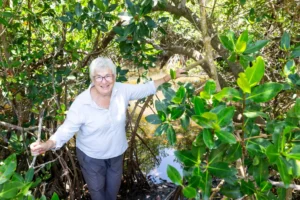
She’s devoted her life to close observation, and she’s brought me to this and another site to show me the layered details of three of the four mangrove species native to Florida: red, white and black. (We won’t spot the fourth, a buttonwood, today.) I want to write this profile of her, but she’s far more interested in talking about the trees than her own life.
“These mangroves are growing like gangbusters!” I hear her say upon catching up to her.
Feller presses her thumbs into leaves, and her sharp eyes scan for critters in the mangroves’ roots. She has the ability to slow time down by pulling my attention into the smallest of details and make them feel huge. She swipes her fingers along leaves, coming away with salt particles on her fingertips; she pulls branches toward her to examine patterns in the bark.
“She’s coming from that scientific-illustrator background,” Loraé Simpson says. “She thinks about mangroves in a way that most ecologists haven’t.”
Simpson is a supervising environmental scientist at the St. Johns River Water Management District. She first encountered Feller more than a decade ago as a Villanova University master’s student looking for a thesis project. Simpson ended up working for Feller for seven years as a field technician, and Feller later served as a doctoral adviser.
Feller has the “innate ability to bring people together,” Simpson says. “And then once you’re in that group, it’s such a warm, welcoming group when it comes to doing science together and talking through problems that we just stick together.
“How do you put words on someone like Candy? You know, she’s like, she’s a legend.”
Indeed, Scientific American called Feller the “Godmother of Mangrove Ecology” and “The Mangrove Queen” in a story documenting mangrove migrations northward, primarily because of climate change.
She scoffs at such veneration. “Too touchy-feely,” she says.
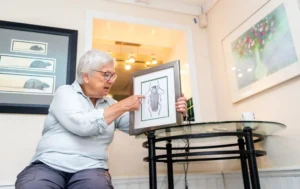
Feller has bachelor’s degrees in biology from the University of North Carolina (1969) and in botany from Ohio University (1971) as she continued to take science courses while her husband worked on a master’s degree. Pouring over drawings of plant and animal anatomical drawings in school – “in the ‘60s, we didn’t have a digital camera in every pocket” – she discovered an interest in scientific illustration. She took informal classes to learn how to develop her sketchbook and found the work as a Smithsonian illustrator. The job took her to mangroves in Belize and led her to studying how intricately they support their ecosystems’ layers of life.
About 20 years later, in 1993, she finished her doctorate in ecology at Georgetown University and joined the Smithsonian Environmental Research Center as a senior scientist. She felt surprised that the institute hired a woman in her 50s.
Feller returned to Belize and other Central and South American countries to teach, study and immerse herself in mangrove ecology.
“Probably every high school biology teacher in Belize went through this course,” Feller says of mangroves classes she taught. Fishermen, resource managers and developers were also students.
“And I have to say that the destruction of mangroves increased probably about 500-fold after. So it didn’t work the way I thought. It was just the opposite. People would have been better off being ignorant. They would have been afraid of the mangrove and then moved on.”
Mangroves’ importance
A Floridian might be able to rattle off a list of reasons why mangroves are appreciated. They mitigate storm surge. They stabilize coasts. They’re nurseries for fish populations. They can create new land where they root. They pull carbon out of the atmosphere.
But they’re also greatly threatened by human development, and their populations have decreased by almost half of their historic range worldwide. Helping them, though, is their adaptability, said Samantha Chapman, an ecology professor and the co-director of the Center for Biodiversity and Ecosystem Stewardship at Villanova University.
“To me, resilience in nature is what we really need and have, luckily,” with mangroves, Chapman said. “You know, they give you all the ecosystem-service reasons, right? That they feed people and they block our storms, and these are the things I write in papers every day. But I really think that it’s deeper than that.”
She pointed to the plants being able to live hundreds of years while sometimes growing no taller than a person’s waist. They live in nutrient-dense areas and in places where they have to forage for scraps. They can be massive forests in the Amazon. They grow in volcanic rock like in the Galápagos. And they can even create new islands.
Chapman is also a former student of Feller, and they’ve remained friends for more than two decades.
“(She) is the consummate creative mangrove scientist,” Chapman said in a speech when Feller was being presented with the Lifetime Achievement Award at the Mangrove Macrobenthos and Management conference in 2023 in Colombia, the largest gathering of scientists dedicated to mangrove research and conservation.
Feller’s original experiments with mangroves showed them absorbing nutrients from their environment, which was novel at the time. She also brought into the Western scientific community an appreciation for how intricately they grow and what abundant life they support. All the while, she has brought in millions to fund their study.
“Time loses all meaning when you’re in the mangroves with Candy,” Chapman said in the speech. “Her long field days are legendary among her mentees, and her ability to proceed without water or food — she’ll maybe eat a boiled egg or a piece of pickled okra while on the move — makes her seem superhuman.”
Chapman encourages her graduate students to spend time with Feller in the field. They learn patience, bravery and curiosity from her, she says. They learn how to consider the communities that rely, too, on the mangroves to survive.
“I think it’s just wonder,” Chapman says. “I think that’s her curiosity, and that she’s brave in the face of all these (threats to the mangroves).”
Feller’s impulse to teach
Feller promises to take me to the two sites near her home in Fort Pierce, but first, she requires that I sit through her hour-and-a-half orientation about mangrove habitats and zonation patterns.
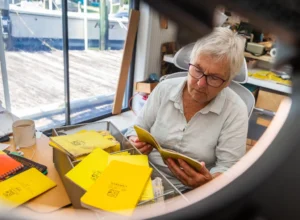
We sit in her work studio, which is tucked between her house and the residential canal behind it. The studio is cluttered by her endeavors, including hundreds of bright-yellow booklets in crates that are labeled with the year and trip name: “Wetfeet, May 2018,” for example
There are also glass jars, paddles hanging on the walls, a bed, a bureau with dozens of drawers, a desk, a computer, a table covered in organized piles of papers and a forgotten bottle of perfume in the corner. Large wooden spoons hang from the ceiling, and sticks are piled in a basket. (Feller is also a whittler.)
In short, it’s a room full of memories.
During the orientation, Feller impresses upon me that the term “mangroves” actually refers to about 80 different plant species found around the globe. Much of her research demonstrating the nuance between the plants proved this to the scientific community. The plants are in many ways similar, but their evolutions diverged because of differing environmental pressures and needs.
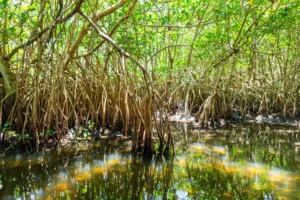
Florida’s mangroves grow in wet, salty areas along the coasts. They don’t need much oxygen. They drink saltwater and filter out the salt. They have roots that sprawl above the water or ones that poke up like fingers. And they are viviparous, meaning they grow live offspring that fall from the parent tree and propagate elsewhere, with pods sometimes floating hundreds of miles before finding a new spot to root.
Feller tells me all this matter-of-factly but also like it’s the most amazing thing. Halfway through her presentation, it’s hard not to feel the same enthusiasm for the plants’ reproductive development.
Later during our excursion, I trip over my feet and squish knee-first into the mud, dodging the webs of orb-weaver spiders. I scramble to right myself and catch up to Feller. She’s waiting before decaying mangrove trunks, which look like old tombstones in a graveyard. Soft, lacy tendrils of cyanobacteria hang from still-standing dead mangroves like the trellis of Miss Havisham’s wedding veil.
This was someone’s study site, Feller says. I sidle up to ask if she’ll check my back for spiders. She swipes at my shoulders while pointing out details of the clearing. “I would guess this is a mangrove heart attack,” she says of the die-off.
Hurricanes can kill mangroves, but the plants have evolved to survive most storms. The larger threats are more direct human activities, such as urban sprawl and altering the amount of time wetlands flood with fresh or saltwater.
Mangroves, though hardy and saltwater-tolerant, can drown when waters rise too high for too long, which may have happened here in a mosquito embankment. And rising tides are a more persistent threat because of sea-level rise.
While I study raccoon prints in the muck, Feller bends over to interact with the mangroves’ pneumatophores — roots that look like rigid snorkels breaking through the ground — and examine the sediment they’re growing in. She says she’s looking for a cyanobacteria layer.
I, meanwhile, think of myself as a tourist witnessing her forensic analysis.
The roots belong to the living black mangroves (Avicennia germinans) that surround this graveyard. Feller calls the mangroves by their genus, like they’re old acquaintances greeting one another by their first names. Red mangroves (Rhizophora mangle) are simply “Rizophora.” They’re the more recognizable postcard image of the trees, with roots that sprawl out like stilts crawling through the water — hence the nickname “walking trees” — and with leafy canopies overhead.
A few hours later, in the mid-afternoon, we’re standing on a trail bridge overlooking acres of red mangroves. Mullet, looking like flashing nickels, school in a watery avenue between the trees. Feller says that if she were a mullet, she’d survive by disappearing into red mangroves’ tangled roots.
“I had a bad interaction with a fisherman down in Belize once,” she says. It was the mid-1980s, and she was in her 30s. “I objected to him clearing mangroves. I turned him into the forestry department for doing it, because it was illegal, and it was in our study site that they’d given us. Anyway, he took exception to that.”
“How so?” I ask.
“He put a price on my head.”
“How much were you worth?”
She was priced at $2,000 Belize dollars, which are U.S. dollars, she says. “That ain’t much.”
Teach your students well
Feller has so many stories to tell students such as Max Portmann, who is staying in her studio while he researches the problem of woody plant encroachment into salt marshes.
Some of her stories involve spectacular mishaps, such as when she was boating alone in Belize and a wave washed her overboard. Separated from the boat, she treaded water until a local happened upon her. As he pulled her into his boat, he asked her what she’d learned, chastising her.
“In terms of my early research career, (working with Feller) has been one of the greatest opportunities I’ve gotten to have,” said Portmann, a 29-year-old marine biology Ph.D. student from Texas. “She’s so nice and just very easy to talk to and super approachable. You can get into a million different, really fun and interesting conversations with her.”
The night before, Portmann didn’t get home until nearly midnight from an all-day trip into the field. He found Feller waiting up, watching TV. He wasn’t sure whether she was waiting on him to come home.
“But as I came into the house … she asked me how everything went. And then she’s like, ‘I’ve got something to show you.’ And then she opens up a book she had … and was showing me this figure of, like, a forestry technique for illustrating canopy structure changes over a site. And so then, we talked for, like, 30 or 40 minutes about how we could do that.”
Chapman, the ecology professor, echoes such warm feelings about working with Feller, even getting choked up when describing her. “She is so curious and so generous with what she’s learned. And because of those qualities, I think she’s built this whole, really, the community of mangrove scientists. I think she’s one of the — probably the — most important mangrove scientist in the world.”
The little things
Feller unravels a leaf.
She is careful, gentle, as she stabilizes its folds with the tips of her fingers. Inside, small, furry gray critters scurry further into the folding. These are psyllid nymphs, small insects that, as adults, look similar to cicadas and that feed on the juice stored in the leaves’ cells.
The leaves curl dehydrated around the nymphs, who hunker beneath the folds like kittens in a sleeping bag.
“They have stylets (that) puncture individual cells and they suck out the … inside of the leaves,” Feller says. “Inside … there’s the baby psyllid, but there’s a world of things. It’s like prime real estate in the mangroves.
“You open it carefully, you might find a spider, a cricket, two or three different species of flies, all kinds of things that go in there and build a nest. Or stuff that just comes in to take diurnal refuge.”
One mangrove leaf Feller gave to a colleague ended up containing an interesting find. In it was Hymenopterans, or leaf miners, and the colleague called Feller to tell her those specific insects haven’t been described by taxonomists.
“I’m so excited!” Feller says. “I know nothing about them, other than what she told me.”
It feels that many of the answers of whom Feller is are right here, housed by the leaves and canopies and roots of the mangroves. I ask her if she thinks people can turn into something similar to what they spend their lives studying. Is she like her beloved mangroves? She brushes the question aside.
She never lost her sense of wonder. There’s still too much left to discover about the world.
CD Davidson-Hiers is a journalist based in northwest Florida who covers a range of topics including climate, conservation and the intersection of science and nature. This article first appeared on The Marjorie and is republished here under a Creative Commons Attribution-NoDerivatives 4.0 International License. This story was funded by the Schooner Foundation and readers like you. Banner photo: Feller inspects a cluster of propagules on a mangrove while at the Round Island South Conservation Area (Photo by Jason Matthew Walker).
Sign up for The Invading Sea newsletter by visiting here. To support The Invading Sea, click here to make a donation. If you are interested in submitting an opinion piece to The Invading Sea, email Editor Nathan Crabbe at ncrabbe@fau.edu.
