


By Brian Rodgers, OtherWords.org
North America’s boreal forests are crucial for wildlife and the climate, but we’re literally trashing them to make pulp for toilet paper and other disposable paper products. Companies are clear-cutting a million acres a year, according to a new report from the Natural Resources Defense Council (NRDC).
The northern boreal forests are Earth’s largest terrestrial biome. They’re the breeding grounds for 3-5 billion migrating birds that populate our backyards. And they’re a key carbon sink, storing 20% of global forest carbon and 50% of global soil carbon.
Studies show these forests have been overharvested and degraded to such a degree that the ecological damage will be difficult to reverse. They’re increasingly beset by global warming, melting permafrost, fires (including multi-year, spontaneously reigniting “zombie fires”), and pests, which threaten to destroy them and release their carbon back into the atmosphere.
The United Nations recently warned of an approaching tipping point that could turn them from carbon sinks to carbon sources. That would be catastrophic. The recent COP30 climate summit, held in Brazil’s Amazon rainforest, was billed as “the forest COP.” But its outcomes were dubious for tropical forests — and nonexistent for boreal forests.
But if climate delegates don’t protect them, consumers can — by buying 100% recycled or alternative fiber products instead of toilet paper made from virgin forest pulp.
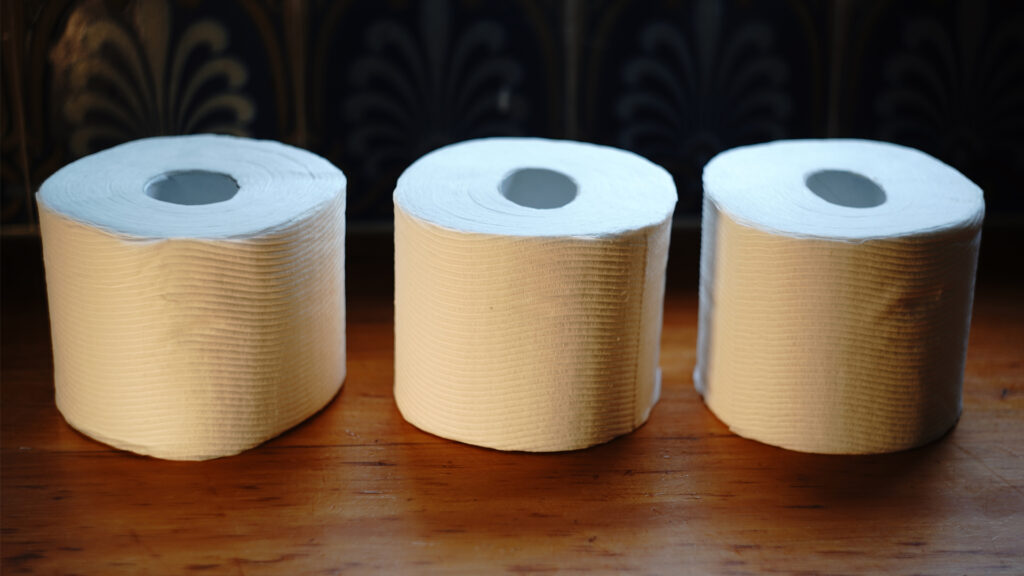
A market for these alternatives is emerging. The U.S. toilet paper industry is worth $42 billion, but a whopping 68% of U.S. consumers surveyed want eco-friendly toilet paper made from recycled pulp, bamboo or cornstalks.
If every American bought just one roll of toilet paper made from recycled paper rather than a conventional forest-fiber roll, it would save 1.6 million trees, 1 billion gallons of water and 800 million pounds of greenhouse gases — the equivalent of taking 72,000 cars off the road for a year, NRDC found.
Eco-friendly toilet paper start-ups have a $1 billion toehold on the overall market so far — little more than 2%. But they’re growing fast. Imagine how many trees, how much water, and how many emissions we’d save if they gained a 68% share.
The big paper companies are imagining it, too. Procter & Gamble (P&G) makes Charmin, the top U.S. toilet paper brand. This year it launched a bamboo version. That gives the company a green-sounding talk point, and a theoretical way into the growing alternative market. But it isn’t really available in stores and doesn’t do anything to change P&G’s bad practices.
It’s well documented that P&G makes regular Charmin by clear-cutting Canadian boreal forests for pulp, cutting down old-growth groves that have stood for a century or more. Only about 20% of these old-growth trees are left.
Any remnant wood left (called “slash”) after logging gets burned, and the land gets plowed and sprayed with glyphosate (RoundUp), eradicating formerly diverse ecosystems that caribou and birds depend on. They’re replaced with monoculture plantations of softwood trees planted in tight rows, worsening vulnerability to wildfires.
Yet P&G has the chutzpah to claim its slash-and-burn practices “absolutely prohibit deforestation” and “incorporate sustainability.” No wonder the company is being sued for greenwashing, with plaintiffs demanding it be held accountable for “egregious environmental destruction of the largest intact forest in the world” and making “false and misleading claims of environmental stewardship.”
Ultimately though, the power to change practices resides with consumers, not courts. Some 90 million Americans buy regular Charmin — and another 5 billion consumers worldwide buy P&G products. Collectively they have enormous power, provided they’re alerted to the problem and aren’t fooled by greenwashing tactics.
But if those conditions are met, consumers can save the boreal forests, one roll at a time.
Forest advocate Brian Rodgers is the producer of the documentary film “Charmin Wipes Out a Forest” This op-ed was distributed by OtherWords.org. Banner photo: Wood logged in a forest (iStock image).
Sign up for The Invading Sea newsletter by visiting here. To support The Invading Sea, click here to make a donation. If you are interested in submitting an opinion piece to The Invading Sea, email Editor Nathan Crabbe.
