


By Diana Udel, University of Miami News
Earth is taking in more energy than it releases back to space — a growing “energy imbalance” that is fueling global warming. A new study led by scientists at the University of Miami Rosenstiel School of Marine, Atmospheric, and Earth Science finds that recent changes in air pollution are not the main reason this imbalance has increased.
Aerosols — tiny airborne particles from sources such as pollution, wildfires and volcanoes — can affect how clouds form and how much sunlight Earth reflects back to space. While aerosols can influence climate regionally, the new research shows their recent global impact has been small.
Published Nov. 28 in the journal Science Advances, the study analyzed nearly two decades of satellite observations combined with modern atmospheric reanalysis data. The researchers found that aerosol changes have affected the climate in opposite ways in the two hemispheres.
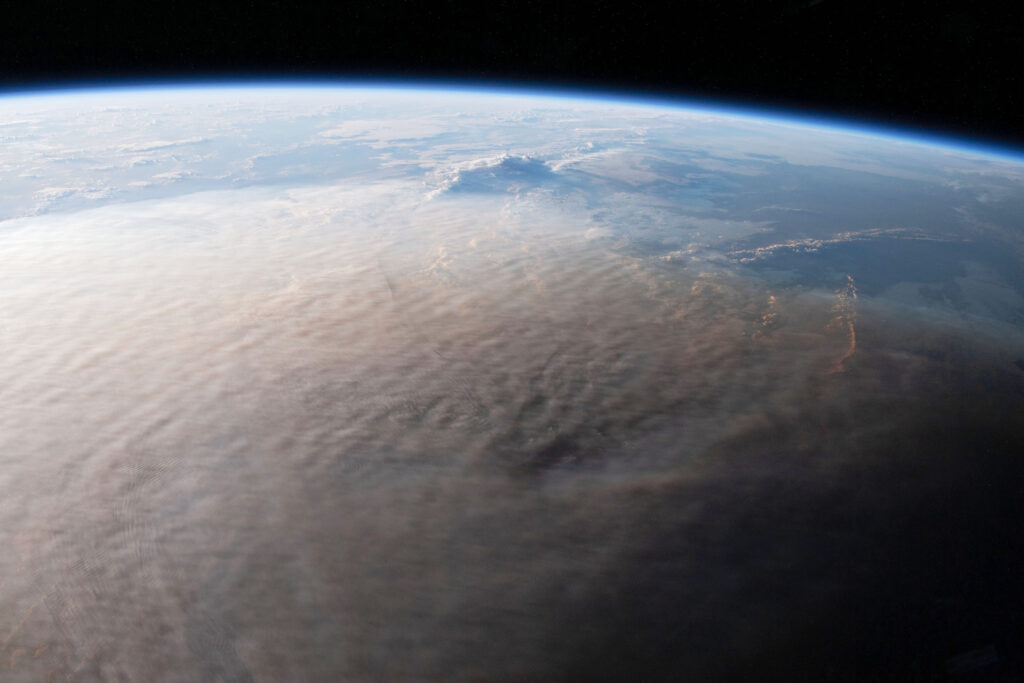
In the Northern Hemisphere, cleaner air in heavily industrialized regions has reduced the number of particles that help clouds reflect sunlight, allowing more solar energy to reach Earth’s surface. In contrast, the Southern Hemisphere has seen large increases in natural aerosols from events such as the 2019–2020 Australian wildfires and the 2022 Hunga Tonga–Hunga Ha’apai volcanic eruption.
These particles made clouds brighter and more reflective, sending more sunlight back to space. Together, the opposing effects largely cancel each other out, resulting in little net global influence from aerosols on Earth’s rising heat imbalance.
The study also shows that the recent increase in Earth’s energy imbalance is driven mainly by changes in reflected sunlight, rather than by changes in heat escaping to space. From 2003 to 2023, Earth gained heat at a rate of about half a watt more energy per square meter each decade, largely because the planet is absorbing more sunlight.
To track how aerosols are changing over time, the researchers used two independent indicators. One came from satellites that observe how aerosols in the air affect the passage of sunlight through the atmosphere. The other came from reanalysis data, which combine observations and models to estimate sulfate particles produced by pollution, volcanoes and wildfires. Despite their different approaches, both methods revealed the same pattern — declining aerosols in the Northern Hemisphere and increasing aerosols in the Southern Hemisphere — indicating that aerosols have had little overall effect on the global energy trend.
“Understanding this hemispheric ‘balancing act’ helps society focus on the true forces behind global warming — changes in cloud behavior linked to surface warming and natural climate variability — rather than mistakenly attributing recent warming to cleaner air,” said Chanyoung Park, lead author of the study and a doctoral student in the Department of Atmospheric Sciences at the Rosenstiel School. “Even though the Northern Hemisphere may experience some regional warming due to reduced aerosols, this does not translate to a significant global impact. This clarity supports better climate planning, more accurate public communication, and informed policy decisions.”
The findings also highlight a potential limitation in some climate modeling studies, which focus mainly on pollution reductions in the Northern Hemisphere and may underestimate the growing influence of natural aerosol events in the Southern Hemisphere.
“Earth’s energy imbalance tells us how fast heat is building up in the climate system,” said Brian Soden, a co-author of the study and a professor in the Department of Atmospheric Sciences at the Rosenstiel School. “Many earlier studies suggested that cleaner air might explain much of the recent increase, but our results show that aerosol changes largely cancel out between the Northern and Southern Hemispheres. That means we need to look more closely at changes in clouds and natural climate variability to understand why the planet is continuing to gain heat.”
The study, titled “Negligible Contribution from Aerosols to Recent Trends in Earth’s Energy Imbalance,” was published in Science Advances on Nov. 28 The authors include Chanyoung Park and Brian Soden of the University of Miami Rosenstiel School of Marine, Atmospheric, and Earth Science. Funding for the research was provided by the National Oceanic and Atmospheric Administration Climate Program Office’s Modeling, Analysis, Predictions, and Projections Program (Grant NA21OAR4310351) and the National Aeronautics and Space Administration (Grant 80NSSC23K0115).
This piece was originally published at https://news.miami.edu/rosenstiel/stories/2025/12/earths-growing-heat-imbalance-driven-more-by-clouds-than-air-pollution-study-finds.html. Banner photo: The sun’s first rays burst over the Earth’s horizon during an orbital sunrise, captured from the International Space Station above the Indian Ocean southwest of Australia (Photo: NASA).
Sign up for The Invading Sea newsletter by visiting here. To support The Invading Sea, click here to make a donation. If you are interested in submitting an opinion piece to The Invading Sea, email Editor Nathan Crabbe.
