


This story was originally published by The Revelator. Subscribe to their newsletter.
Migration: Many animal species do it — from tiny zooplankton to enormous whales — moving over every continent and through all oceans, from north to south, south to north, Europe to Asia, Asia to Africa. That movement by individual animals in response to season or life stage typically involves substantial numbers and vast distances.
Recent studies are giving scientists a better understanding of migrations at the species and population levels and reveal implications for conservation. This series focuses on a few particular species, what we’re learning about their migrations, and how that knowledge may help us protect them.
This second installment in the series looks at a group of reptiles who really get around: sea turtles.
Sea turtles live complex lives that have mostly gone unstudied and unobserved by human researchers. But new technology, including lightweight satellite transmitters as small as a thumb drive, is increasing the ability of scientists to tag and track the turtles at every stage of their development. The resulting data have upended several major assumptions and revealed details of the movements of these highly migratory marine reptiles — details that could support efforts to protect them.
“If you look at their life cycle, sea turtles occupy the entire oceanic realm,” says Pam Plotkin, a retired Texas A&M University Department of Oceanography professor. “They’re in bays and estuaries, on beaches, near shore, and out in the high seas. And threats exist in all those areas.”
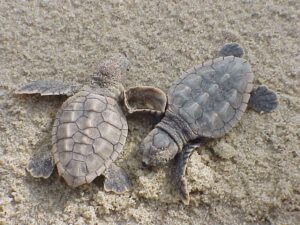
Sea turtles nest on beaches, and hatchlings move to nursery areas over waters deeper than about 650 feet (200 meters). Scientists long believed the young turtles passively drifted with ocean currents for four to six years, but didn’t know much about this oceanic stage, calling it the “lost years.”
They also assumed that after the animals returned to coastal waters as larger juveniles, they remained there through adulthood, with seasonal migrations to foraging areas and nesting beaches.
But those assumptions weren’t entirely accurate.
“The more tags we put out, the more we saw turtles doing things we weren’t expecting,” says Kate Mansfield, a professor at the University of Central Florida Marine Turtle Research Group, who started satellite-tracking animals more than 12 years ago during their post-hatchling period (after they leave their natal beaches for the open ocean). “It was our first inkling that there’s more nuance to it.”
The first unexpected discovery was that post-hatchlings are active swimmers, confirmed by research on oceanic-stage loggerheads (Caretta caretta) and green sea turtles (Chelonia mydas) in the North Atlantic and juveniles of different species tagged in the Gulf.
For example, juvenile loggerheads spend their summers in Chesapeake Bay before heading south to warm Gulf Stream waters in fall. But about a third to a quarter of those tracked went far offshore, some for a long time.
“We started questioning the model that once they check the box on the oceanic stage, they move into coastal habitat and remain the rest of their lives,” Mansfield says. “That has big implications for understanding where and when these animals are and the threats they may encounter.”
Those peripatetic loggerheads, for example, pass through coastal and longline fishery areas.
Olive ridleys
Research that Plotkin started in 1990 upended another truism, this one about olive ridley sea turtles (Lepidochelys olivacea), who practice mass nesting events called arribadas.
Plotkin expected to track throngs of them migrating between a Costa Rican arribada beach and a feeding ground somewhere in the eastern Pacific Ocean. That would have made it relatively easy to protect their route between the two.
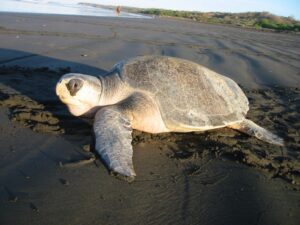
But the data showed olive ridleys swim hundreds to thousands of miles from their nesting beach, taking different and unpredictable routes among multiple areas that vary one year to the next. Not so easy to protect.
In addition, conservation efforts had focused on protecting known arribada beaches in Mexico and Costa Rica, but it turned out that many olive ridleys nest alone on beaches from Mexico to Ecuador.
“The idea had persisted that solitary nesters just missed the arribada, didn’t get the memo,” Plotkin says. “But there are hundreds of thousands of them, and they are widely distributed.”
Olive ridleys are classified as vulnerable on the International Union for Conservation of Nature and Natural Resources (IUCN) Red List of Threatened Species. The most recent status report on this species, to which Plotkin contributed, noted significant declines on many solitary nesting beaches, highlighting the need to protect those sites as well.
Green sea turtles
The IUCN Red List recently reclassified green turtles from Endangered to Least Concern, noting that the population has increased by 28% since the 1970s. This positive milestone reflects international, long-term conservation and protection of nesting beaches and marine habitats, guided by a lot of research.
Green sea turtles nest in significant numbers on the Florida and Texas Gulf coasts. As Mansfield’s research showed, after years in the open ocean after hatching, as small juveniles they move to nearshore seagrass beds, reefs and lagoons.
Ryan Welsh, a senior scientist at the Inwater Research Group, says larger juveniles then go to areas like the Florida Keys, where deeper waters near seagrass beds help them avoid predators as they mature into adults. In 2022 he and Mansfield found one of the world’s densest green sea turtle foraging aggregations near Key West, in an area called the Eastern Quicksands. An estimated 3,000 animals, ranging from 150 to 500 pounds, occupied 18 to 22 square miles (30 to 36 square km).
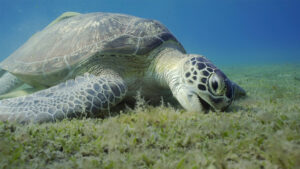
“This is unique in the density of animals, especially big animals,” says Welsh.
The Eastern Quicksands are under jurisdiction of the Florida Keys National Marine Sanctuary, providing some protection for the turtles and seagrasses. But Welsh recommends further protecting the area with Endangered Species Act critical habitat designation.
“Adults are especially vulnerable,” he says. “As they migrate to nesting beaches in Costa Rica, Mexico, and the eastern U.S., they’re exposed to a lot of risks and enter areas where they might not be protected. Giving them the best protection we can where they spend the majority of their time is critical and the least we can do.”
In July 2023 NOAA published a proposed rule to designate critical habitat for green sea turtles that included the Quicksands and other areas. But it remains just a proposal.
The Quicksands are the site of a lot of fishing activity for Caribbean spiny lobster and Florida stone crab, and those nets can entangle sea turtles. Welsh would like to see the sanctuary prohibit or limit fishing there. A series of meetings with multiple stakeholders proposed creating a Marquesas Keys Turtle Wildlife Management Area, he says, but the Florida governor vetoed it.
Other protections
It takes more than protected areas to help these highly mobile reptiles, though.
Incidental capture by fisheries is a common threat, including from bottom trawlers, which tow a net along the ocean floor to capture target species such as shrimp. A 2021 paper in Nature reported that trawlers scrape some 1.9 million square miles each year.
Turtle excluder devices, or TEDs, have reduced capture of sea turtles by bottom trawlers in the United States, according to Plotkin. A TED is a grid of bars in the neck of the net and an opening in the net’s top or bottom. Small shrimp pass through the bars and into the net while larger animals, such as sea turtles, are stopped by the bars and escape through the opening. A recent NOAA pilot project showed that narrower bar spacing reduced bycatch of juvenile sea turtles, which could slip through standard bars, without significantly decreasing shrimp catch.
Texas Sea Grant, where Plotkin previously served as director, was instrumental in developing these devices and gaining their acceptance among Gulf of Mexico shrimpers. But the U.S. currently requires TEDS only in shrimp and summer flounder trawl fisheries. Other countries don’t always require them or enforce their use.
“Catch remains a significant problem for sea turtles,” Plotkin says. “And trawlers operating near nesting grounds or foraging grounds can do a lot of damage.”
Pelagic or deep-sea longline fisheries, which set out baited hooks at various depths that often remain in place for hours, are another threat. Sea turtles can swallow hooks, be hooked in the flippers or head, or become entangled in longlines and drown.
Sea turtles are less likely to swallow circle hooks and can more easily escape this type of gear. Other techniques to reduce bycatch include changing baits, minimizing how long lines are in the water, and limiting mainline length. But these methods are not used everywhere, Plotkin says.
Other options are moving fisheries to areas less frequented by sea turtles and closing areas at certain times to accommodate their migrations.

Those measures require ongoing research to better identify those areas.
“Just a handful of tags opened our eyes to how complex the picture is,” Mansfield says. “We have holes to fill in. A lot of our work is in the North Atlantic and we need similar work elsewhere.”
More research also is needed on the role of temperature on migration and other behaviors. Sea turtles are ectotherms (what we used to call “cold-blooded”) and cannot regulate their body temperatures, which means water temperatures affect their bodies and behavior. In addition, sex is determined by the temperatures that eggs are exposed to in the nest, with higher temperatures producing females.
Changing temperatures therefore could shift sea turtle sex ratios as well as nesting and foraging habitats, according to scientists at the Université libre de Bruxelles in Belgium. They predict the disappearance of 50% of current known sea turtle hotspots by 2050.
The lengthy sea turtle life cycle is another reason for ongoing study.
“Even when we see upticks in nesting, as we have with greens, that needs to be maintained for a long time before it represents a solid recovery,” Mansfield says. “You can’t just take a good year here and there, it takes generations. Bottom line, we need to learn more about where these animals are going and what they are doing there.”
This piece was originally published at https://therevelator.org/sea-turtle-migration/. Banner photo: A green sea turtle swimming (iStock image).
Sign up for The Invading Sea newsletter by visiting here. To support The Invading Sea, click here to make a donation. If you are interested in submitting an opinion piece to The Invading Sea, email Editor Nathan Crabbe.
