


This story was originally published by The Revelator. Subscribe to their newsletter.
The Floridian I would one day marry went to college in Gainesville, where the University of Florida’s sports teams are known as the Gators. That nickname fits. This is Gator Country, as the song goes — home to countless American alligators (Alligator mississippiensis).
In Gainesville the reptiles cluster in places like Paynes Prairie Preserve State Park, but they don’t stay confined there. They make use of the sewer system and sometimes stroll through the city streets.
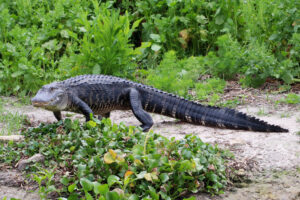
For my future wife, alligators were simply part of the landscape. For me, with roots in a different part of the world, they were foreign. I’d never seen an alligator up close until adulthood, when I began visiting her in Florida.
The experience was awe-inspiring — and not just because of the reptiles themselves. In Florida I witnessed approaches to large carnivore conservation that reached beyond wilderness and protected areas into shared human landscapes, sustaining populations that remained both demographically and genetically viable.
Alligators teetered on the brink of extinction in the 1950s but recovered thanks to conservation work that took a broad approach: a federal ban on hunting, protection under the Endangered Species Act, wetland preservation, and an innovative management model that combined science, legislation and local economies.
In Florida today there are about 1.3 million alligators, and altogether in the United States there are about 5 million — from smaller individuals in southern North Carolina to massive beasts in Florida, Louisiana and eastern Texas.
Millions of people now live close to these big predators, who can weigh around 600 pounds. Around the southeastern U.S. they attract tourists to swamps, so they’re important to the local economy.
One autumn, when my wife and I visited Louisiana, we found ourselves in lush wetlands where heavy Spanish moss hung from cypresses that cast shade over some of the region’s momentarily sleepy alligators. A herd of wild pigs also moved through the swamp.
That surprised us, but what shocked us was seeing wetlands near the bayou drained to make room for suburban housing, asphalt, and concrete. That was hard to understand since Hurricane Katrina had visited the region in 2005 and showed how indispensable wetlands were when the waters rose.
These landscapes are certainly scenic, but they’re also a vital protective infrastructure.
Alligators belong to that infrastructure. Their presence, I learned, shapes wetlands in ways that extend far beyond what meets the eye — including how much carbon these places can keep out of the atmosphere.
Wetlands are among Earth’s richest — and most endangered — ecosystems. Between 60 and 70% of the wetlands that existed in preindustrial times have been wiped out. The wetlands that remain, however, store large amounts of carbon in oxygen-poor soils. When these ecosystems are drained, carbon dioxide is released. Today drained wetlands account for up to 10% of the world’s land-use emissions.
The draining and building we witnessed in Louisiana’s swamps were thus driving human-caused climate change.
But the United States can play an important role regarding wetlands’ significance for climate mitigation: North America harbors 42% of the world’s tidal-influenced wetlands.
Researchers speak of “blue carbon,” the carbon stored in marine biomes and coastal ecosystems such as mangroves, salt marshes, and swamps. These environments are particularly effective carbon sinks because they combine rich vegetation with slow decomposition.
For a long time, science mainly focused on the roles of plants and microorganisms in the carbon cycle. But researchers at Southeastern Louisiana University and the Louisiana Universities Marine Consortium wanted to find out what role predators — in this case, alligators — might play. One of the researchers, Christopher Murray, who has worked with alligators for more than two decades, told me in an email, “I believe the value of a single animal can be quantified in terms of carbon stock.”
To test that idea, the researchers analyzed 649 soil samples from wetlands along the Atlantic and Gulf coasts, drawing from the Smithsonian’s Coastal Carbon Network. They compared carbon levels in surface soils with maps of alligator distribution and density, focusing on samples collected over recent decades.
The pattern was consistent. Across alligators’ native range, wetlands stored about 0.16 grams more carbon per square centimeter in surface soils when alligators were present. In mangrove forests, the difference rose to roughly 0.20 grams per square centimeter — a trivial amount in a handful of mud, but a substantial gain when multiplied across thousands of square miles of coastline.
Louisiana offered even clearer insight. There, researchers had precise data on nesting patterns and population density. They found that carbon storage increased every time alligator numbers increased. More gators meant more carbon locked into the soil.
How does this work? The answer lies in chain reactions in the ecosystem — the ecological domino effects that occur when top predators influence whole habitats.
Alligators feed, among other things, on herbivorous mammals such as nutria (Myocastor coypus), as well as crabs, fish, and sometimes various kinds of wild pigs. By keeping these populations in check, alligators protect vegetation that would otherwise be trampled or devoured. More plants mean more photosynthesis — and therefore more carbon bound in biomass and soil.
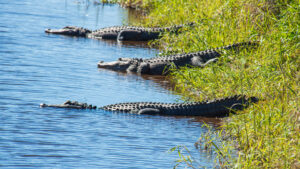
Alligators also function as ecosystem engineers. When they dig dens, move through the muck, or create small pools, sediments and nutrients are redistributed. These processes can create pockets where organic material is preserved for longer.
And the animals can live for 35 to 50 years (or even longer). Their impact accumulates slowly but persistently.
Alligators affect both what is eaten and what the landscape looks like. In short, these enormous reptiles are living regulators of carbon flows, and the predator’s presence enhances nature’s own climate solutions.
The relationship between alligators and carbon storage is strongest in mangrove forests — tropical wetlands where tree roots stretch like braids into the tidal zone.
Mangrove forests are already recognized as outstanding carbon sinks. They store up to 10 times more carbon per acre than an average forest. That alligators can amplify that effect shows how a predator’s presence can improve nature’s own climate solutions.
Researchers have previously found similar patterns in the ocean. Where sea otters (Enhydra lutris) live, kelp forests flourish. But in areas without these predators, kelp forests are decimated by sea urchins (class Echinoidea), and much of the carbon-sequestration capacity is lost.
When top predators return, ecosystems’ structure and function change — including how they store carbon. A British study estimates that reintroducing wolves (Canis lupus) to Scotland — where they could prey upon vegetation-eating deer and other animals and allow woodland to expand — could lead to an additional 1 million tons of CO2 stored per year. Each individual gray wolf is estimated, through its ecological impact, to contribute to the absorption of 6,080 tons of CO2 per year. Each wolf is therefore worth about £154,000 ($202,763), using accepted current valuations of carbon.
In boreal Canada scientists estimate that recovering wolf populations to historical levels could allow forests to store 46 to 99 million additional tons of CO₂ every year — equivalent to the annual emissions of up to 71 million cars.
This new understanding also reveals that predator-control policies have a hidden climate cost. In many regions — from Scandinavia to the U.S. West — large predators are deliberately kept at densities far below what ecosystems can naturally sustain. These decisions are typically justified through concerns about livestock, hunting interests, or culturally ingrained fear. But the climate consequences are rarely counted.
In Sweden undersized predator populations have led to oversized populations of ungulates who consume enormous quantities of young trees, slowing natural forest growth. Forest ecologists estimate that this overgrazing reduces Sweden’s carbon sink potential by about 12 million tons of CO₂ per year. Allowing predator populations to recover to ecologically functional levels could restore roughly half of that capacity — a natural climate gain of about 6 million tons of CO₂ annually.
There are not yet precise figures for alligators’ influence, but the research already suggests that each individual, through its lifelong presence, contributes to increased carbon storage in wetlands.
That biodiversity and climate wins often go hand in hand is an established reality. Protecting top predators is therefore not just about saving species but about preserving an entire ecosystem’s ability to help stabilize the climate.
Conservation should therefore not only be about counting species and their populations, but also about measuring how much CO2 their presence helps to sequester. Nature itself, with its ancient networks and its interplay of life and death and life, shows that everything is intertwined. When balance is found here, it is also found in the atmosphere.
In parts of the Southeast, they have managed to combine climate work with industry. Alligator-related commerce, which partly relies on limited hunting and farming, requires viable wild populations. That means that, on a practical level, the economy favors the conservation of both predators and wetlands.
Generally speaking Americans accept alligators because people feel it’s possible to live with them, control the risks, and even benefit from their presence.
For my wife it was natural to grow up with alligators almost on her doorstep. She knows the folklore and believes that Floridians take pride in them as a natural part of both regional identity and environment. In the primordial creature that is the alligator, culture and nature are united.
Alligators may not care much about this as they go about their lives in the swamps. But these ancient beasts nevertheless do great good, and benefit life on our shared living planet.
Emil Siekkinen is an environmental writer based in Sweden. This story was originally published at https://therevelator.org/alligators-climate-guardians/. Banner photo: An alligator in a pond (iStock image).
Sign up for The Invading Sea newsletter by visiting here. To support The Invading Sea, click here to make a donation. If you are interested in submitting an opinion piece to The Invading Sea, email Editor Nathan Crabbe.
