


By Gisele Galoustian, FAU News Desk
The concept of the “15-minute city” has gained global traction as a blueprint for more livable, sustainable communities by placing daily essentials – such as grocery stores, schools, restaurants and parks – within easy reach of residents. The idea envisions neighborhoods where people can meet most of their daily needs within a 15-minute walk, bike ride or transit trip from home, reducing automobile dependence while improving quality of life.
But research from Florida Atlantic University suggests the formula for truly local living may be simpler – and more specific – than many planners assume.
To better understand how the 15-minute city functions in practice, researchers examined how urban design and socioeconomic conditions influence “internal trip capture,” or the share of trips that begin and end within the same neighborhood.
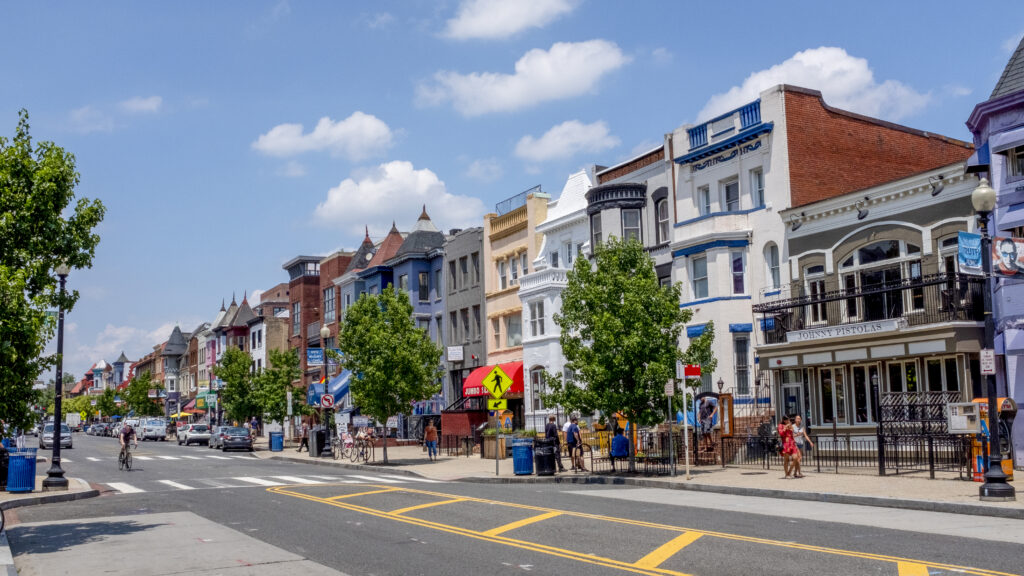
The study analyzed nearly 200 transit station areas, covering 1-mile buffers around 96 stations each in the Portland metropolitan area and the Washington, D.C., metropolitan area. Using large-scale mobility data from StreetLight Data, the researchers were able to observe thousands of real-world trips per location, providing a far more detailed picture of travel behavior than traditional survey methods.
Researchers then evaluated factors including job density, street connectivity, income and transit accessibility to jobs, applying machine learning techniques to identify the strongest predictors of local travel. This approach enabled the team not only to determine which factors are associated with local travel, but also the points at which those factors begin to meaningfully influence whether people remain within their neighborhoods for daily activities.
Results of the study, published in the Journal of Urban Mobility, reveal that the strongest predictor of whether people meet daily needs close to home is the concentration of jobs within a neighborhood. The study also found that connected street grids were the second strongest built-environment predictor of local travel, reinforcing earlier research showing that walkable, well-connected street networks play a critical role in supporting neighborhood-level activity.
“What emerges is a clear and, in some ways, unexpected picture,” said Louis A. Merlin, Ph.D., senior author and an associate professor in the Department of Urban and Regional Planning within FAU’s Charles E. Schmidt College of Science. “Across both regions, employment density consistently stands out as the strongest predictor of local travel. Neighborhoods with more jobs are far more likely to function as self-contained environments, where people live, work, shop and socialize without leaving the area. What this research shows is that proximity to jobs may be doing far more of the heavy lifting than we realized. If we want communities where people can truly live locally, we need to focus on where and how employment is concentrated – and how that interacts with transit and the street network. That’s where the real leverage is.”
The findings differ from earlier large-scale studies of mixed-use developments, likely reflecting both the use of more fine-grained mobility data and the study’s focus on transit-oriented neighborhoods.
“The ability to capture thousands of observed trips per location rather than relying on smaller survey samples provides a more detailed picture of everyday travel behavior, especially short walking trips that are often underrepresented in traditional data sources,” said Merlin.
Walking emerged as the dominant mode of local travel in both regions, accounting for more than 86% of internal trips. This reinforces a core principle of the 15-minute city: that proximity, when paired with supportive urban design, naturally encourages non-motorized movement. The study also identifies a practical ceiling for job density, finding that internal trip activity levels off at about 11,600 jobs per square kilometer – suggesting that beyond a certain point, simply adding more jobs does not further localize travel.
“This study is significant because it connects the concept of 15-minute communities with observed travel behavior around transit stations and provides practical insights into how people move in these areas. Rather than simply examining nearby services, it looks at whether people are actually making trips within these station-area neighborhoods,” said Mary A. Asumang, co-author and a graduate research student in FAU’s Department of Urban and Regional Planning. “Using internal trip capture, GIS-based built environment measures, StreetLight travel data and machine learning models, the study identifies neighborhood features – such as employment density, street connectivity and transit access – that support more local trips within 1-mile transit station areas. The findings provide stronger evidence of how land use and transportation decisions can work together to create more walkable, transit-supportive communities.”
Looking ahead, the researchers emphasize the need for continued investigation using large-scale mobility data, particularly to refine how mixed-use is measured and to better understand how transit riders link regional and local trips. As cities continue to invest in walkable, transit-oriented development, the study offers a clear takeaway: building truly local communities may depend less on assembling the right mix of uses – and more on ensuring that opportunity itself is close at hand.
Study co-author is Wen Zhang, Ph.D., a post-doctoral researcher in FAU’s Department of Urban and Regional Planning.
This research was supported by grants from the Center for Equitable Transit-Oriented Communities and FAU.
This piece was originally published at https://www.fau.edu/newsdesk/articles/15-minute-city-study.php. Banner photo: Public transportation in downtown Portland, Oregon (iStock image).
