


By Barbara Kates-Garnick, Tufts University
When the Trump administration announced it was moving to eliminate dozens of U.S. climate policies, Environmental Protection Agency Administrator Lee Zeldin said he was sending “a dagger straight into the heart of the climate change religion.”

That drive – to both repeal environmental regulations and cast doubt on science – reflects the Trump administration’s approach to environment policy.
Deregulation has long been a key theme in Republican environmental policy. The conflict between the obligation to protect public health and the desire to boost markets traces back to Ronald Reagan’s presidential administration. Reagan’s perspective that government is not a solution to problems, but is the problem instead, set the stage for Republican administrations that followed.
Reagan argued that the growth of government spending and business regulation had stymied economic prosperity. Environmental regulations were a prime target.
Forty years later, America is seeing many of the same concepts in the Trump administration. However, its strategy could have a greater effect than Reagan ever envisioned.
Slashing budgets and staffing
There are many ways to kneecap government agencies: Instituting massive budget cuts, cutting staff with critical functions and appointing leadership whose goal is limiting the reach and effectiveness of the very agencies they direct are just a few.
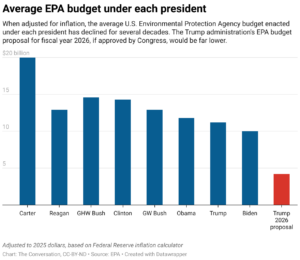
In these efforts, Reagan and Trump had similar approaches to the EPA, although with different levels of intensity.
Trump’s EPA budget plan for 2026 includes a draconian 50% cut from the previous year and the lowest budget proposal, when adjusted for inflation, since Reagan. Staff cuts in just the first six months of the second Trump administration put the agency’s total employment at 12,448, down from 16,155 in January.
Reagan dissolved the EPA Office of Enforcement to limit “unnecessary regulation,” which resulted in a 80% decline in actions to enforce environmental regulations. Trump is also stopping enforcement actions, dismantling the EPA’s Science and Research Office and politicizing the agency’s science by putting political appointees in charge, moves that undermine EPA’s independence and expertise.
Both cut EPA’s budget, but that alone does not reduce an agency’s effectiveness.
Politicizing EPA leadership
When the EPA was founded in 1970 during the Nixon administration, it represented a bipartisan consensus: After decades of auto exhaust, polluted waterways and smog-filled air, environmental protection had become a national policy priority.
But industries that EPA regulated argued that the costs of implementing the agency’s mandates were too high. That created tension between economics and science and enforcement.

As part of his “government is not the solution” approach, Reagan issued an executive order shortly after taking office in 1981 requiring federal agencies to submit all proposed rules to the White House Office of Management and Budget before making them public. In Reagan’s eyes, this approach centralized power in the White House and was a way to eliminate burdensome regulations before the agencies announced them to the public.
He also appointed an EPA administrator who shared his anti-government perspective. Anne Gorsuch Burford was a lawyer and state legislator from Colorado, where she routinely voted against toxic waste cleanup and auto pollution controls.
Once in Washington, she appointed several people to the EPA’s leadership team with direct ties to industries the EPA regulated. An example was Rita Lavelle, head of the EPA’s toxic waste programs, who was later convicted of perjury for lying to Congress about when she knew her former employer, a defense contractor, was disposing of toxic waste at a now notorious dump site.
These appointments were an example of regulatory capture by the industries EPA was in charge of overseeing. Anne Gorsuch Burford was held in contempt of Congress for not turning over records related to the Superfund cleanup of the same hazardous waste site, which led to her resignation. The Superfund program to clean up toxic waste dumps was new and one of EPA’s largest programs at the time.
The scandals, broken staff morale, stripped budgets and fights over policy discredited the agency.
Going after government scientists
Anne Gorsuch Burford’s deregulation efforts weren’t fully successful, in part because EPA staff experts rallied to preserve science and regulatory functions. They leaked materials about delays in the Superfund site cleanup to sympathetic congressional staff, who in turn found support from Republican and Democratic senators.
That history may have influenced the Trump administration’s strategy toward the federal bureaucracy’s staff experts, who Trump calls “the Deep State.”
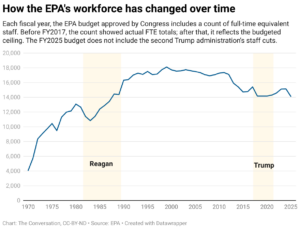
The Department of Government Efficiency, an unofficial group Trump set up in early 2025 headed by Elon Musk, directed the firing of tens of thousands of government scientists and other staff with expertise that government agencies rely on. Thousands more have resigned amid intimidation tactics such as surveillance.
Trump’s head of the Office of Management and Budget, Russell Vought, has been clear about targeting bureaucrats. He said in 2023: “We want their funding to be shut down so that the EPA can’t do all of the rules against our energy industry because they have no bandwidth financially to do so. We want to put them in trauma.”
There is a clear focus today on EPA programs that don’t align with the administration’s views. Programs related to environmental justice for low-income communities are in the line of fire. The appointment of people from the chemical, fossil fuel and corporate industries to high-level regulatory and legal positions raises questions about regulatory capture – whether their focus will be more on the health of the industries they oversee than on the health of the public.
An example is decision-making related to who bears the costs of cleaning up pollution from PFAS “forever chemicals” − persistent, harmful chemicals that are now found in drinking water and in people’s bloodstreams. Steven Cook, a Trump appointee, once represented chemical companies that are fighting a rule that would require them to clean up PFAS pollution. He has now proposed scrapping the rule, The New York Times reports. That move could shift what are expected to be billions of dollars in cleanup costs to taxpayers instead. It would be a significant shift away from the 45-year Superfund mantra that “the polluter pays.” Such actions blur the lines between ethics, policymaking and consumer and company interests.
The first Trump administration had a focus on reforming permitting and bureaucracy. While appearing radical at the time, the revamping of scientific boards to include more industry representatives, the undoing of power plant rules and the lessening of enforcement hobbled but did not completely undo the agency.
The second Trump administration, in actively supporting fossil fuel “energy dominance,” is taking steps to not just eliminate regulations but to ensure future administrations can’t bring the regulations back, by using a complex set of legal arguments related to the regulation of greenhouse gases.
At the same time, the administration is trying to discredit scientific research to downplay the risks of a warming planet.
The Reagan administration, while it also pushed for deregulation and expanded permitting of oil, gas and coal leases, embraced some elements of environmental protection. Reagan designated more than 10 million acres as protected wilderness and signed the Coastal Barriers Resources Act, which helped protect 3.5 million acres of shoreline from development. When Reagan signed the Montreal Protocol in 1988 to help protect the ozone layer, he cited scientific data showing the growing risks of ozone-depleting substances.
When Congress doesn’t push back
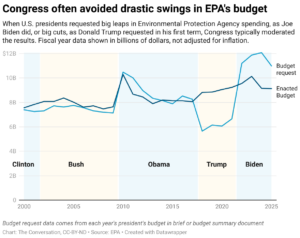
There is another critical difference between the first and second Trump administrations: The current Republican-controlled Congress is consenting to almost every request the president makes.
Congress has a constitutional responsibility to be a check on the executive branch, and a bipartisan Congress has long taken an active role in oversight and investigation involving environmental issues.
In 2025, however, Congress has approved most of Trump’s demands, including voting to repeal much of the Inflation Reduction Act, a package of pro-environment spending it had just passed two years earlier and that included many projects in Republican districts.
The administration’s effort to eliminate U.S. climate policies will take time and face lawsuits.
In an irony of history, Anne Gorsuch Burford’s son Neil Gorsuch now sits on the Supreme Court. His vote when those cases come before the court may be the ultimate Reagan legacy on the Trump EPA.
Barbara Kates-Garnick is a professor of practice in energy policy in The Fletcher School at Tufts University.
This article is republished from The Conversation under a Creative Commons license. Read the original article. Banner photo: Trump speaks in front of a portrait of Reagan in the Oval Office on Feb. 12. (The White House, Public domain, via Wikimedia Commons).
Sign up for The Invading Sea newsletter by visiting here. To support The Invading Sea, click here to make a donation. If you are interested in submitting an opinion piece to The Invading Sea, email Editor Nathan Crabbe at nc*****@*au.edu.
