


By Jon Paul “J.P.” Brooker, Ocean Conservancy
These are the sorts of anniversaries we don’t celebrate with cake, funny hats or a toast.
As we mark the one-year anniversaries of hurricanes Helene and Milton, thousands of Floridians are still recovering from the historic storms. Whether they live in the rural Big Bend area, where Helene made landfall as a Category 4 hurricane, or in urban areas such as Tampa Bay, which experienced record storm surge from Helene and historic rainfall from Milton, life is far from normal for many. They are still seeking building permits, waiting for financial help and hiring contractors as they struggle to rebuild their houses and their lives.
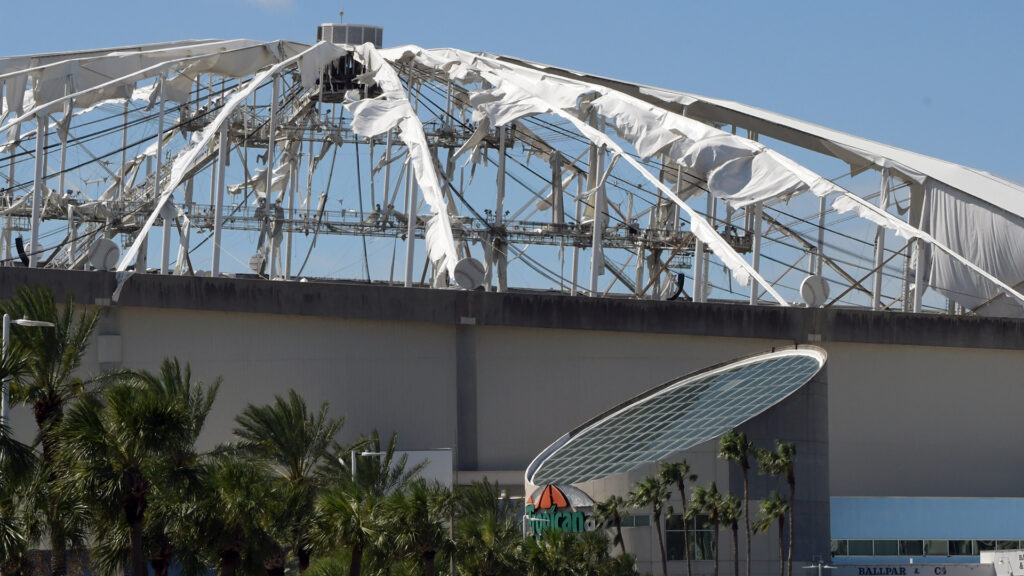
Even as Floridians work to regain their footing, we are keeping a wary eye on the weather reports as we navigate what’s still predicted to be a worse-than-normal hurricane season. All of this makes the talk of deep cuts in the federal agencies that we rely on for accurate hurricane information and the protection of our sensitive environment even crueler.
The president’s proposed 2026 budget would cut funding for the National Oceanic and Atmospheric Administration by more than a quarter. That $1.7 billion cut would bring NOAA’s budget down to $4.5 billion, and it would have a devastating, potentially deadly impact on Florida. It’s vital that Floridians let our members of Congress know what those cuts would mean for the Sunshine State.
The past 20 years have seen about a 50% improvement in the accuracy of hurricane forecasting; we now know earlier and with much greater certainty when, where and how severe storms will be.
But that progress is now at risk. The administration has already eliminated hundreds of jobs at NOAA, which includes the National Weather Service and the National Hurricane Center. Accurate hurricane predictions rely on a host of programs at NOAA working together — from satellites to buoys to research labs. Cut any piece of that, and Americans will suffer. We cannot further undermine the agency’s core mission.
This is personal to me; we lost our car and nearly half of our St. Petersburg house as storm surge flooded our neighborhood with 6.5 feet of salt water during Helene. It should be personal to you as well.
Other proposed NOAA cuts would harm critical services that Florida relies on, from algal bloom prediction modeling to protecting environmentally sensitive areas. These cuts would threaten public health and safety, decimate tourism and hurt local economies. For example, the president’s budget proposes eliminating all funding for:
- Natural Estuarine Research Reserves, which draw millions of tourists a year and support major fisheries and local fishing communities. In Florida, those include the Rookery Bay National Estuarine Research Reserve, a 110,000-acre area just south of Naples that contributes over 500 jobs and $55 million a year in revenue to Collier and Lee counties. Funding also would be cut for the Apalachicola National Estuarine Research Reserve, which protects about 235,000 acres in Northwest Florida and includes one of the most famous oyster fisheries in the world.
- The Cooperative Institute for Marine and Atmospheric Studies, which provides critical technical support for the National Hurricane Center. This would impact more than 100 researchers in and around the University of Miami and nine other universities working on hurricane predictions and forecasting ocean conditions such as harmful algal blooms.
- The Atlantic Oceanographic and Meteorological Laboratory in Miami, which studies hurricanes, coastal ecosystems, oceans and human health, climate, global carbon and how oceans change over time. That research is crucial to generating weather predictions and understanding severe storms.
Cuts at NOAA also could harm other important programs in Florida. Those include the University of South Florida Flood Hub and Ocean Circulation Lab, a collaborative effort that improves our understanding of ocean circulation and the atmosphere.
Fortunately, members of Congress are pushing back on the deepest proposed cuts. In the House, legislation would reduce NOAA’s spending by about $400 million, which is roughly a quarter of the president’s proposed cuts but still around a 6% reduction in spending. In the Senate, members of both political parties have talked of the importance of NOAA and, particularly, the National Weather Service.
Floridians know firsthand how important all of the work NOAA does in a nonpartisan fashion. We all should raise our voices in support of full funding for NOAA, which provides life-and-death defenses for Florida as it protects our communities, our ecosystems and our economy.
Jon Paul “J.P.’’ Brooker is Ocean Conservancy’s director of Florida conservation. This opinion piece was originally published by the Tampa Bay Times, which is a media partner of The Invading Sea. Banner photo: A satellite image of Hurricane Helene (NOAA GOES).
Sign up for The Invading Sea newsletter by visiting here. To support The Invading Sea, click here to make a donation. If you are interested in submitting an opinion piece to The Invading Sea, email Editor Nathan Crabbe at ncrabbe@fau.edu.
