


By Stefan Hagens, The Invading Sea
Twin brothers Keith and Kyle Rossin grew up in South Florida deeply connected to coastal ecosystems and with a desire to protect them. By selling hats and sun-protective clothing as a means to restore Florida’s mangrove coastlines, their company MANG has centered its brand around environmental restoration.
Their company’s Buy One, Plant One initiative ensures that every product sale results in a mangrove being planted. Beyond that, the MANG clothing line offers UPF 50-plus protection and most of their apparel is made to order to minimize waste. The clothing also features mangroves and Florida wildlife designs, allowing customers to engage with the environment in more ways than one.
Now, more than a decade after it was founded, their West Palm Beach-based company has become an established brand that has also successfully carried out its mission of revitalizing mangrove ecosystems. The initiative is responsible for mangrove plantings at the Jupiter Inlet Lighthouse, Sanibel Island and other sites across Florida and beyond.

Next year, MANG anticipates planting its 1 millionth mangrove since the start of the company.
“It’s been our goal for a long time. … That’s where Kyle and I wanted to be when we first dreamed it up. We’re 10 years in business, but to me it feels like we’ve just started,” Keith said.
The brothers’ enterprise began when Kyle started looking for a way to preserve the Floridian coastal ecosystems in which he grew up fishing and diving. At Florida Gulf Coast University, he turned his attention toward mangroves.
“I went to FGCU and pursued a degree in environmental studies. It leaned me towards wanting to give back to our ecosystems. … My degree was pretty depressing in a lot of ways; there was not a lot of hope for the world. So, I was like, ‘There’s got to be something that I can tie myself to that has a purpose’ and so we found mangroves,” Kyle said.
After an idea for creating a mangrove camouflage, the brothers started MANG. They implemented environmentally sustainable practices to produce their apparel, including minimizing packaging, using algae-based inks and printing 90% of their shirts on demand to reduce waste.
The foundation was then set for a business that could pay homage to the environment and give back to it as well. From there, they established key mangrove farming practices and offered mangroves to nearby private property owners.
Mangroves play a major role in keeping Florida’s coastal ecosystems healthy, providing numerous benefits to the environment and people alike. They provide habitats for fish and wildlife populations, filter pollutants, absorb carbon, buffer storm impacts and mitigate rising sea levels.
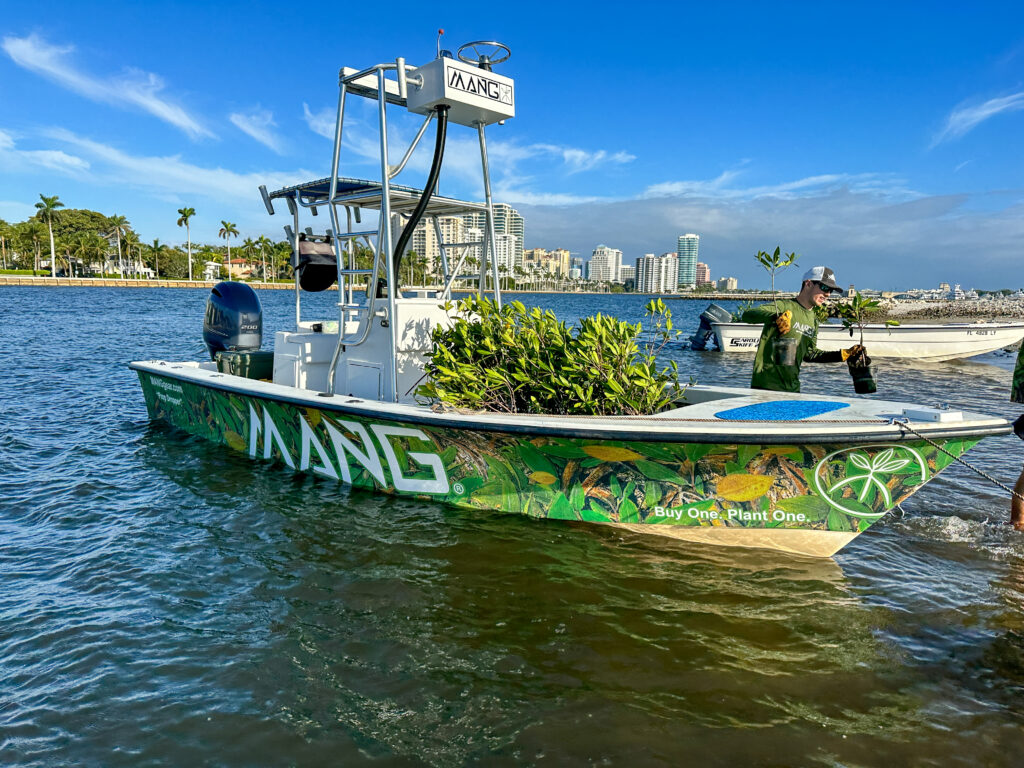
In a project close to their home base of West Palm Beach, the Rossins set the tone for how they could make a lasting impact. In their first partnership with Palm Beach County, MANG played an important role in the restoration projects in the Lake Worth Lagoon. The estuarine habitat, which runs along the Palm Beach barrier islands, serves as an important ecosystem for wildlife and is known for its fishing and boating recreation.
“The county had been actively building these islands in the Lake Worth Lagoon … and we became a little bit of a squeaky wheel… (They) said, ‘Yeah, sure, we’ll take your mangroves, it helps us, we don’t have to go buy them.’… It was a great partnership,” Kyle said.
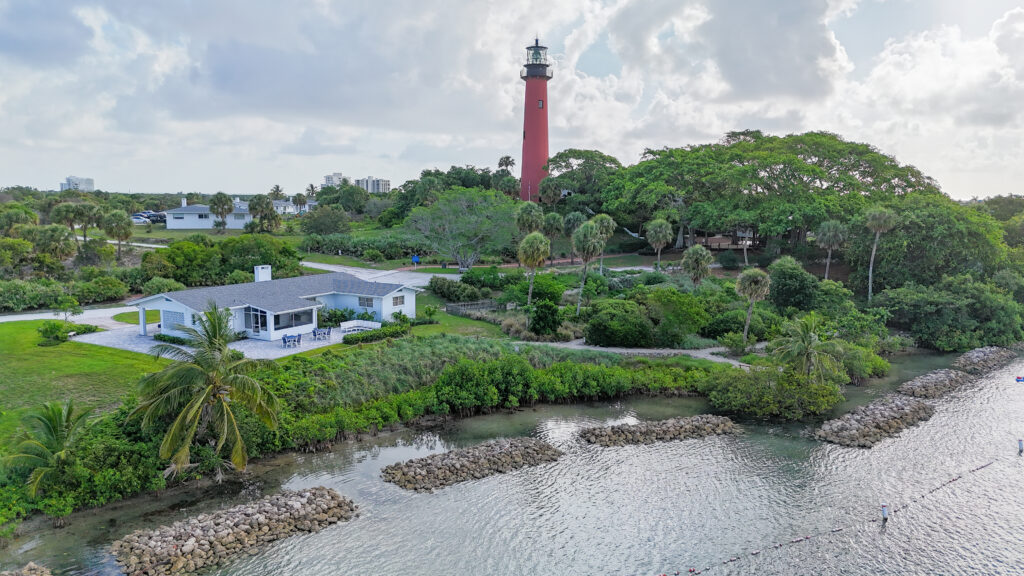
Other restoration projects include the site of the historic Jupiter Lighthouse. The site had been experiencing up to 7 feet per year of erosion along the shoreline due to rising sea levels, higher tides and boat wake.
In partnership with the Jupiter Inlet Lighthouse Outstanding Natural Area, MANG provided mangroves for a shoreline stabilization project. Jupiter Inlet District Executive Director Joseph Chaison, a coastal engineer, said the project even changed the minds of homeowners who have been skeptical about introducing mangroves on their properties.
“That living shoreline at the lighthouse there, it has really been fantastic how quickly and how thoroughly that shoreline has stabilized,” he said.
MANG also worked on Gulf Coast to help restore environments that were destroyed by hurricanes. After Hurricane Ian, the Sanibel-Captive Conservation Foundation approached MANG to help restore the mangrove coastlines that they had lost.
“One of our sites was completely devastated. We reached out to MANG to help us with their expertise and also with bringing over their mangroves from the east coast,” said Kealy Pfau, Coastal Watch director at the foundation.
MANG and SCCF have maintained a connection for several years. Pfau said their shared commitment to restoration was instrumental in its success.
“They came in with their story and their mission, and we loved that. It aligned with what we believe in our mission. We have had a great relationship with them for years now. … They came in and sold us on what they’re trying to do,” Pfau said.
MANG’s mangrove donations and volunteer engagement were felt by the Sanibel-Captiva community, which has faced several hardships over the past few years.
“I think that mangrove restoration events are a way for the community to give back to the habitats that helped protect them from the storms,” Pfau said.
As MANG continues to grow toward the next million mangroves planted, the Rossins aim to keep cultivating a movement toward environmental restoration and connecting people to wild Florida.
“We’re making sure that we’re doing everything we can to protect our beautiful ecosystem that we call home,” Keith said.
Stefan Hagens is a junior majoring in environmental engineering at Florida Atlantic University who is reporting for The Invading Sea. Banner photo: Keith and Kyle Rossin wear mangrove camouflage while holding mangroves for planting (Photo courtesy of MANG).
Sign up for The Invading Sea newsletter by visiting here. To support The Invading Sea, click here to make a donation. If you are interested in submitting an opinion piece to The Invading Sea, email Editor Nathan Crabbe at ncrabbe@fau.edu.

Love this! Proud of my alma mater and colleagues from CES.