


By Stefan Hagens, The Invading Sea
Since she started with the Florida Public Archeology Network nearly a decade ago, Sara Ayers-Rigsby has seen rising sea levels and erosion eat away at important historic sites on the coast.
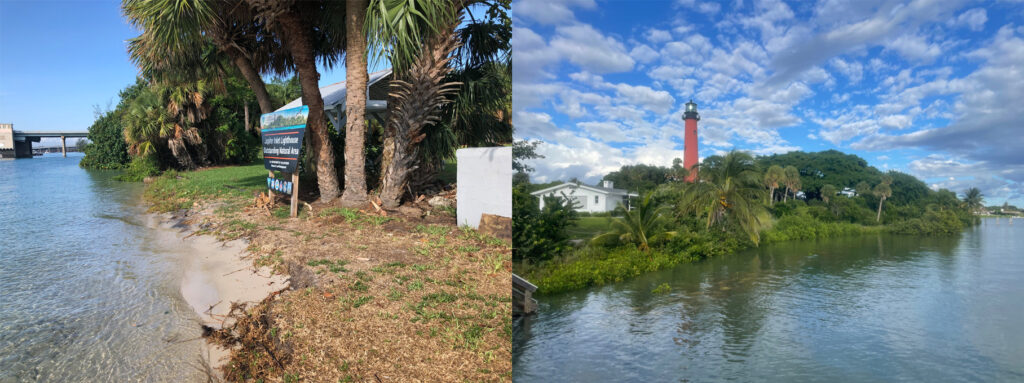
Ayers-Rigsby’s work with FPAN brought her to places like the Jupiter Inlet Lighthouse, where she would give kayak tours of important historical sites on the property. She recalled a bench near the shoreline where she would show visitors replica artifacts, until the effects of erosion took a toll.

“Every few months there was less and less beach in front of this little bench. … One day there was basically no beach and the bench was in the water – and, of course, the next time the bench was totally gone,” she said.
As archeological sites in Florida face growing climate impacts, Ayers-Rigsby works to promote the preservation of these sites as director of the network’s Southeast region. FPAN’s Heritage Monitoring Scouts program allows the public to take an active role in these efforts.
“HMS Florida is one the programs we have developed within FPAN as a way to try and engage people with archeology, the past, the world around them and the climate change impacts of their local areas,” said Ayers-Rigsby, who is based at Florida Atlantic University’s Davie campus.
Archaeological sites are facing numerous challenges in Florida, given that many are located in coastal areas. Cemeteries, shell mounds and even shipwrecks are all being affected by flooding, shoreline erosion and hurricanes.
Katharine Napora, an environmental archaeologist at Florida Atlantic University, has personally participated in the HMS Florida program and highlighted the importance of tracking these at-risk sites.
“The program collects data that helps scientists better understand which archeological sites are at risk of erosion and other costal processes, and probably which we should focus on studying before some of them are lost,” Napora said.
Having more eyes on archeological sites allows FPAN to better assist communities and local governments that work within the constraints of their limited resources.
The database that HMS scouts expanded has proven to be a valuable resource for FPAN, local organizations and state archeologists alike. In the case of the Jupiter Lighthouse, this data proved to be an important piece in starting initiatives to preserve the site.
“We were using that information to write damage assessments and say, ‘Hey, this shoreline really needs to be stabilized.’… The Bureau of Land Management then worked with the Jupiter Inlet District to then stabilize the southern side of the shoreline,” Ayers-Rigsby said.
The HMS Florida program trains volunteers on what risks to identify at sites and how to document observations in the database. The program now offers its training fully online. Once the training has been completed by a hopeful participant, FPAN staff can then assign them to a site to monitor. From there, participants can monitor as few or as many sites as they are willing to.
Fully equipping people to make meaningful contributions to archeological work satisfies FPAN’s missions of both preserving history and educating the public.
“Public engagement is probably the most important aspect of what we do as archeologists and as scientists. … I think (HMS Florida) is wonderful for both archeologists as well as for the public,” Napora said.
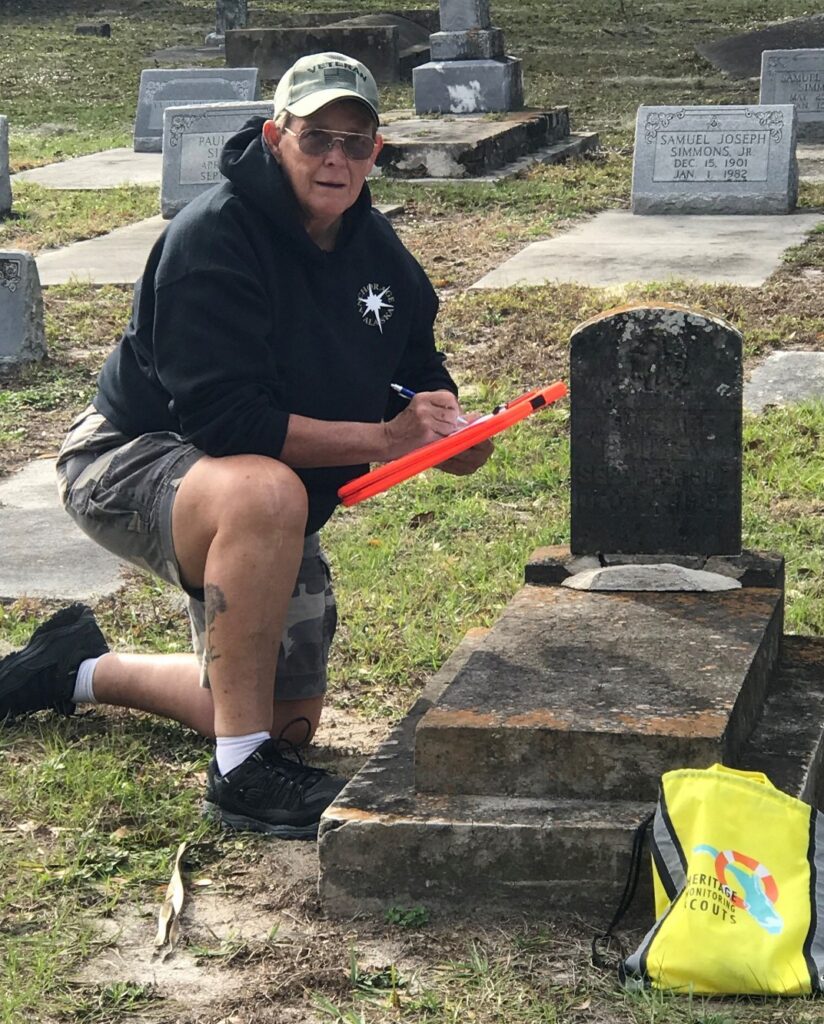
Chris Nolan, a 70-year-old Army veteran, started her journey with HMS Florida in 2017. She has since visited and documented over 700 cemeteries, contributing valuable information to the FPAN database.
Once introduced to cemetery monitoring through HMS Florida, Nolan was hooked. Her efforts have led her across the state, encountering different conditions at every site.
“I try to report anything that I see as damaging and just try to make sure that everybody is informed,” said Nolan. She continued, “I’ve seen a lot of things that if someone doesn’t go and find, you would never know, for example, that there was a big puddle of water that had been standing there for weeks.”
These kinds of sightings are becoming more crucial to document as Florida experiences storms intensified by climate change.
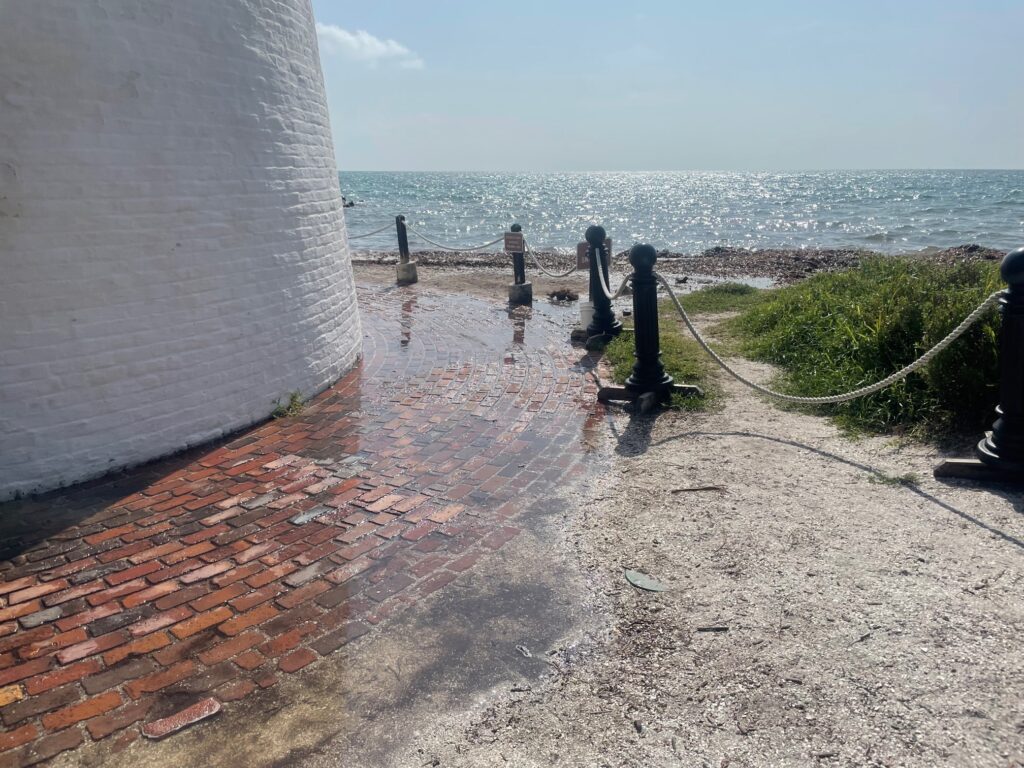
Some of the most important work HMS scouts do is visit sites in the aftermath of intense storms. The HMS Florida program educates scouts on climate issues, helping them to make accurate reports on their site visits.
Napora also mentioned that some of her colleagues utilize the HMS Florida program as part of their climate change curriculum.
“We also talk about climate change because we want people to have the vocabulary to understand what is happening at the site and some of the different impacts they might see,” Ayers-Rigsby said.
Ayers-Rigsby’s studies of Florida’s past has left her with a sense of optimism.
She recalled that thousands of years ago, the peninsula was twice as wide and home to a vastly different climate. Some ancient Floridians would have seen the coastline encroach by the length of an entire football field in their lifetime alone.
“People were able to adapt to what was a very rapid period of global climate change. … I think that there is a real message of hope in terms of dealing with modern anthropogenic climate change,” she said. “Adaptation is possible as we see these significant impacts on our heritage.”
Stefan Hagens is a junior majoring in environmental engineering at Florida Atlantic University who is reporting for The Invading Sea. Banner photo: A view of the Jupiter Inlet Lighthouse from the surrounding water (Bureau of Land Management, CC BY 2.0, via Wikimedia Commons)
Sign up for The Invading Sea newsletter by visiting here. To support The Invading Sea, click here to make a donation. If you are interested in submitting an opinion piece to The Invading Sea, email Editor Nathan Crabbe at ncrabbe@fau.edu.
