


By Lisa Moore, Save Crystal River
In one of Florida’s most celebrated coastal treasures, a place famous for its sapphire-blue springs, wild manatees and eco-tourism, there is a gurgle of potential, or potentially a very imminent threat, bubbling just beneath the surface.
Tucked along the Gulf Coast, Crystal River is one of the last places in the world where visitors can legally swim alongside manatees. It’s a sanctuary of springs and biodiversity, and a cornerstone of Florida’s nature-based economy. But the very islands that protect this paradise — and the people who live around it — are disappearing at an alarming rate.
A disappearing shield
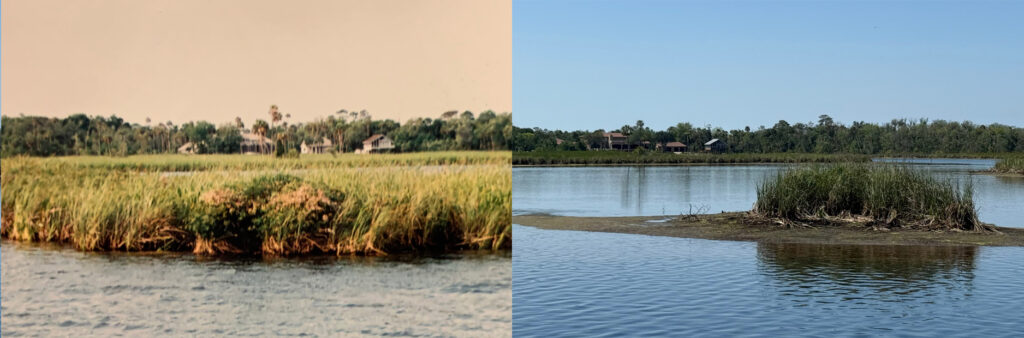
Over the past decade, Crystal River’s protective barrier islands have been eroding faster than ever, especially following the destructive hurricane seasons of 2023 and 2024. These small islands are the community’s first line of defense against storm surge and flooding. They also act as filters for sediment and as natural breakwaters that keep Kings Bay and its famous springs clear and healthy.
But the land is vanishing.
A recent 11-year erosion study (2010–2021) shows that 2.8 net acres of land disappear every year within the 3.3-square-kilometer Kings Bay system. Banana Island, which protects the iconic Kings Spring, has lost 40.5% of its total area. Warden Key has eroded by 37.1% and is nearly gone. Buzzard Island is splitting apart, while Parker Island is disintegrating — sending sediment into nearby spring vents that choke young eelgrass and cloud the once-crystalline waters.
Some areas are eroding by as much as 10 feet per year, leaving the community’s homes, infrastructure and ecosystems dangerously exposed.
Proven solutions
Through partnerships with environmental experts, government agencies and local businesses, Save Crystal River, an all-volunteer nonprofit, has proven what community action can achieve above and below the surface.
Rehabilitation, restoration and protection have fueled their mission to truly Save Crystal River over the last decade.
Now, building on that success, Save Crystal River is expanding its mission beyond the waterline — focusing on shoreline resiliency and island restoration to protect the very barriers that keep these restored springs healthy for generations to come.
In collaboration with Sea & Shoreline, Florida’s leading aquatic restoration firm, Save Crystal River has restored more than 120 acres of eelgrass, removed over 700 million pounds of muck and algae, and uncovered more than 850 previously buried spring vents — results that have transformed once-clouded waters into thriving ecosystems once again. In 2025, the team celebrated the revitalization of the 2nd magnitude spring at Hunter Springs Park, the first of more than seven major named springs within the 70-spring Kings Bay complex slated for restoration.
A community taking action
Now, Save Crystal River is aligning with leaders and environmental groups to restore the area’s protective islands and the seagrass meadows around them. Efforts include rebuilding natural sawgrass barriers, stabilizing shorelines and expanding education programs on stewardship and responsible anchoring.
This isn’t just about saving land. It’s about protecting homes, livelihoods and one of the last truly wild places where nature and people still coexist in balance.
As Florida faces a future of stronger storms and rising seas, Crystal River’s story is one of resilience and renewal — proof that communities can come together not only to defend what they love, but to restore it for generations to come.
A local story with global meaning

What’s happening in Crystal River reflects a growing global challenge — the loss of coastal and island ecosystems that quietly shield communities from rising seas and stronger storms.
- In North Carolina, Sugarloaf Island near Morehead City faces nearly identical erosion challenges, prompting emergency stabilization projects led by Sea & Shoreline and local partners.
- Louisiana’s Gulf Coast continues to lose a football field of land every 100 minutes.
- Nantucket, Massachusetts is battling rapid coastal cliff loss and home devastations and relocations.
- Across the Caribbean and Pacific, small islands that once protected entire villages are slipping beneath the sea.
- Even Hawaii’s sacred coastlines are eroding as sea levels rise and storms intensify.
Crystal River offers a powerful case study for global communities to reference and replicate, before it is too late.
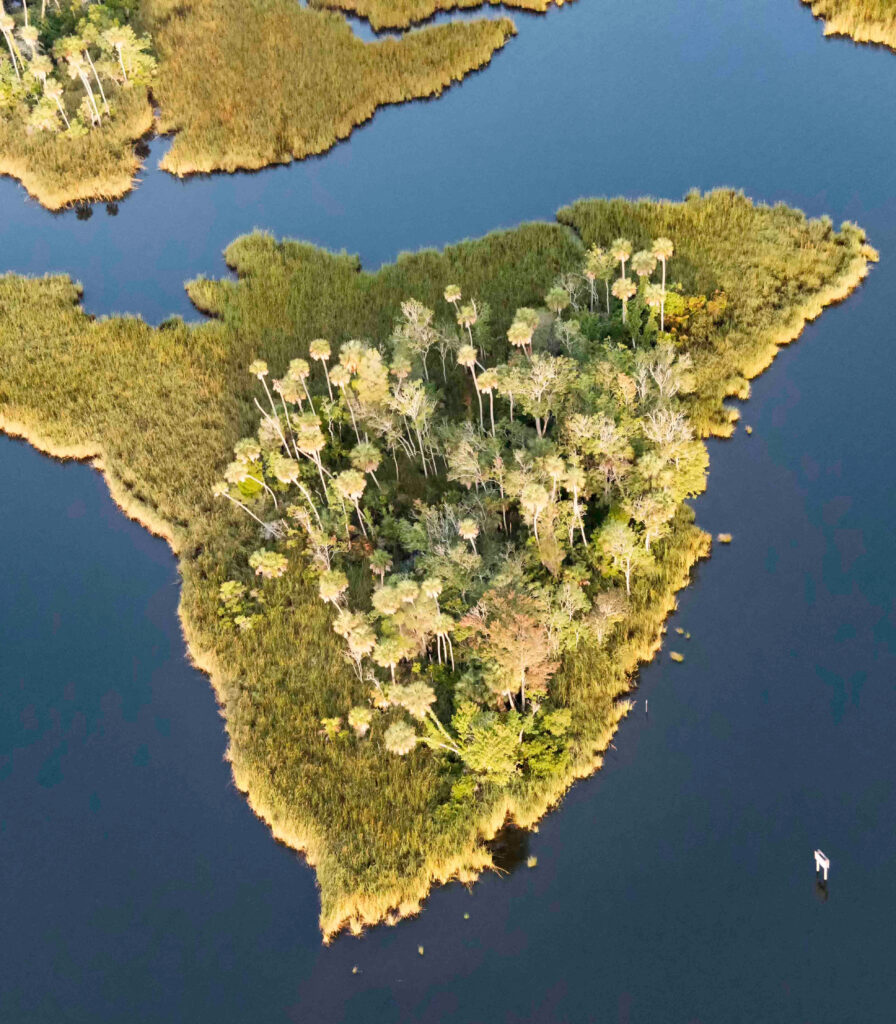
Lisa Moore is the president of Save Crystal River, a nonprofit organization dedicated to the restoration and protection of the beauty and health of Crystal River for future generations. Banner photo: An aerial view of Crystal River (Photo courtesy of Sonny Vergara).
Sign up for The Invading Sea newsletter by visiting here. To support The Invading Sea, click here to make a donation. If you are interested in submitting an opinion piece to The Invading Sea, email Editor Nathan Crabbe at ncrabbe@fau.edu.
