


This article originally appeared on Inside Climate News, a nonprofit, non-partisan news organization that covers climate, energy and the environment. Sign up for their newsletter here.
By Amy Green, Inside Climate News
The 2025 Atlantic hurricane season may be best-remembered for its unusual distribution of storms, including Melissa, which struck Jamaica as a devastating Category 5 hurricane.
Meanwhile the U.S. was left relatively unscathed, sparing the emergency response system here of a major test after Trump administration plans to overhaul or abolish the Federal Emergency Management Agency plunged FEMA into turmoil. The season ended Nov. 30.
“It was kind of a strange season, just how the storms played out,” said Phil Klotzbach, a senior research scientist at Colorado State University’s Department of Atmospheric Science. “It was an odd distribution of storms, and the hurricanes that formed were quite strong.”
For the U.S. it was the first time in a decade with no landfalling hurricane. No named storms formed in the Atlantic between Aug. 24 and Sept. 16, a rare lull near the height of hurricane season that has occurred only twice since 1939.
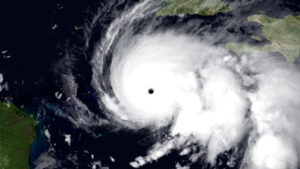
Melissa caused between $6 billion and $7 billion in damage in Jamaica after making landfall Oct. 28 near New Hope, according to Colorado State University. The hurricane also battered Cuba and Hispaniola.
The storm formed over extremely warm waters in the Caribbean, where sea temperatures peak in October, said Brian McNoldy, senior research associate in the Rosenstiel School of Marine, Atmospheric, and Earth Science at the University of Miami.
“It wasn’t moving for a few days. We could have walked quicker than it was moving, and its intensity exploded,” he said. “This was very deep, very warm water. So it could just sit there and not really be able to upwell any cooler water. It was just sitting over an endless fuel source.”
Melissa was one of the most intense hurricanes ever documented. Top winds clocked in at 184 miles an hour, trailing only 1980’s Allen, still the strongest on record. Its landfall pressure was 892 millibars, tied with the 1935 Labor Day Hurricane as the lowest ever noted, another measure of its unusual strength.
Three Category 5 storms — Melissa, Humberto and Erin — were recorded during the season, defined by winds of 157 miles an hour or greater. Erin caused storm surge and tropical storm conditions along the North Carolina Outer Banks and rough surf and rip currents on the East Coast. Humberto remained out at sea.
The number of top-tier storms was the second-highest on record, after four category 5 hurricanes were recorded in 2005. The 2025 season also saw four hurricanes undergo an extreme rapid intensification, which is becoming more common as climate change heats the planet’s oceans.
In the U.S. the only named storm that threatened land was Chantal, which swirled ashore July 6 as a tropical storm near Litchfield Beach, South Carolina. That storm caused less than $500 million in damage, according to Colorado State University.
The lack of hurricane activity in the U.S. came as President Donald Trump has called for drastic change at FEMA and said more responsibility in the management of emergencies should be shifted to the states.
His administration in May pushed out Cameron Hamilton, the acting administrator at the agency, after he told Congress that FEMA should not be eliminated. Hamilton’s successor, David Richardson, resigned last month. He had faced criticism for what Republicans and Democrats characterized as a lack of responsiveness to the deadly July 4 floods in Texas. Richardson also told employees in June that he did not know the U.S. had a hurricane season, The New York Times reported, a remark the agency later said was a joke.

“FEMA is kind of being stripped of personnel like every other government agency,” said Wesley Cheek, assistant professor of emergency management at Massachusetts Maritime Academy. “All those hurricanes could have just as easily hit the southeast United States. The answer to what they would have looked like with FEMA as it is right now is that … we have no idea. We have no idea because no one knows what is happening at FEMA right now.”
Neither FEMA nor the Department of Homeland Security responded to requests for comment.
Karen Evans, a political appointee at FEMA whose background is in cybersecurity and national security, stepped in Dec. 1 as acting FEMA administrator. A task force appointed to consider how to reform the agency is expected to release a report by the end of the year.
The hurricane season ended as above-average, as defined by the number of major hurricanes and overall storm activity, according to Colorado State University. The activity likely was driven in part by warmer than usual sea surface temperatures in the tropical Atlantic and Caribbean, the researchers said.
The researchers attributed the lull near the height of the season to a dry and stable tropical Atlantic. They also said there was an upper-level cold low, which typically is associated with increased vertical wind shear that can break up developing storms. Wind shear also likely kept the Gulf of Mexico quiet. McNoldy noted that Imelda came close to making landfall in the Carolinas in late September.
“But just through luck Hurricane Humberto was at the right place at the right time to its east, and they interacted and it pulled Imelda away from the coast,” he said. “So that was just a really good-luck hurricane interaction that helped the U.S. avoid a hurricane landfall.”
Banner photo: Damage in Jamaica from Hurricane Melissa (Pan American Health Organization, CC BY-NC-ND 4.0, via flickr).
Sign up for The Invading Sea newsletter by visiting here. To support The Invading Sea, click here to make a donation. If you are interested in submitting an opinion piece to The Invading Sea, email Editor Nathan Crabbe.
