


By Gisele Galoustian, FAU News Desk
The College of Engineering and Computer Science at Florida Atlantic University has received a $600,379 grant from the Florida Department of Environmental Protection to advance groundbreaking technology that targets one of the state’s most persistent environmental threats: harmful algal blooms (HABs).
The award was included in Florida Gov. Ron DeSantis’ recent announcement of more than $112 million in statewide water quality and water supply investments, which support alternative water projects, freshwater springs restoration and innovative HAB mitigation technologies.
The governor’s initiative included $50 million for 14 alternative water supply projects, another $50 million to support 23 springs restoration efforts and $12 million for 16 innovative technology projects designed to prevent, detect, clean up and mitigate HABs. FAU engineering’s newly funded project falls within this last category and is part of Florida’s growing portfolio of HAB-response technologies that enhance scientific capabilities, expand monitoring tools and support local governments during bloom events.
“We are profoundly grateful to Gov. Ron DeSantis and the Florida Department of Environmental Protection for their ongoing commitment to safeguarding Florida’s environment and water quality,” said FAU President Adam Hasner. “Their vision and leadership have enabled Florida Atlantic to accelerate the development of technologies that protect communities, preserve ecosystems and strengthen the state’s resilience. This grant is a testament to the importance of scientific innovation and the power of strategic partnerships in addressing water challenges that impact every Floridian.”
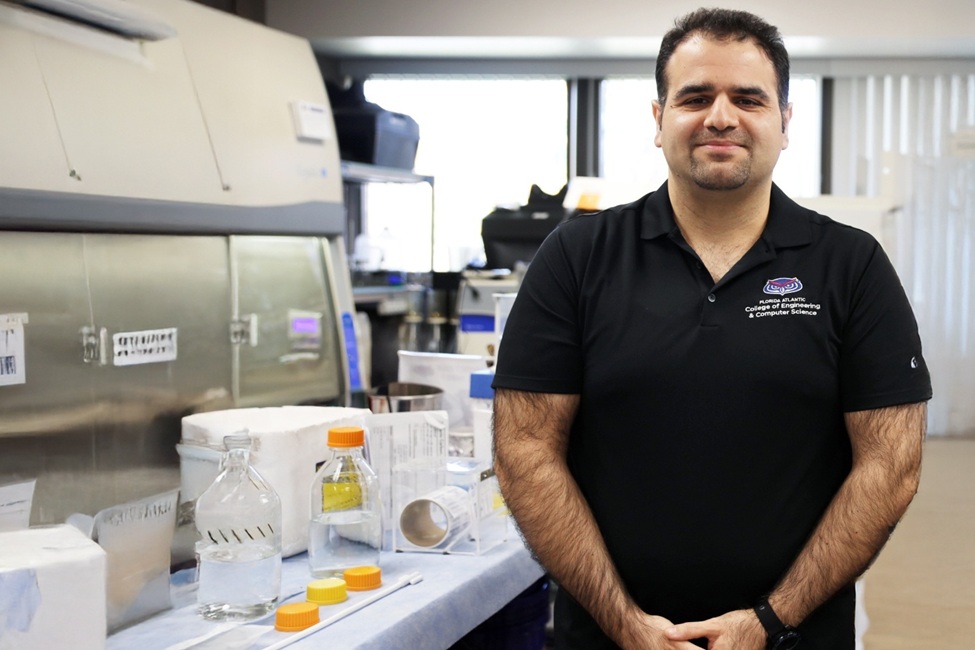
The FAU project, titled “Developing Novel 3D-Printed Adsorbent Materials for Phosphate Removal from Surface Waters,” is led by Masoud Jahandar Lashaki, Ph.D., principal investigator, associate professor and graduate program director in the FAU Department of Civil, Environmental and Geomatics Engineering, with co-investigators Yalan Liu, Ph.D., an assistant professor, and Mohammed Abdellatef, Ph.D., an assistant professor, both within the Department of Civil, Environmental and Geomatics Engineering. The two-year project period begins next April.
HABs continue to threaten Florida’s aquatic ecosystems, public health, economy and quality of life. Excess phosphorus – largely from fertilizer runoff, wastewater, urban stormwater and other nutrient sources – is often the primary driver of bloom formation in Florida’s lakes and freshwater systems.
When phosphorus levels spike, algae can grow uncontrollably, consuming oxygen, blocking sunlight, producing toxins and destabilizing entire ecosystems. With high nitrogen-to-phosphorus ratios documented in the Everglades, Indian River Lagoon, Lake Okeechobee and other watersheds, phosphorus reduction remains a critical focus of the state’s environmental strategy.
FAU’s new project builds on the research team’s earlier work under two prior Department of Environmental Protection Innovative Technologies for Harmful Algal Blooms grants. In previous studies, the team successfully transformed algal biomass collected from bloom events into activated carbon materials capable of removing phosphorus at high efficiencies. They also demonstrated that modifying these materials with lanthanum – an element widely used in aquariums and ponds – dramatically enhances phosphate uptake through the formation of a stable mineral called rhabdophane, which permanently sequesters phosphorus and prevents algae from using it.
“We are extremely proud of Professor Lashaki and his colleagues for their pioneering work and their dedication to advancing environmental engineering solutions that have both regional and global significance,” said Stella Batalama, Ph.D., dean of the College of Engineering and Computer Science. “The innovation emerging from our college reflects Florida Atlantic’s strong commitment to research excellence, impact and meaningful service to our state and supports Florida’s long-term vision of safeguarding its waterways for future generations.”
The new grant enables the team to advance this technology by converting their lanthanum-modified powders into robust 3D-printed structures that can be directly submerged into freshwater bodies. Unlike powdered materials, which settle into sediments and cannot be easily recovered, the 3D-printed structures are engineered for durability, tunable porosity, retrievability and long-term use. They allow water to flow through them efficiently, improving phosphate removal while minimizing the release of chemicals into the environment. Once spent, the structures can be withdrawn, regenerated or recycled, preventing phosphorus accumulation in sediment and reducing maintenance costs for water managers.
FAU researchers will deploy and evaluate these 3D-printed phosphate adsorbents in multiple ponds on the Boca Raton campus, allowing real-world testing of both performance and environmental safety. Because the structures can support multifunctional integration, future versions may combine lanthanum for phosphate capture with activated carbon for organic contaminants or ion-exchange materials for nitrogen removal, further broadening the technology’s water quality benefits.
“I am deeply honored that Gov. Ron DeSantis and the Florida Department of Environmental Protection has entrusted our team with this important responsibility,” said Lashaki. “Harmful algal blooms continue to pose a serious threat to our state’s ecosystems and communities, and we are committed to advancing technologies that can meaningfully reduce phosphorus levels in vulnerable water bodies. This funding allows us to take a major step forward by developing 3D-printed structures that offer both scientific innovation and practical, real-world application. We are proud to contribute to Florida’s leadership in protecting its waters.”
In addition to its technological advances, the project includes a robust statewide educational and workforce development component. The research team will integrate HAB-focused modules into FAU undergraduate and graduate classes; partner with the FAU Stiles-Nicholson STEM Teacher Academy to train K–12 science teachers; host after-hours and weekend environmental engineering camps for middle and high school students; and deliver public lecture series for adult learners through FAU’s Osher Lifelong Learning Institute. The educational activities aim to enhance scientific literacy, equip Florida’s future workforce and empower residents to make informed decisions that reduce nutrient pollution.
This piece was originally published at https://www.fau.edu/newsdesk/articles/fdep-grant-harmful-algal-blooms.php. Banner photo: Algae in Lake Okeechobee (iStock image).
Sign up for The Invading Sea newsletter by visiting here. To support The Invading Sea, click here to make a donation. If you are interested in submitting an opinion piece to The Invading Sea, email Editor Nathan Crabbe. To learn more about harmful algal blooms, watch the short video below.
