


By Rafe Pomerance, The Upper Limit Project
Nearly 7 in 10 Americans reject President Donald Trump’s handling of Greenland, according to the latest Associated Press poll — a blunt rebuke and sign that voters are paying attention. But they are missing the real danger: Greenland’s melting ice is causing sea-level rise that threatens U.S. coasts.
Trump called Greenland a national security priority, citing a prevalence of Russian and Chinese ships as the reason in an interview with The Atlantic. But Greenland’s real threat isn’t sailing offshore. It’s frozen onshore.
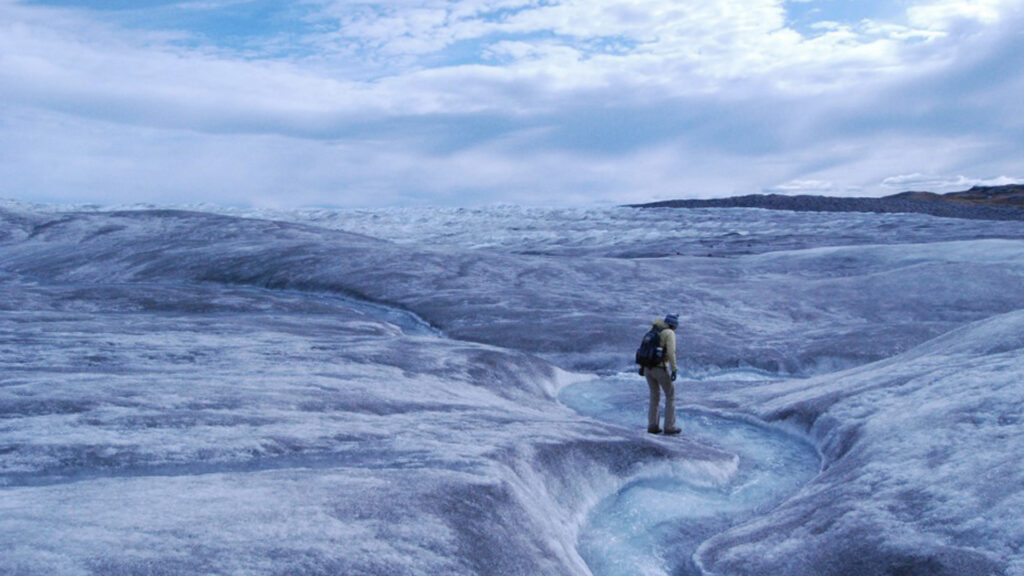
It should be a national priority to protect Greenland and the U.S. from the real threat posed by accelerated melting of Greenland ice sheets. Ice melt is creating a wave of insecurity, manifesting not as a foreign invasion, but as rising seas that steadily erode shorelines, destroy infrastructure and erase economic productivity.
In January, Trump said that if he couldn’t acquire Greenland “the easy way,” he would do it “the hard way.” Later, at his World Economic Forum speech, he doubled down, demanding U.S. “ownership.” Europe pushed back. Leaders rallied behind Denmark. The backlash was swift — and global.
After Trump’s speech, NATO Secretary-General Mark Rutte helped broker an off-ramp. Trump dropped tariff threats and agreed to negotiations he could have secured months earlier — without rattling a NATO ally or further straining fragile alliances.
If we want to protect U.S. national interests, we don’t need to buy Greenland or seize it. We need to stabilize it. Put bluntly: The fate of Greenland is the fate of Miami … and Tampa, Jacksonville, Pensacola, and dozens of other coastal communities in Florida and around the world. The Eastern Seaboard is particularly at risk, and cities like Charleston, New York and Boston are raising the alarms.
To understand why Greenland matters to a homeowner in Coconut Grove or a port authority worker in Port Canaveral, look to the 2025 Arctic Report Card produced by the National Oceanic and Atmospheric Administration. It confirms that we have entered an era of cascading climate impacts.
The Arctic just experienced its hottest and wettest year in 125 years of record-keeping. Summer sea ice is now sparse, locking the Arctic Ocean into a “new normal” of extensive open water. We are looking at an ice-free Arctic Ocean summer within the next 25 years.
Greenland’s melt does not raise sea levels evenly. It raises them higher along the U.S. Eastern Seaboard. This isn’t just “climate change.” It is a redistribution of physical risk that targets our most vital economic hubs as melting ice in Greenland becomes sea-level rise on U.S. shores.
Yet the Trump administration denies this risk outright — and has withdrawn the United States from the U.N. Framework Convention on Climate Change, the primary forum for coordinating a global response to this danger.
A security crisis for the American engine
The conversation about Greenland must move from abstract geopolitics to the streets, subways and balance sheets of all coastal cities.

• Miami: The mortgage cliff
South Florida’s real estate market is a $1.3 trillion engine. As sea-level projections shorten the lifespan of coastal property, lenders will stop issuing 30-year mortgages. When financing disappears, values collapse — not in 2050, but immediately.
• The New York metro area: Wealth at risk
Greater New York represents nearly 10% of the U.S. gross domestic product. It is the global capital of finance, yet it sits on a vulnerable coastline. When markets finally price in the reality of future coastlines, the result will not be a temporary real estate correction, but a permanent evaporation of household wealth — trillions of dollars that underpin pensions, municipal finance, and national economic stability.
• Boston: Infrastructure under siege
Boston already experiences more high tide “sunny-day” flooding than any other U.S. city. As sea levels rise, what was once an occasional nuisance is becoming routine disruption. Legacy infrastructure — subways, tunnels, sewage systems — was built for a stable coastline. Greenland’s melt turns rare storm-driven floods into regular events, threatening systems that took generations to build but minutes to disable.
The territorial distraction
Against this backdrop, the fixation on “acquiring” Greenland is a dangerous delusion. Military dominance is irrelevant here.
You cannot deter a melting ice sheet. You cannot threaten a tipping point away. You cannot bomb sea-level rise into submission.
The case for an upper limit
While the White House chases 19th-century land deals, our coastal cities and states must act to protect themselves from the real 21st-century risks.
Just as the 2015 Paris Agreement set an upper limit on global temperature (1.5 degrees C), our coastal jurisdictions must establish a formal upper limit on sea-level rise. We need to set a firm threshold, since exceeding it would sharply increase costs and jeopardize economic viability.
Mayors and governors in Miami, New York and Boston do not need to wait for a federal administration to acknowledge the melting of Arctic ice. They can define what constitutes a safe upper limit to sea-level rise now as a matter of responsibility for fiscal and physical survival. By codifying what we cannot tolerate, we force a national reckoning: either we stabilize the Greenland ice sheet through aggressive global decarbonization or we accept the steady failure of our coastal economic engines.
The borders that matter most to our national security aren’t drawn in ink on a map. They are carved in ice. And right now, those borders are vanishing.
Rafe Pomerance served as the U.S. deputy assistant secretary of state for environment and development from 1993 to 1999, and played a key role in bringing climate change to the policy forefront. In 2014, Pomerance founded Arctic 21, a network focused on communicating the unraveling of the Arctic. Pomerance is a founding member of The Upper Limit Project, an initiative aimed at establishing an upper limit for sea-level rise. Learn more at sealevelrise-upperlimit.org.
Sign up for The Invading Sea newsletter by visiting here. To support The Invading Sea, click here to make a donation. If you are interested in submitting an opinion piece to The Invading Sea, email Editor Nathan Crabbe. Banner photo: A man looks at icebergs off the coast of Greenland (iStock image).
