


By Candis Whitney, Amelia Island Whale Ambassadors
The Florida First Coast is a community shaped by its relationship with the water and the natural environment. Many of us have chosen to call this place home or start small businesses or organizations simply because of the beauty and abundance of the natural world that surrounds us.
I spent more than three decades running a marina in Northeast Florida and working in the boating industry, and I understand the enjoyment, interconnectedness and freedom that come with that experience. I also understand that these waters are shared, and that awareness brings responsibility.
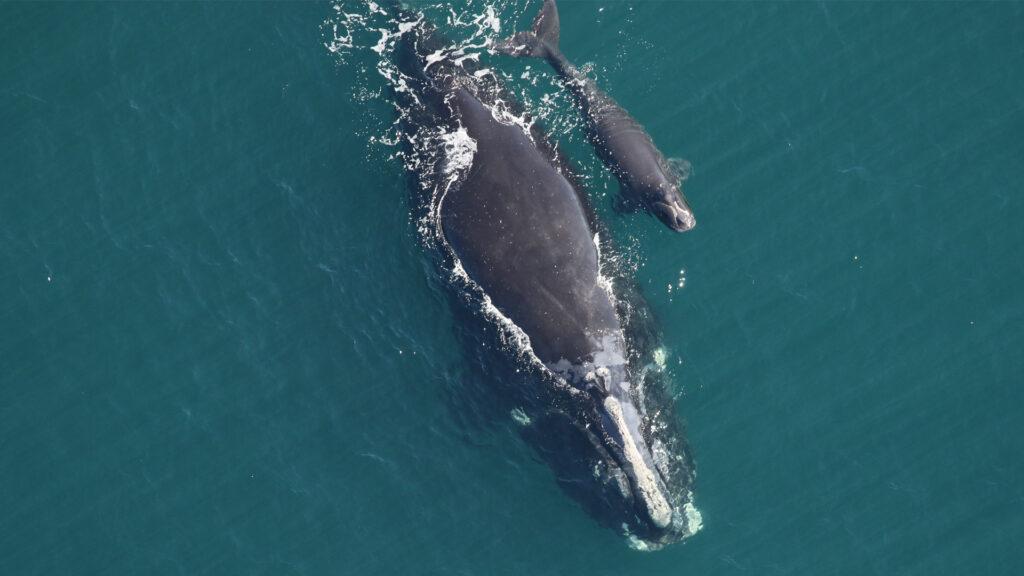
If you have taken a winter-morning drive down A1A from Fernandina Beach to Marineland or Flagler Beach, you would have likely seen groups of volunteers gathered on the coastal boardwalks, beach accesses and dunes with binoculars scanning the ocean horizon. While it might look like they’re gazing out into the vast emptiness of the dark blue Atlantic Ocean, they actually gather as part of sighting networks of volunteers, hoping to spot one of the rarest and most endangered whales on earth: the North Atlantic right whale.
Each winter, North Atlantic right whales return to our coastal waters to give birth and nurse their young. With only about 380 individual whales remaining, volunteers play a critical role in helping spot and alert authorities about the presence of the whales.
These sightings help set off a network of communication that informs boaters, vessel operators and other maritime users of their presence. The confirmed sightings trigger temporary and area-specific speed limits for vessels over 65 feet to reduce the threat of collisions with these whales.
This danger is not theoretical along our coast. Just a few years ago, a North Atlantic right whale calf was struck and killed by a 54-foot sportfishing yacht just outside the St. Augustine Inlet. Its mother, an adult female known as “Infinity,” was spotted days later with severe injuries from the same vessel strike and is presumed to have died as well.
It was a painful reminder of how quickly tragedy can occur. For a species with such a small population, the loss of even one individual represents not only a present loss but the disappearance of future generations.
Vessel strikes remain one of the leading causes of death for North Atlantic right whales, but there is a clear way to reduce this risk. In 2008, the National Oceanic and Atmospheric Administration (NOAA) implemented the Vessel Speed Rule, requiring larger vessels to reduce speed to 10 knots in areas where right whales are present. Research has consistently shown that slower speeds significantly reduce both the likelihood and severity of collisions, making this one of the most effective tools available.

However, this rule could now be on the chopping block. In March, NOAA published an advance notice that it will consider deregulation of existing rules that protect critically endangered North Atlantic right whales from deadly ship strikes.
There are a number of technologies in development that may have some benefit for North Atlantic right whales, but at this point, none are proven to reduce the risk to the whales or at the scale of boat traffic in U.S. waters. And while technology can be a tool to help protect whales, it does not replace the need for mandatory protections to save North Atlantic right whales from extinction.
The future of the North Atlantic right whale remains uncertain, but it is not without hope. The decisions made today will determine whether these animals continue to return to our shores. Supporting measures like the Vessel Speed Rule is one way to ensure that coexistence remains possible. NOAA is accepting public input through June 2, providing an opportunity for our community to be heard.
Candis Whitney is executive director of Amelia Island Whale Ambassadors and lives in Fernandina Beach. Banner photo: Another image of a North Atlantic right whale and calf (NOAA Photo Library, Public domain, via Wikimedia Commons).
Sign up for The Invading Sea newsletter by visiting here. If you are interested in submitting an opinion piece to The Invading Sea, email Editor Nathan Crabbe.
