


By Eve Cooke, Environmental Defense Fund
Over the past four years, Florida has been battered by severe storms, tropical cyclones and record-breaking floods. From unnamed downpours to devastating hurricanes like Ian, Helene and Milton, these events have caused more than $100 billion in damage — disrupting families, businesses and ecosystems alike.
In a recent Environmental Defense Fund survey, a range of experts across sectors in Florida stood united on one thing: Nature-based solutions are key to protecting people and property from extreme weather, and they believe there is a clear path forward to incorporating these solutions into building resilience.
What is a nature-based solution?
According to the United Nations Environment Program Finance Initiative, a nature-based solution describes actions that protect, sustainably manage and restore natural and modified ecosystems that address societal challenges effectively and adaptively, simultaneously benefiting people and nature.
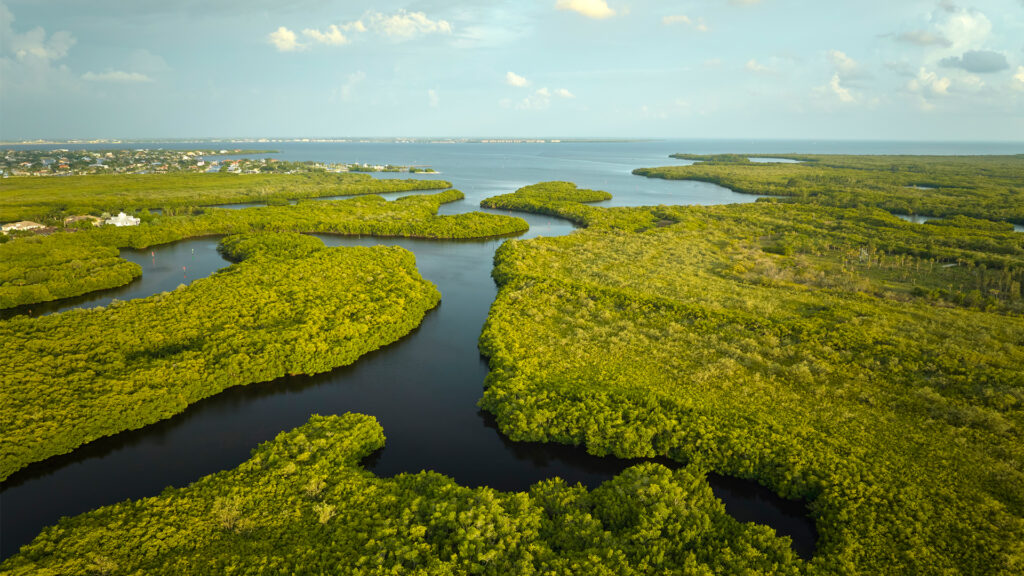
Nature-based solutions include repairing and protecting mangroves and wetlands to manage flooding or utilizing rain gardens to reduce stormwater runoff, among others. When implemented successfully, nature-based solutions provide a range of benefits like reducing disaster impacts and recovery costs, improving community well-being, supporting outdoor recreation and more.
This means Florida’s coastal wetlands, floodplains, mangroves, coral reefs and urban tree canopies offer more than beauty — they are also our first line of defense against natural disasters and extreme weather. But to fully harness their potential, we need to break down the barriers that are holding back implementing nature-based solutions.
What the experts are saying
Ninety practitioners participated in EDF’s survey on nature-based solutions and come from a range of backgrounds like government, engineering, nonprofit organizations, water management, research and more. Together, their feedback offered a clear pathway forward to prioritizing nature-based solutions across Florida and beyond.
Here are the top six recommendations:

- Develop straightforward permitting: Updating state and federal processes, especially for low-impact nature-based solution projects, would speed up approvals and bring benefits to communities faster.
- Create design guidelines: Developing a menu with proven nature-based solution designs tailored for Florida would simplify permitting and provide practical options for engineers.
- Expand workforce development: Expanding training programs in design, construction and maintenance would ensure Florida has the workforce to implement these solutions at scale.
- Boost funding: Increasing financial support for nature-based solutions would help address the upfront costs of land and materials.
- Showcase the value: Accessible tools to quantify and communicate the economic, social and ecological benefits of a nature-based solution would help prioritize projects that offer the best return on investment and long-term outcomes.
- Raise public awareness: Educating communities and officials about the many benefits of nature-based solutions would build critical support for these approaches.
As Florida rebuilds from past disasters and prepares for those to come, we have a choice: invest in outdated, hard infrastructure alone — or embrace the proven solutions that work with nature, not against it.
The good news? Florida’s diverse range of experts already agree on the next steps. Now it’s up to decision-makers, funders and advocates to help put these recommendations into action.
Eve Cooke is a fellow in the Environmental Defense Fund’s climate resilient coasts and watersheds initiative. This piece was originally published at https://blogs.edf.org/growingreturns/2025/07/23/nature-based-solutions-are-essential-to-advancing-climate-resilience/. Banner photo: A living shoreline project on the Florida Panhandle (Florida Sea Grant/Apalachicola National Estuarine Research Reserve, CC BY-NC-ND 2.0 DEED, via flickr).
Sign up for The Invading Sea newsletter by visiting here. To support The Invading Sea, click here to make a donation. If you are interested in submitting an opinion piece to The Invading Sea, email Editor Nathan Crabbe at ncrabbe@fau.edu.

Let me offer some objective criticism of what to me is another focus on adapting to climate change (the buzz word is resiliency) without noting that unless we do something about the cause of the problem we will inevitably be beyond the point of being able to save ourselves.
The author Eve Cook says according to the United Nations Environment Program Finance Initiative, a nature-based solution describes actions that protect, sustainably manage and restore natural and modified ecosystems that address societal challenges effectively and adaptively, simultaneously benefiting people and nature.
Attacking the cause of the problem would, in my view involve restoring the ecosystems – in particular the carbon cycle that is out of balance because of human’s burning of fossil fuels. Too much carbon in the atmosphere has the natural, and necessary phenomenon of the greenhouse effect in overdrive. We are overheating.
As most are aware, Florida politicians are famously known for not mentioning climate change much at all, and when they do to make people think they care about threats to our property. it is only in terms of resilience. mention of attacking the cause is not allowed because of their allegiance to the fossil fuel corporations who donate to them, and of course the denier -in – chief who keeps repeating the lie that climate change is a hoax.
It’s a shame that a non-profit like the EFD is also not advocating for the truth.