


By Stacey Balkan
As a lifelong bicycle commuter and advocate for safe streets, my experience in Boca Raton has been sorely disappointing.
My daily ride to Mizner Park for a morning Pilates class, a quick trip to the library to return the latest Karen Russell novel, or my commute to Florida Atlantic University (where I serve as a tenured associate professor of environmental humanities) are often death-defying endeavors.
This is so despite the fact that the League of American Bicyclists awarded its Silver Medal to the city of Boca Raton. This is an upgrade from the Bronze, which supposedly implies compliance with a couple of the organization’s “key steps to Silver” — creating a “low-stress-on-road-bike-network,” “developing communitywide parking standards” and “launching a bike share system that is open to the public.”
While the city promises to incentivize bike-friendly businesses — another of the criteria, and a laudable goal for any viable downtown — we certainly do not boast a “low-stress” environment.
There is yet to be more than a handful of protected bicycle lanes beyond the central business district, or a citywide public bike share program. And while the league also identifies eight bicycle-friendly campuses, Florida Atlantic is not one of them.
Surely I didn’t expect the local transportation network to compete with my previous university town of New York City, but I assumed that decreased traffic congestion and abundant sunshine might prove fertile ground for a more vibrant cyclescape.
Of course, the bicycle commuter is a far less recognizable species than the recreational cyclists gliding along the exquisite El Rio Trail, or cruising A1A — both examples of recreation and not transportation. But even on A1A amid hundreds of fellow cyclists from all over the world, the lanes are appalling — quite often shy of the stipulated 6 feet.
To add insult to injury, northbound travelers must also navigate around embedded reflectors — situated well within the bicycle lane on a hairpin turn heading toward the Boynton Beach Inlet. Evidently, the road diet along our glimmering coast, like the rest of the state and most of the country, caters primarily to the speeding cars that seem to move with impunity.
Writing in December of 2024, Jim Wood also commented on the paltry safety conditions on A1A — our premier cycle track. In the wake of an extraordinary crash — common for a state that boasts the highest fatality rates for cyclists in the nation, but nonetheless terrifying for cyclists like us — this member of the Boca Raton Bicycle Club argued powerfully that existing efforts to “upgrade” such lanes are “dangerous by design.”
Wood recognizes as an engineer, as many non-motorists have long recognized, something that micro-mobility justice advocates refer to as “coercive automobility.” Also recounted in “Confessions of an Recovering Engineer,” this refers to the ways in which traffic infrastructures are designed to serve only motorists, which is to say folks who are not “transit-impoverished” as so many Floridians are. If you’ve ever almost accidentally killed a cyclist turning from Spanish River to Military, you know exactly what I mean.
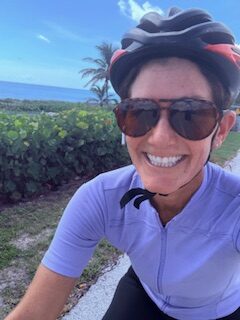
Also commenting that, in the words of many an urban planner, “paint is not infrastructure,” Wood calls for protected bicycle lanes of the sort featured on Key Biscayne. I have elsewhere written about the possibility of more equitable cyclescapes: recognizing both the enduring history of traffic designs that are complicit in marginalizing the working poor, as well as the many organizations on the ground, which do in fact demonstrate the possibility of a “just future for cycling.” Perhaps the model that Wood documents in Key Biscayne could indeed serve as a model for Boca.
But I fear that this would only address central business districts such as Mizner, which is to say yet another space for elite cyclists like me — those with the privilege of a shorter commute, a flexible schedule and a personal office in which to change on those many days when abundant sunshine is not a gift. What of the transit-impoverished? What of the working poor, many of whom live farther west — and many of whom must pedal through Interstate 95 on-ramps to serve consumers in places like Mizner Park?
A comprehensive road diet truly committed to all of our city’s residents would attend to the needs of workers and not merely consumers. It would enable my students, who live quite far away, to toss their bicycles on a Palm Tran bus as I do and easily navigate to campus where they could then safely ride to class.
The city of Boca is holding its first ever micro-mobility summit on Thursday, Oct. 30.This promises to be a robust series of presentations by local and national stakeholders as the city celebrates three years of pedestrian and bike advocacy. Hopefully, we can go for the gold this time — creating a city that truly serves all of its constituents.
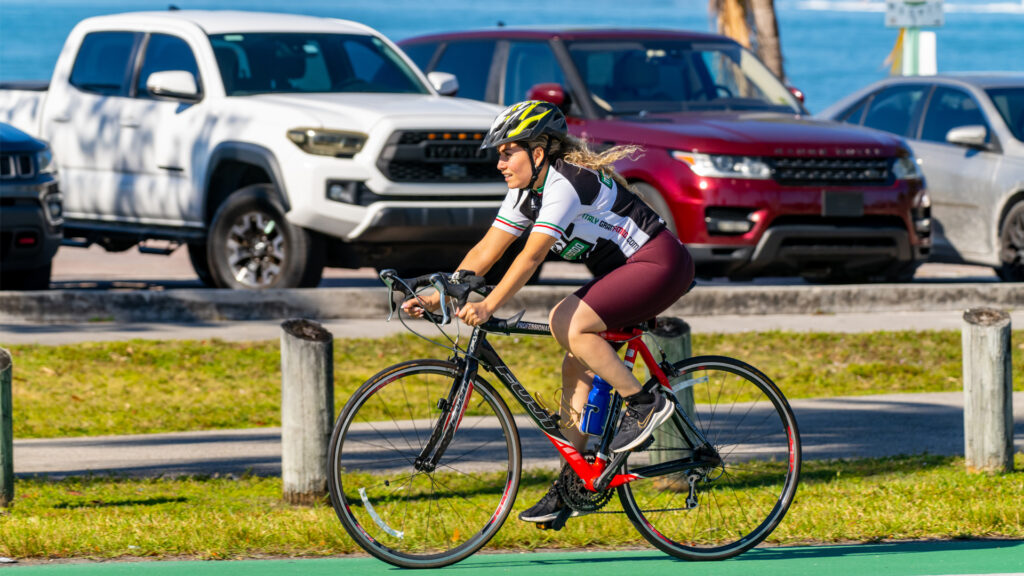
Stacey Balkan is an associate professor of environmental literature and humanities at FAU, and program coordinator for the undergraduate minor in environment and society and graduate certificate in environmental studies. She is the author of the forthcoming book, “Bicycling in Paradise: On Radical Cadence and Just Futures in the End Times.” Banner photo: A woman rides a bike on city street (iStock image).
Sign up for The Invading Sea newsletter by visiting here. To support The Invading Sea, click here to make a donation. If you are interested in submitting an opinion piece to The Invading Sea, email Editor Nathan Crabbe at ncrabbe@fau.edu.
