


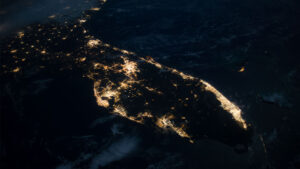
Turner River Road is little more than a gravely path through cypress stands and spongy marshland, but for 21 miles it cuts through one of Florida’s wildest expanses. Along this artery in the Everglades is an unmarked spot where domes of light are distantly visible from two faraway cities on opposite coasts.
In between them, darkness. Or rather, a swath of darkness so vast and deep that millions of flickering stars shine through.
Since the 1950s, the road has been a conduit to nature for city folk fleeing bright lights. Now, it’s the road Anthony Sleiman takes when he treks out to the swamp to photograph some of the darkest skies east of the Mississippi River.
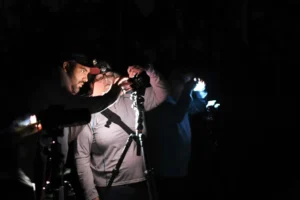
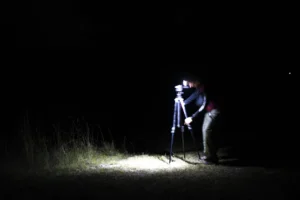
On other nights he ventures 16 miles from Homestead to the largest stretch of sub-tropical wilderness in North America, the last frontier on the peninsula before hitting the Florida Keys. On a muggy night in November, Sleiman, a Venezuelan native and Miami-based nature photographer, led six other photographers down a limestone trail through sabal palm and longleaf pine stands. The only light from an array of headlamps casting bobbing shadows at their feet.
They weaved through the brush, batting at branches and ducking under spiderwebs until they reached a sawgrass prairie under an uninterrupted sky. Above them, a patchwork of bright constellations — Orion, Cassiopeia, Aquarius and Cygnus’ swan — dive through the Milky Way.
To the east, a gradient of light from the coastal cities. Sleiman pointed west, where the darkness turned primordial.
“People say it’s miles and miles of nothing,” he said, but for many, including him, it’s much more. “ I’ve spent seven years of my life educating people about light pollution, going to Big Cypress, going to different places in Florida, just to show people that you don’t have to travel out of the state to see the Milky Way galaxy. You can see it right here.”
Eight months later, Sleiman returned to Turner River Road where a third, new light dome shone from inside Big Cypress Preserve. There, at an old airfield, was Governor Ron DeSantis’ immigrant detention center which opened in July.
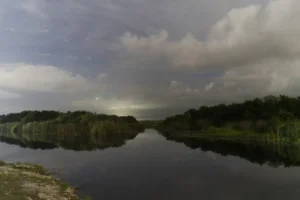
West of Miami and deep in the darkest parts of the Everglades, the glow of Alligator Alcatraz shines a spotlight on the difficulty of maintaining and advocating for dark sky conservation in Florida, where the state is stripping local governments of the authority to manage development in their own communities.
For centuries, night skies have been backdrops upon which we ponder our past and future. Stars, planets and distant moons have propelled us to explore daunting questions about our place in the universe. But all over the state and country, visible stars are winking out.
Light pollution, the hazy skyglow caused by human light sources that hangs like an artificial aura over most urban areas, is increasing by nearly 10% each year. A figure which means that a child born today where 250 stars are visible, might only be able to see 100 stars in that same spot by their 18th birthday, according to a 2023 study by astronomer Connie Walker and physicist Christopher Kyba. Unnatural light spills into our lives in unwitting ways, disrupting natural rhythms in our biology and in the environment.
Walker is a scientist at the National-Optical Infrared Astronomy Research Laboratory and also the co-founder of a citizen science project tracking light pollution across the world called Globe at Night. The findings of her project reveal a bright future, but not in the way you might think.
A bright future
In the shadows of some of Florida’s brightest places, are its darkest skies. A little under an hour from Orlando and its brightly lit theme parks is Groveland, the first town to receive a dark sky designation from Dark Sky International, a nonprofit working to protect the night from the effects of light pollution. Big Cypress National Preserve, equidistant from Fort Lauderdale and Naples, and Kissimmee Prairie Preserve, are also certified by DSI.
Kissimmee Prairie landed the classification in 2016. But it’s not an easy classification to get. Park staff must commit to a management plan that limits light pollution and submit annual reports on lighting practices.
But even as these protected places remain nighttime havens, rapid development in the rest of the state is snuffing out stars from the skyscape.
Data from Globe at Night shows light pollution increasing at a far faster rate than previously thought, Walker’s 2023 study found, in part due to blue light LEDs not easily picked up by satellites measuring light in space. What’s more, the popular and inexpensive LEDs emit shorter wavelengths of blue light, which readily disperse in the atmosphere.
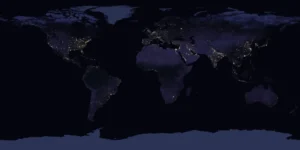
John Barentine, the principal consultant at his dark sky consulting company and former DSI director of public policy, said there are two primary ways to measure light pollution: from the ground and from space. Satellite measuring is responsible for the National Aeronautics and Space Administration’s familiar Black Marble map that shows light emission across the globe. Otherwise, light is measured from the ground up.
“In that case, we are looking at light that is coming back down to us after being scattered in the atmosphere,” Barentine said. Some light makes it through the atmosphere, other times it bounces off particles in the air and makes the sky look brighter than it would without any artificial light.
No night sky is ever truly black. High above, in earth’s upper atmosphere, atoms shed excess energy emitting layers of red, green, purple and yellow light that encompass the planet. This is airglow, the constant background brightness that faintly illuminates the night.
Natural light sources keep the dark marginally bright. Think moonlight and rarer phenomena like the aurora borealis or zodiacal light — a ghostly glow of sunlight scattered across interplanetary dust during the spring and fall equinoxes.
But other atmospheric influences, like air pollutants, exacerbate light pollution.
“Any place that has some level of pollution will see more light dispersion,” said Daniel Mendoza, an atmospheric sciences professor at the University of Utah, who studies pollution events that light up the night sky. Smog, smoke and dust accumulate in the atmosphere and diffuse unnatural light across broader areas. “You end up having massive amounts of skyglow,” he said.
That kind of light pollution is far-reaching.
“If I go to the South Rim of the Grand Canyon and look west, I can see the glow of Las Vegas about 170 miles away,” Barentine said.
Previously, the biggest culprit of light waste was thought to be street lighting. Lights on tall poles emit straight into the sky and bounce light off buildings and roads. But increasingly, area lighting such as parking lot light is considered a major contributor.
Dark sky city
When the sun sets in Florida’s Groveland, street lights flicker on across town much like they do in many American towns, with a few small but significant differences.
Gone is the white-light glow that bleeds through most cities. Instead, low temperature LED’s are tucked into specially designed lamps that shield their reckless shine from the stars above. At a lower and warmer color temperature, these LEDs emit less blue light which causes more ecological disruption and brighter pollution.
The retrofitted street lights are new to Groveland, which dubs itself “a community of natural charm.” Installed only in the last few years after local residents pressured the city to adopt better lighting practices after an influx of new developments, they play an important role in helping the city maintain its DSI certification.
“We’re going to be a city of 80,000 to 100,000 people,” said Andrew Landis, conservation manager for Groveland. “How do we accommodate that from a light pollution perspective?”
In 2022, Landis worked alongside Steven Miller, an Orlando astrophotographer, to write a comprehensive lighting ordinance for the city that would make it a viable candidate for DSI. In 2023, it earned that designation. Now it’s working to meet the dark sky lighting standards. That means replacing all city-owned lights with shielded lamps; keeping light under 3,000 Kelvins; and collaborating with new housing developments, residents and utility companies to make less wasteful choices.
In one of the fastest-growing regions in the state, Landis wants Groveland to serve as a model for other expanding cities.
“ We’re fortunate in a sense that light pollution is a really easy problem to solve,” Barentine said. “We can reverse the effect very quickly, which makes it different from other kinds of pollution that we encounter in the environment.”
How do we use light? How much are we using? These are the questions that Barentine encourages people to ask on both a personal level and the larger scale. Any small act of reducing or redirecting light has a measurable effect on the night sky. In a state with no comprehensive light pollution law, the onus is on residents and local governments to maintain and protect dark skies. A statewide lighting ordinance addresses light pollution along the coast to protect sea turtles. In the mid 1980s, Florida passed a rule to regulate beaches after biologists cataloged hundreds of dead and disoriented hatchlings led astray by lights cosplaying as the moon. The ordinance instructs beachfront properties to use downward facing, low-temperature lights and to shield indoor light with tinted windows. But the rule leaves the rest of the state in the dark.
Eighteen other states also have lighting laws, ordinances, or standards. Some of them require full or partially shielded streetlights, but the legislation is often limited to state-owned buildings or land.
The ecology of darkness
The night sky is a menagerie of constellations mirroring our earthly fauna: Cancer, a crab; Lupus, a wolf; Pavo, a peacock. Their landbound counterparts — from dung beetles to harbor seals — use the stars to navigate and regulate their natural cycles.
The effect of light pollution on animals is well documented. Migratory birds and hatchling sea turtles are led astray on nights that are unnaturally bright. Local volunteer groups along Florida’s coasts patrol the shores during turtle nesting season to make sure hatchlings are not misguided by the bokeh of light from nearby hotels and beach-side condos.
For animals whose biological clocks are synced by cycles of light and darkness, light pollution muddles their natural rhythms with its never-ending twilight, Kyba said. Seasons and time of day become blurred for many organisms, down to the plants we rely on for food.
“Soybeans that have street lights on them will not produce fruit,” he said. “They don’t realize that it’s not spring or high season of summer. They don’t realize fall is coming because the light prevents them from understanding what time of year it is.” Plants have photoreceptors that cue them in to the time of day and the day’s length. Constant light from unnatural sources can cause them to bloom and shed their leaves at the wrong time.
Bright LEDs can also interfere with human sleep cycles. Blue light wavelengths interrupt melatonin production, disrupting both the quality and duration of sleep, according to the American Medical Association.
Fire-folk
At the center of traditional Mayan homes near the ruins of Coba, an ancient city on the Yucatan Peninsula, stones form triangular hearths that mirror three stars at the bottom of the Orion constellation. In Mayan legend, the stars form a cosmic furnace from which the world was born. At the constellation’s center, a whirl of space dust like smoke: the Orion nebula — thought to be from the fires of creation.
“Now, if you leave the Yucatan and float out to the Caribbean and meet the Caribs, they will tell you a different story about Orion,” said Anthony Aveni, professor emeritus of astronomy, anthropology and Native American studies at Colgate University.
“In other words, Orion is not Orion to everybody,” he said. The stars are the medium we use to tell stories relevant to our history and human shortcomings. Star stories are different around the world, but they have common themes.
“Life and love and death. We are all a part of that,” he said. “If you can get the sky to be dark enough, and you really look at it, it becomes a storyboard.”
At Everglades National Park, Park Ranger Kensie Stallings tells those stories with music.
Stallings guides visitors on a nighttime tour of the constellations playing “Starry Night,” a musical composition by Jenni Brandon, on clarinet. The whistling tune is told in three parts. The first imagines the stars as fire beings — inspired by a line in Gerard Hopkin’s poem “The Starlight Night:”
“Look at the stars! look, look up at the skies!
O look at all the fire-folk sitting in the air!”
“The second movement,” she said, “has this idea of how long light takes to travel — and how it never wavers.” She points out Andromeda in the night sky with a red laser and tells guests that it is not just two and a half million light years away: What we see is also two and a half million years old.
“We are seeing into the past when we look at the stars,” Stallings said. In the last movement, Stallings reminds her audience where we come from — star stuff. Hydrogen, oxygen and other elemental atoms recycled from galactic explosions and from stars bursting open across the universe, dying and being reborn.
Stars are not only the ingredients that forged our world and bodies. They also give us a sense of belonging. When she looks up at the night sky, Stallings feels a connection to our larger home.
“ It’s not just in down here in Florida. It’s not just the United States. It’s not just planet Earth,” she said. Home is the spiraling expanse of the Milky Way where Earth spins on its axis surrounded by billions of glittering stars. They are shared beacons to our origins, our mythology, our science — knowable only in dark skies.
Sarah Henry is a reporter based in Arizona whose stories intersect with climate change, environmental contamination, conservation, and more. Previously, she was the Boyd’s Station Mary Withers Writing fellow where she covered rural communities in Kentucky. She is a 2024 graduate of the University of Florida’s College of Journalism and Communications.
This article first appeared on The Marjorie and is republished here under a Creative Commons Attribution-NoDerivatives 4.0 International License. Banner image: Stars shine above a grassy field in Big Cypress National Preserve on Nov. 30 (Photo by Sarah Henry).
Sign up for The Invading Sea newsletter by visiting here. To support The Invading Sea, click here to make a donation. If you are interested in submitting an opinion piece to The Invading Sea, email Editor Nathan Crabbe at ncrabbe@fau.edu.
