


This article originally appeared on Inside Climate News, a nonprofit, non-partisan news organization that covers climate, energy and the environment. Sign up for their newsletter here.
By Amy Green, Inside Climate News
If you want to see a ghost orchid in the wild in Florida, typically you will have to hike for a very long time through the watery wilderness of the Everglades.
The trek will take you through swamps and sloughs and water that is anywhere from knee- to chest-deep. Past alligators and water moccasins and deer and barred owls keeping watch and, perhaps, an endangered Florida panther, the official state animal. The water itself is clear but colored, like tea, by the leaves of the thick canopy soaring high overhead.
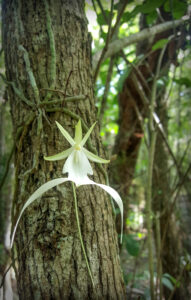
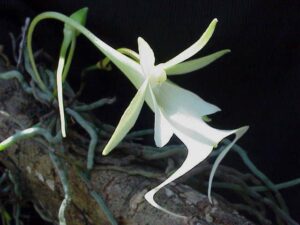
Eventually, deep within the swamp, if you are lucky and the time of year is right, you may discover an elusive and mysterious flower suspended by spindly roots from Florida water ash, pond apple and bald cypress trees, as though the bloom is floating on air. In the trees’ shadows the flower can appear starkly, almost ghostly white. Two petals dangle longer than the rest, like the legs of a dancing spirit. No wonder the flower is called a ghost orchid.
“Its rarity only increases the mystique of it,” said Elise Bennett, Florida and Caribbean director and senior attorney at the Center for Biological Diversity, an advocacy group. “It’s so delicate, and the fact that it’s still clinging to existence is just an incredible thing.”
In the U.S., the ghost orchid is only found in the southwest corner of a vast watershed that spans much of the Florida peninsula and is among the most altered on Earth. Some of the most complex water management infrastructure in the world has made it possible for modern life to coexist here with the wild Everglades, although the waterworks have caused many environmental harms, including for the orchid. The flower’s population in the state has declined to fewer than 1,000 plants, less than half of which are mature enough to reproduce, according to the U.S. Fish and Wildlife Service.
Poachers steal the orchids from the mostly protected lands they inhabit, including the Big Cypress National Preserve and Fakahatchee Strand Preserve State Park, as chronicled in the book “The Orchid Thief” and dramatized in the film “Adaptation.” Hurricanes and saltwater intrusion also pose mounting threats to the fragile freshwater swamps. The confluence of factors moved the Fish and Wildlife Service in June to side with conservation groups that had brought legal action over the orchid’s plight and propose that the flower should be included on the federal endangered-species list.
“I had tramped around through the swamp for many, many months before being able to see one in the wild,” said Melissa Abdo, a Florida-based regional director for the National Parks Conservation Association. Her work experience includes participating in a floristic inventory of the 729,000-acre Big Cypress National Preserve, a job that included helicoptering into remote areas. “That sense of discovery that I had really ignited in me the sense that there are still things to be discovered in a place like the Everglades,” she said.
The Fish and Wildlife proposal involving one of Florida’s most famous flowers is among the more high-profile actions taken by the Trump administration under the Endangered Species Act. In the first months of his second term, President Donald Trump has targeted a vast gamut of environmental regulations and programs, including protections for the nation’s most imperiled plants and animals.
Perhaps most notably, the administration issued a proposed rule in April that would rescind nearly all habitat protections for endangered species. The rule would redefine what it means to “take” a species protected under the Endangered Species Act, excluding harms caused by individuals, government agencies or corporations that involve habitat modifications or degradation.
A February move by the administration related to Trump’s “Unleashing American Energy” executive order called for revoking three Endangered Species Act regulations finalized under the Biden administration. The order directed the Fish and Wildlife Service to review and revise critical habitat designations to take into account how they may affect the economy and national security. Critical habitat is a legal term used to describe places that are considered vital for a species’ recovery.
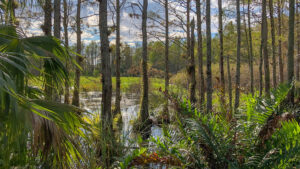
Some of these measures may affect the ghost orchid. Bennett worries the executive order on energy could be used to justify an expansion of oil drilling in the Big Cypress National Preserve, which is among some 10% of federally protected lands where the government owns the surface terrain while private entities retain the mineral rights underneath. Big Cypress channels more than 40% of the water flowing into Everglades National Park. A multi-billion-dollar federal and state restoration of the Everglades is among the most ambitious of its kind in human history.
Mass firings across the federal government also have hampered the work of managing public lands and preserving imperiled species, conservation groups say. During the first Trump administration a mere 25 species were protected under the Endangered Species Act, the lowest number of any administration, according to the Center for Biological Diversity. Abdo said since January the National Park Service has lost 24% of its permanent staff.
“We believe that staff have been pushed to the breaking point,” Abdo said.
Besides Florida, the ghost orchid is found in Cuba. Fewer than 230 plants are known to exist in the island’s Guanahacabibes National Park, although there are some plants in eastern Cuba.
The orchid tethers itself to its host tree with its roots, which it also uses to photosynthesize. In Florida the flower thrives in swamp and slough environments characterized by standing or slow-moving water, which staves off frost and wildfires. Reproductively mature orchids typically flower from May to August, although sometimes they can flower outside these months.
In Cuba the orchids inhabit tropical semi-deciduous hardwood trees rooted in fractured reef limestone with little or no standing water, and usually they flower between October and December. It can take 15 years or more for a ghost orchid in the wild to reach reproductive maturity and bloom. At night the blossoms emit a sweet fruity fragrance that attracts two nighttime pollinators, the fig sphinx moth and pawpaw sphinx moth.
The U.S. Fish and Wildlife Service concluded the ghost orchid’s situation fits the federal definition of endangered after the Institute for Regional Conservation, the National Parks Conservation Association and Center for Biological Diversity filed a petition in 2022 requesting that the orchid be listed federally. The law defines an endangered species as one that is at risk of extinction throughout all or most of its range, while a threatened plant or animal is considered likely to become endangered in the foreseeable future.
The conservation groups also asked that the Fish and Wildlife Service designate critical habitat for the orchid, but the federal agency said publishing even a vague whereabouts for the flower, which is highly prized by collectors, could attract poachers.
Poaching represents a significant threat for the ghost orchid, which is difficult to raise in a greenhouse. In the Big Cypress National Preserve, staff members have taken steps such as locking a gate to an access road near one population and discontinuing maintenance of the road, but poachers still managed to flag trails leading to the flowers.
As recently as 2024, staff members removed more of the illicit flags. In the Fakahatchee Strand Preserve State Park, 10 plants were stolen between 2005 and 2020, representing 8% of the population. In 2023 poachers were caught red-handed in the Fakahatchee, the Fish and Wildlife Service said.
A critical habitat designation would prevent the federal government from permitting, funding or carrying out activities in those areas that would adversely affect the orchid, such as oil drilling, Abdo said. The conservation groups planned to push for a critical habitat designation before the Fish and Wildlife Service publishes its final rule, expected by next summer.
“There is nothing in the law that says you have to identify exactly where these flowers are,” Bennett said. “I do think it is wrong to downplay the impact of habitat loss.”
Vast hydrological changes over the past century across the Everglades watershed, which includes central and south Florida, have led to drier conditions and wildfires. A wildfire in 2018 in the Picayune Strand State Forest destroyed one subpopulation of ghost orchids.
Saltwater intrusion from rising ocean levels has boosted water salinities in the freshwater swamps to the point where it threatens the orchid’s host trees. The Fish and Wildlife Service also acknowledged in its proposed rule, published in the Federal Register, that hurricanes are becoming more destructive, although the rule does not mention the terms climate change or sea level rise.
The federal agency said the storms’ floodwaters and winds stand to inundate the delicate orchids and damage or destroy their host trees. At the Florida Panther National Wildlife Refuge, at least 48 orchids died after Hurricane Irma in 2017 toppled their host trees or harmed the trees’ branches.
The ghost orchid is listed as endangered by Florida, and all orchid species are protected under a global treaty that requires permits for their international trade. A federal listing would provide more funding and a team of experts dedicated to understanding how to save the orchid, whether that might involve protecting habitat or restoring areas that have been degraded, Bennett said.
“It makes a huge difference,” she said. “The really amazing part of the Endangered Species Act is the teamwork and funding that it releases.”
“It’s a really beautiful elusive plant that is iconic,” Abdo added. “By protecting the ghost orchid, we’re making sure that wild heritage stays alive and inspires future generations.”
Banner photo: A ghost orchid in Florida Panther National Wildlife Refuge (Josh O’Connor/USFWS, Public domain, via Wikimedia Commons).
Sign up for The Invading Sea newsletter by visiting here. To support The Invading Sea, click here to make a donation. If you are interested in submitting an opinion piece to The Invading Sea, email Editor Nathan Crabbe at ncrabbe@fau.edu.
