


By Danielle Greenblat
Living in the Dominican Republic, Elena Martínez Martínez has witnessed firsthand the buildup of sargassum that has overrun coastlines. This invading seaweed has disrupted both the tourism and fishing industries, while straining the economies and health of local communities.
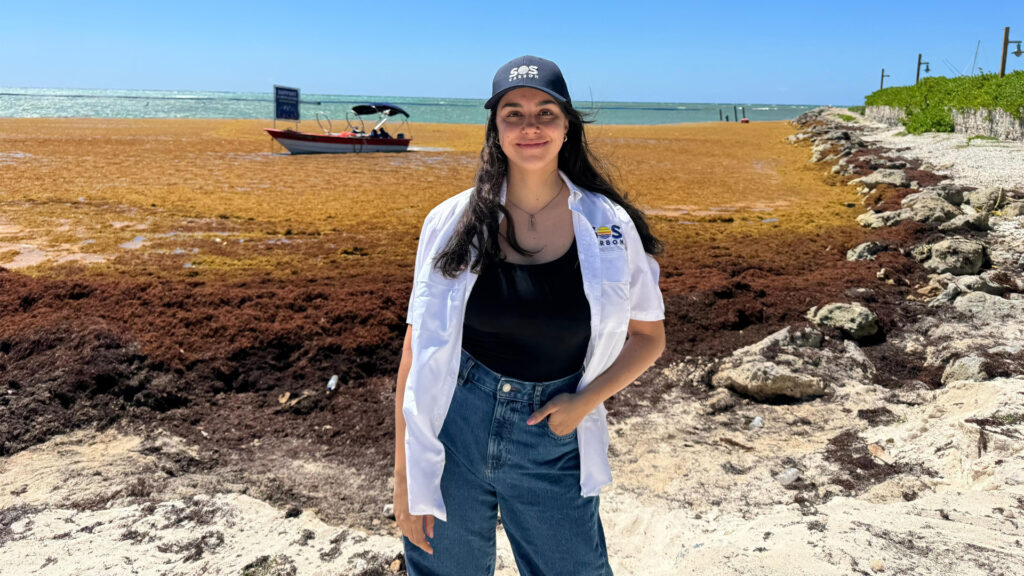
SOS Biotech, which Martínez calls the first blue biotech company in the Dominican Republic, offers a solution to these challenges. The company aims to turn problems into assets, following a circular model that repurposes waste into sustainable resources that can be used in various industries.
The company is based in Santo Domingo and was co-founded by Martínez, whose educational background is in oceanography and biotechnology. She previously worked on projects to transform aquaculture waste into cosmetic products.
“The line between waste and raw material is extremely thin,” she said.
SOS Biotech earns revenue from removing sargassum from the water before it piles up on Dominican beaches and renting its technologies to other Caribbean countries, as well as from using the seaweed to produce products. Its revenue continues to grow as new agricultural and cosmetic products made from sargassum are developed.
The company was a finalist in the 2025 award competition for Ocean Exchange, a Fort Lauderdale-based nonprofit that aims to accelerate the adoption of innovative solutions for a healthy ocean and sustainable blue economy.
Sargassum challenges and solutions
Sargassum drifts across the ocean in floating patches, providing food and shelter for marine life under normal conditions. But warming oceans and pollution are fueling its growth, creating a large mass stretching for thousands of miles called the Great Atlantic Sargassum Belt.
Sargassum can prevent sunlight from reaching the vegetation and marine life below, inhibiting their survival. As it reaches Caribbean waters, it begins to decompose, emitting toxic gases such as ammonia and hydrogen sulfide. The gases irritate people’s lungs and skin when sargassum rots on beaches, while potentially seeping into freshwater sources and posing a risk to the agricultural industry.
While sargassum absorbs carbon dioxide when alive, it releases carbon emissions when it washes ashore and decomposes. SOS Biotech, working alongside its sister company SOS Carbon, has estimated that their removal and upcycling of sargassum has prevented 30,000 tons of CO2 from being dispersed as a result of their rapid collection and harvesting process.
Through the company’s patented system called the Littoral Collection Module, local fishing boats are transformed into high-capacity sea harvesters. Installing the technology onto locally available boats allows the harvesting to be done at sea, during the early phases of decomposition, preventing beach buildups and reducing the spread of toxins.
SOS Biotech, through SOS Carbon, is licensing its system in locations such as Antigua and Barbuda, Puerto Rico and Mexico. Using widely accessible boats and locally available skills allows the company to leverage local infrastructure and avoid additional capital expenditures while generating an additional source of revenue through rental fees.
Product lines and applications
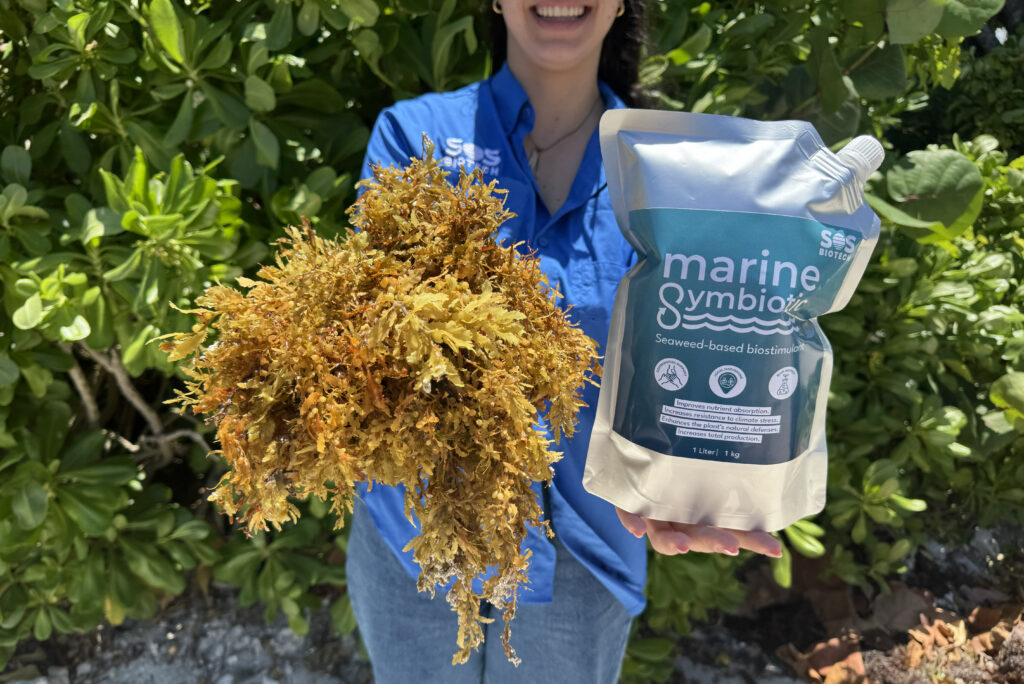
After the sargassum is collected, it is dried and sent to a biorefinery in Santo Domingo. Extracts from the seaweed are used to formulate fully organic-certified biostimulants, which are natural products that help fortify plant growth for both agricultural industries and household gardens. The compounds contained within the biostimulants replace the synthetic and petroleum-based products heavily relied upon today.
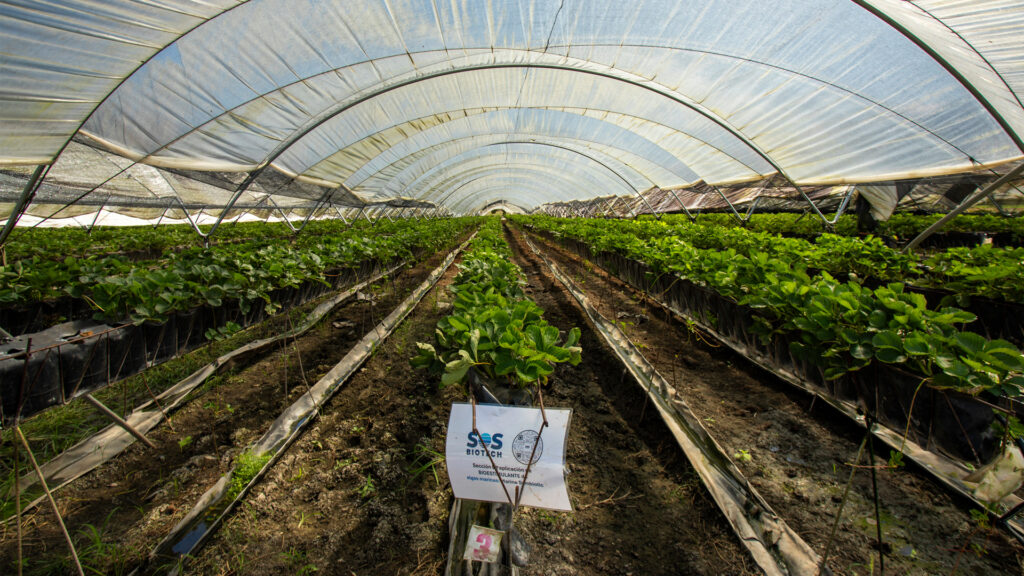
Currently, the biostimulants are being sold in five locations across the Dominican Republic. The biostimulants are sold in stores to smaller-scale consumers and are also available wholesale directly to larger agricultural operations. With the company’s new accreditation by the U.S. Department of Agriculture, it will now begin exporting to the United States, where it is already working with five farmers.
The company is currently working to expand its product line in cosmetics, one of the fastest-expanding consumer markets today. Sargassum contains polyphenols, polysaccharides, amino acids and fibers, supporting multiple purposes in its cosmetic products. A recent breakthrough has allowed it to form an emulsifier made completely from seaweed.
SOS Biotech is also expanding its portfolio into packaging solutions. Various prototypes of cardboard have been created that can be easily decomposed after use, expanding the company’s impact by addressing the escalating global waste problem.
The removal of sargassum remains the primary profit driver as hotel chains rely on SOS Biotech to remove the sargassum that spreads on their beaches. As new products come to market and sales grow, profits from goods sold are expected to make up a larger share of the company’s overall revenue.
Global expansion and future prospects
As its product portfolio grows and sales continue to increase, SOS Biotech aims to eventually set up modular biorefineries in other countries, allowing sargassum to be processed and stored locally.
While the sargassum crisis remains its primary focus, the company is also aware of similar invasive seaweed species, such as Rugulopteryx okamurae, which are spreading along the coastlines of Spain and Portugal. SOS Biotech plans to pilot the processes it developed in the Caribbean in Europe to determine whether its methods can be scaled to new regions.
Moving forward, SOS Biotech is committed to partnering with agricultural and cosmetic companies that share its same mission.
“We work in a way that ensures we don’t create another environmental problem while trying to solve this one,” Martínez said.
Danielle Greenblat is an undergraduate student studying economics at Florida Atlantic University. Banner photo: SOS Biotech uses local boats and workers to collect sargassum at sea. (Photo courtesy of SOS Biotech).
Sign up for The Invading Sea newsletter by visiting here. To support The Invading Sea, click here to make a donation. If you are interested in submitting an opinion piece to The Invading Sea, email Editor Nathan Crabbe. To learn more about sargassum, watch the short video below.
