


By Diana Udel, University of Miami News
A severe and prolonged U.S. drought in the late 1980s played a central role in one of the largest fisheries declines ever recorded in the Gulf of Mexico, according to a new study published in Nature Communications.
The research, led by scientists at the University of Haifa and co-authored by Ben Kirtman, a climate scientist and dean of the University of Miami Rosenstiel School of Marine, Atmospheric and Earth Science, found that drought-driven reductions in Mississippi River flow sharply limited nutrient delivery to coastal waters.
“Our findings show that the fisheries collapse was not driven by fishing pressure alone,” said Igal Berenshtein, head of the Marine Ecology and Ocean Health Laboratory at the University of Haifa, and the study’s lead author. “The prolonged drought reduced river discharge and nutrient input to the Gulf, weakening phytoplankton production and primary productivity at the base of the food web. That disruption cascaded through the ecosystem, ultimately reducing fish biomass and fisheries yields.”
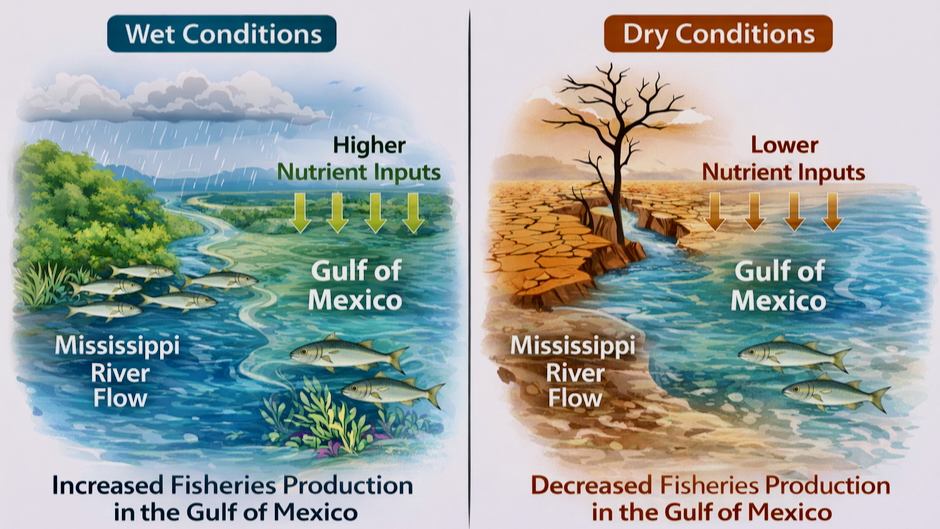
The study documented a roughly 42% drop in total fish biomass and a 34% decline in fisheries catch following the drought period. Nearly 90% of species groups examined showed decreases in biomass.
The Gulf ecosystem depends heavily on nutrients delivered by the Mississippi River to sustain commercially important species. One of the hardest-hit species was Gulf menhaden, a key forage fish that supports the region’s largest fishery by landings and provides essential prey for predators such as mackerel, tuna, sharks, marine mammals and seabirds.
“Our results demonstrate how climate extremes on land can directly affect marine food production,” Kirtman said. “As droughts become more frequent and intense under climate change, the risks to seafood supply and coastal economies increase.”
Using a Gulf-wide ecosystem model, researchers projected that under high greenhouse gas emission scenarios, fisheries biomass could decline by approximately 60% by mid-century and more than 70% by the end of the century if severe drought conditions persist.
The findings highlight growing food security concerns. The Gulf supports one of the nation’s most productive fisheries, supplying seafood to domestic and international markets.
“Managing fisheries in a changing climate will require accounting for shifts in temperature, rainfall, river flow, nutrient delivery, and ecosystem productivity,” Kirtman added. “Adaptive strategies that incorporate climate variability will be essential to sustaining fisheries over the long term.”
The study titled, “Historical depletion and future drought-driven risks to Gulf of Mexico fisheries production,” was published Feb. 9 in the journal Nature Communications. Funding for the study was provided by RESTORE grant No. NA17NOS4510098 and Gulf Research Program of the National Academies of Sciences, Engineering, and Medicine under award No. 10000883. The authors include Berenshtein, Kirtman, Kim de Mutsert of the Division of Coastal Sciences at the University of Southern Mississippi, and David D. Chagaris from the Nature Coast Biological Station at the University of Florida.
Sign up for The Invading Sea newsletter by visiting here. To support The Invading Sea, click here to make a donation. If you are interested in submitting an opinion piece to The Invading Sea, email Editor Nathan Crabbe. Banner photo: A satellite view of the Mississippi River Delta (NOAA image).
