


By Annie Reisewitz and Diana Udel, University of Miami News
An international team of coral scientists is calling for urgent regulatory reform to support assisted gene flow (AGF) — a powerful tool to boost coral resilience — before climate change causes further reef decline and irreversible damage to coral ecosystems.
Writing in a policy forum in Science, the researchers outline the regulatory reforms needed to enable international exchange of coral broodstock with the goal of introducing new genetic diversity. These reforms include adapting existing rules for the exchange of non-commercial plant exchanges among herbariums and nurseries so that they can be applied to corals; establishing regional land-based coral biobanks as repositories for these shared corals; and leveraging political networks among overseas countries and territories to enable timely, cross-border coral exchanges. Regulatory reforms have become necessary because international efforts to curb carbon emissions have not yet been sufficient to reduce ocean warming.
“New approaches are needed to help save coral reefs from the threat of climate change and we need to adapt international regulations to help countries work together,” said Andrew Baker, the paper’s lead author and a professor of marine biology and ecology at the University of Miami Rosenstiel School of Marine, Atmospheric, and Earth Science.
AGF is the managed movement of individuals (or their sperm or eggs) between populations within species ranges to facilitate interbreeding, usually with the goal of boosting genetic diversity and improving traits like resilience or disease resistance — especially in the face of climate change.
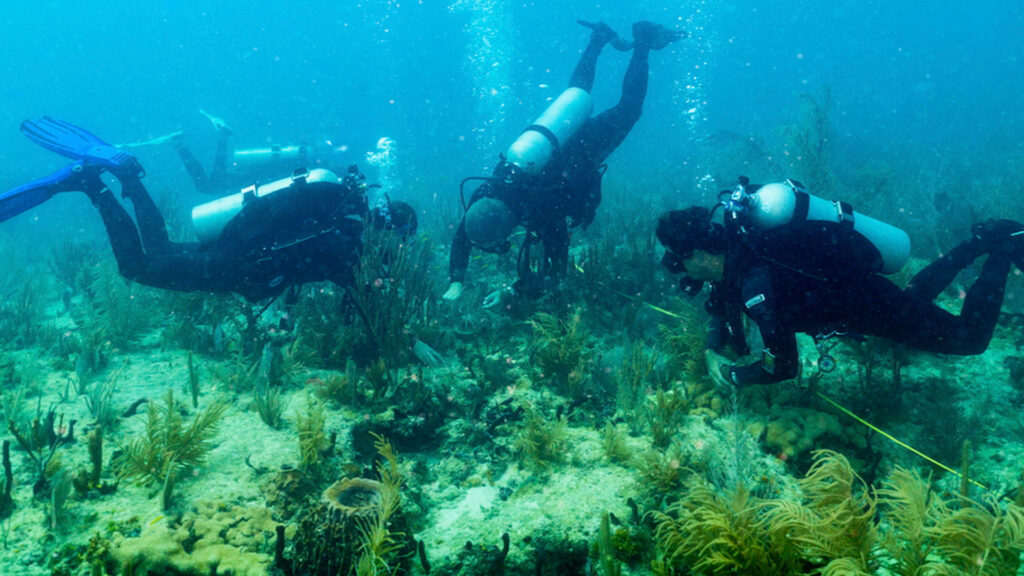
The new paper comes just three weeks after the outplanting of elkhorn corals in Miami that were bred from international crosses of elkhorn coral parents from Florida and Honduras. These corals were the first corals ever to be permitted for outplanting on wild reefs that were bred from parents from different countries. Prompted by catastrophic losses during the 2023 marine heatwave, these crosses were conducted to allow genetic rescue of elkhorn corals (Acropora palmata) and support the recovery of the threatened Florida coral population. The successful collection, export, breeding, rearing, and outplanting of these “Flonduran” corals now paves the way for more scientific studies of how these outplants can support restoration efforts.
“We urgently need to expand the use of assisted gene flow across more species and sites throughout the Caribbean, while also establishing regional biobanks to preserve coral diversity and serve as international breeding hubs,” said Baker. “These efforts are critical to scaling up the production and exchange of climate-resilient corals — buying time for Caribbean reefs as we work to slow the pace of ocean warming.”
The paper discusses the risks of introducing new diversity from outside a local population and how best to mitigate any potential risks. One concern about introducing genetic diversity from outside a local coral population is the potential for outbreeding depression—where mixing genes could disrupt traits that help corals thrive in local conditions.
“Despite these potential risks, inaction is not an option, as many coral populations are no longer well adapted to their rapidly warming environments,” said Iliana Baums, a co-author and a professor of marine conservation at the University of Oldenburg, Alfred Wegener Institute, Germany. “In fact, assisted gene flow has been successful in boosting resilience across many animal species and may offer a critical lifeline for struggling coral populations.”
Coral reefs worldwide are under threat from rising temperatures caused by climate change, as well as nutrient pollution, disease and other impacts. The recent 2023-2025 bleaching event was the fourth global bleaching event on record, impacting 84% of the world’s reefs.
“Countering these global impacts takes cooperation at the regional scale because individual reefs do not have ready access to new diversity in the timeframe needed to help stem declines. New international approaches are needed that require a level of cooperation and scaling unlike any we have seen yet. This paper lays out how regulatory action can help with those efforts,” added Baker.
The paper, titled “Proactive assisted gene flow for Caribbean corals in an era of rapid coral reef decline,” was published July 24 in Science. The authors are Baker; Baums; Sarah Davies of Boston University; Andrea Grottoli of The Ohio State University; Carly Kenkel of the University of Southern California; Sheila Kitchen of Texas A&M University at Galveston; Ilsa Kuffner of the United States Geological Survey; Mikhail Matz of the University of Texas at Austin; Margaret Miller of SECORE International; Erinn Muller of Mote Marine Laboratory; John Parkinson of the University of South Florida; Carlos Prada of the University of Rhode Island; Andrew Shantz of the University of Hawai’i Manoa; Ruben van Hooidonk of SymbioSeas; and Scott Winters of the Coral Restoration Foundation.
The paper is a product of the Coral Restoration Consortium’s Genetics Working Group. Funding for the elkhorn coral AGF efforts on which the paper was based was provided by the National Oceanic and Atmospheric Administration’s Coral Reef Conservation Program and the Paul Allen Foundation.
This piece was originally published at https://news.miami.edu/rosenstiel/stories/2025/07/scientists-call-for-urgent-policy-reform-to-accelerate-cross-border-coral-restoration-efforts.html. Banner photo: A threatened elkhorn coral in Dry Tortugas National Park bleached during the summer 2023 ocean heatwave (University of Miami).
Sign up for The Invading Sea newsletter by visiting here. To support The Invading Sea, click here to make a donation. If you are interested in submitting an opinion piece to The Invading Sea, email Editor Nathan Crabbe at ncrabbe@fau.edu. To learn more about coral bleaching, watch the video below.
