


By Robert C. Jones Jr., University of Miami News
The hardest-working assistant a scientist could ever ask for sits atop a building on the University of Miami’s Marine Campus around the clock, every day of the year, performing the only job it’s been tasked with: looking at the sun.
Essentially a robot, this assistant gathers the critical atmospheric data researchers need to study everything from Saharan dust to the chemical components of smoke from Everglades wildfires.
And now, the instrument has gotten an upgrade.
Like its forerunner, the new sun photometer on the roof of the Rosenstiel School of Marine, Atmospheric, and Earth Science’s Marine Science Center collects, quality controls, and displays data on aerosols in the atmosphere, measuring their properties after they have interacted with clouds, water vapor, gases, and other small particles.
“It’s especially useful for Miami because it gives us a very high-quality reading of how aerosols in the sky are blocking sunlight,” said Paquita Zuidema, professor and chair of the Rosenstiel School’s Department of Atmospheric Sciences.
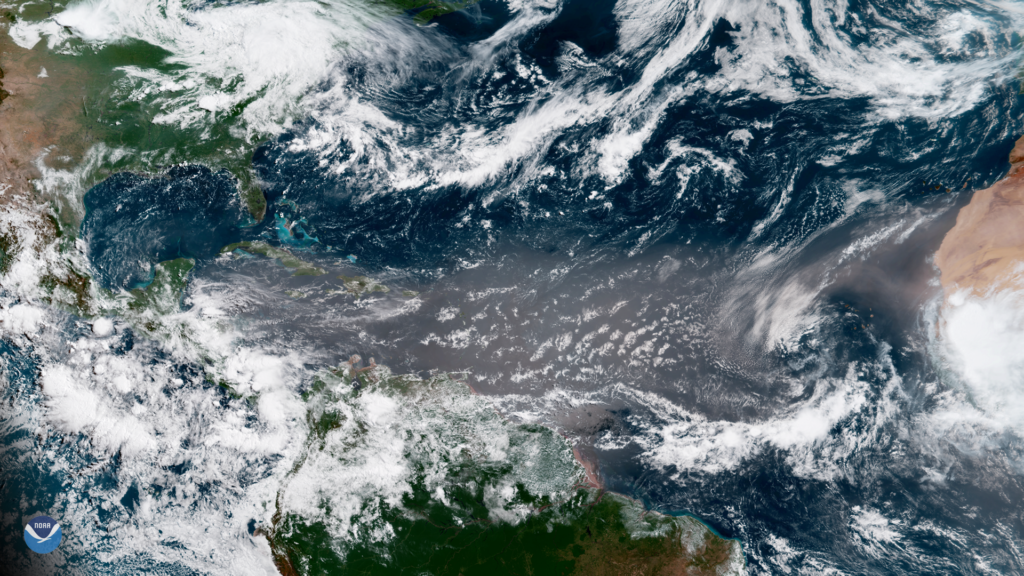
“Our primary pollutants here are the Saharan dust that comes across the Atlantic Ocean during the summer and the smoke from sugarcane fires. So, the device is ideal for studying those impacts,” she said. “On a larger scale, it is also highly valuable for the global models that are trying to understand how changing aerosol loads in the atmosphere spanning several decades are impacting large-scale weather patterns. There’s more work being done that points to aerosols as a contributor to how those large-scale weather patterns are changing our planet.”
Zuidema initially installed a sun photometer on the Marine Science Center’s roof nearly 20 years ago, continuing a time record first started by emeritus professor of physics Kenneth Voss. But over time, sea salt in the air started to erode some of the instrument’s highly sensitive components, jeopardizing its ability to take accurate readings.
With software upgrades, a more self-contained design, and a direct link to a cellular network, the new device, installed over the summer, is a significant upgrade over the old one, according to Michael Perez, a Ph.D. student in atmospheric sciences who maintains the instrument.
It is vital that Perez keeps the sun photometer operating efficiently. It serves as the Key Biscayne site in NASA’s AErosol RObotic NETwork, or AERONET, a group of global ground-based remote-sensing aerosol-monitoring stations.
From North and South America and the Caribbean to Africa, Asia, and Europe, hundreds of AERONET monitoring instruments operate around the world, spitting out aerosol data approximately every 15 minutes and enabling mapping of about 90 percent of the Earth’s surface.
The Rosenstiel School’s Barbados Atmospheric Chemistry Observatory is also part of that network.
Data from the sun photometers is available in near real time and is accessible to anyone through the AERONET website.
Because of their locations in different parts of the world, the sun photometers can type aerosols that are specific to that region.
“Miami is lucky because our air is pretty clean,” Zuidema said. “But up the U.S. Eastern Seaboard, where the big metropolitan areas are, there’s a lot of industrial pollution. The sun photometers take measurements of aerosol optical depth at a range of wavelengths. They can take ratios of those wavelengths, and that gives you a sense of what kind of aerosol — dust, smoke or anthropogenic pollution — is impacting visibility and air quality.”
Sun photometers in California have helped assess the composition of aerosol particles from smoke caused by wildland fires there, noted Pawan Gupta, a research scientist in the Biospheric Sciences Laboratory at NASA’s Goddard Space Flight Center, who co-leads the AERONET program.
Zuidema is deploying a series of smaller, low-cost sensors that measure particulate matter, a mixture of solid particles and liquid droplets found in the air. The sensors are part of the so-called PurpleAir network aimed at empowering communities that collect air quality data and share it with the public.
She said she hopes to combine data from those sensors with data collected from the sun photometer “toward connecting the aerosol affecting our health on the ground, where we live, with what is above us.”
“This can help us understand aerosol transport patterns,” Zuidema explained. “Because the data is relatively easy to analyze, I anticipate developing more hands-on assignments for students in our undergraduate Meteorological Instrumentation and Observation class as well.”
This piece was originally published at https://news.miami.edu/stories/2025/09/hows-the-air-up-there.html. Banner photo: Perez tends to the sun photometer on the roof of a building at the University of Miami Marine Campus (Photo: Matthew Rembold/University of Miami).
