


By the Orlando Sentinel Editorial Board
Floridians are not used to hearing the word “extinct” applied to species that play significant roles in the state’s ecological and economic landscape.
So when researchers with the National Oceanic and Atmospheric Administration recently announced the grim news that two key species in Florida’s iconic coral reefs had become “functionally extinct,” it took a while for reality to settle in — though the damage had been done in 2023, when coral was obliterated by the hottest year on record in 130 years.
Scientists already knew that elkhorn coral and staghorn coral — with complex, branching structures that create havens for all manner of fish and crustaceans and attract divers from around the world — had been hit hard by disease and previous hot summers. And they’d been fighting to save it. But over a period of a little more than a month, the water hit a temperature high that triggered the coral to jettison the beneficial algae that live in its structures. The process, known as bleaching, leaves the coral to lose its color and eventually starve to death. The stark white skeletons might remain for a time, but the once-living coral is dead, and will not reproduce.
The study, released in October, found that at least 97% of those two coral species off the Florida Keys and the Dry Tortugas are now dead or dying. The damage is likely to be devastating for John Pennekamp State Park in Key Largo, the most popular destination in the Florida parks system, which draws more than a million snorkelers, divers, anglers and others per year to view 83 square miles of underwater reef.
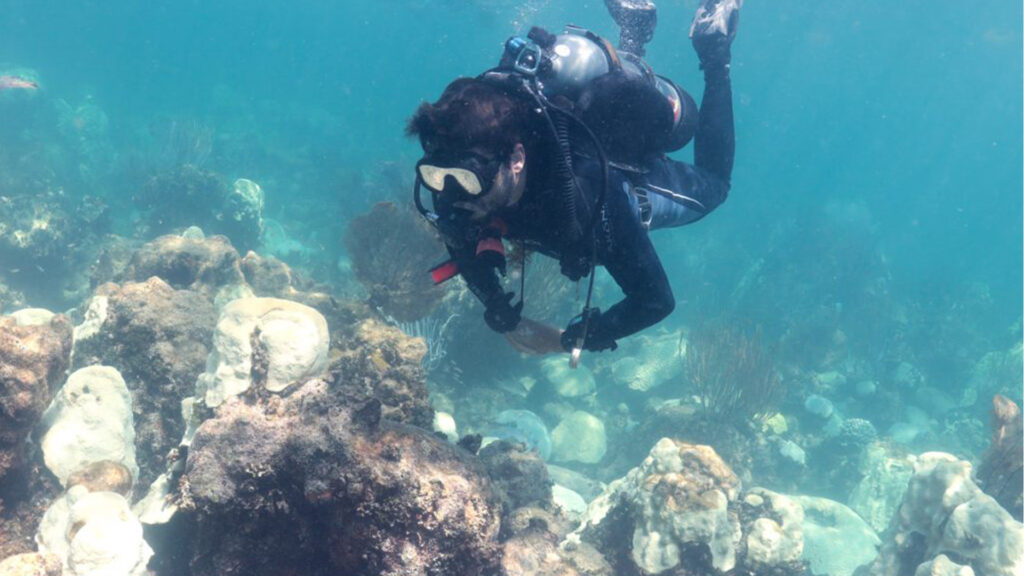
The degree of damage declines off the coasts of areas north of the Keys, but reefs off South Florida were still showing a 39% loss just from the warming event. Ross Cunning, a coral biologist with Chicago’s Shedd Aquarium and one of the dozens of researchers working on the study that was just released, told NBC News that the two species were among the most important “reef builders” in Florida waters — and that the amount of living coral still holding on to life won’t be enough to allow the species to repair the damage done.
Heat isn’t the only threat. Coral species weakened by pollution and generally hotter water have become more vulnerable to disease. And the loss of tourism directly from divers and other visitors isn’t the only cost. Florida’s reef system — the only one in the continental United States — also serves as a spawning ground for many of the fish and other sea life that feed the state’s sport fishing industry that puts generates $13 billion-plus in revenue each year.
And it gets worse, because of course it does. When people think of Florida’s natural attractions, the first thing that comes to mind are the state’s 1,200-plus miles of beaches. A functioning reef system can absorb up to 90% of offshore wave energy, reducing the intensity of waves crashing into the coastline and carrying away beach sand. Florida is already leaning on dredging operations to replace sand lost to erosion and save some of its most iconic beaches. In 1989, the state took its first survey of critically eroded beaches, and came up with nearly 218 miles of shoreline and another 115 miles of beaches that were at risk.
The state’s most recent survey shows 226 miles of critically eroding beach on the state’s east coast (including 36.5 miles in Brevard and 27.2 miles in Volusia County) and another 433 miles of eroding Gulf beaches. Depending on how you measure the state’s coastline, that’s more than half the state’s beaches. At some point, erosion will be taking so much beach that it will be impossible to save it all, even at the cost of billions of dollars. Eventually, Florida may be forced to abandon some of its barrier-island coastal communities because the very ground under the condo towers, hotels and restaurants is washing away.
This is an environmental emergency, and one whose damage could spread statewide. Unfortunately, the current crop of Florida officials may not be willing to take it seriously; for years now, they’ve insisted that global climate change isn’t primarily caused by human activity and thus, not reversible. While scientists at several marine institutes around the nation are working on ways to revive coral species along Florida’s coasts, the ultimate determiner of the reefs’ survival comes down to a matter of degrees. Fahrenheit or Celsius, take your pick — but hotter oceans mean dying coral, and that’s an equation that can only be reversed with a nationwide commitment to reduce carbon emissions and treat the earth with more respect.
We’re hoping that even the most adamant deniers will be unable to look past the evidence of bleached, brittle skeletons of reefs that once teemed with life, and heed the alarm call that’s being sounded over the threats to the state’s reefs — and to Florida itself.
This opinion piece was originally published by the Orlando Sentinel, which is a media partner of The Invading Sea. The Orlando Sentinel Editorial Board consists of Opinion Editor Krys Fluker, Executive Editor Roger Simmons and Viewpoints Editor Jay Reddick. Banner photo: The effects of coral bleaching in 2023 in Biscayne National Park (NPS image by Pete Wintersteen).
Sign up for The Invading Sea newsletter by visiting here. To support The Invading Sea, click here to make a donation. If you are interested in submitting an opinion piece to The Invading Sea, email Editor Nathan Crabbe at ncrabbe@fau.edu. Watch the short video below to learn more about coral bleaching.
